Key Takeaways
- ISRO has completed over 8,000 ground tests for the Gaganyaan mission.
- The final launch date hinges on two critical tests: the parachute air-drop and crew escape system abort test.
- Four astronaut-designates are in advanced simulation training in Bengaluru.
- Success will place India as the fourth nation to achieve independent human spaceflight.
India’s first human spaceflight programme, Gaganyaan, is now in its final launch phase. The Indian Space Research Organisation (ISRO) has crossed a major milestone by finishing more than 8,000 ground tests to certify all systems for crew safety.
Final Assembly and Critical Systems Testing
ISRO Chairman S. Somanath stated the agency is focused on the final integration of the crew and service modules. Rigorous testing of the Environmental Control and Life Support System (ECLSS) is also underway.
“We have crossed a major milestone by completing over 8,000 ground tests on various systems, including propulsion, parachutes, and avionics. The human rating of the launch vehicle is also progressing well,” Somanath said.
The mission aims to send three astronauts to a 400 km orbit for a three-day mission before bringing them back for a splashdown in Indian waters.
Foundation Laid by Previous Missions
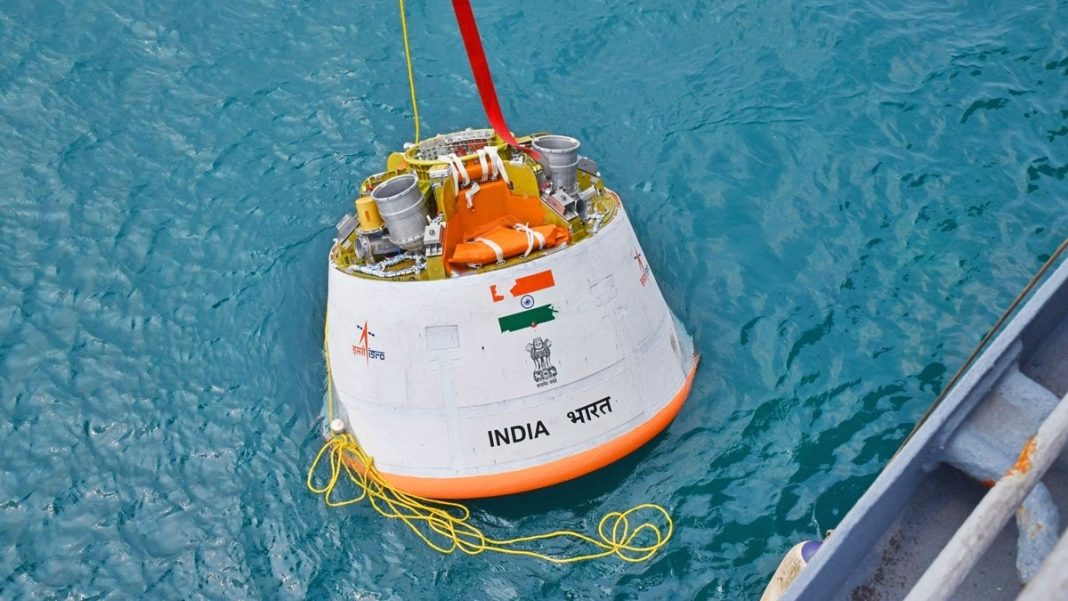
ISRO has already validated key technologies through two precursor missions. The Test Vehicle (TV-D1) mission successfully demonstrated the crew escape system, while the unmanned Gaganyaan (LVM3-M1) flight tested the orbital module in space.

Astronauts in Advanced Training Phase
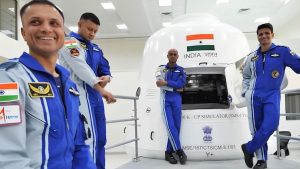
The four astronaut-designates, trained extensively in India and Russia, are now undergoing high-fidelity simulation training in Bengaluru. They are rehearsing both nominal and emergency scenarios.
“The astronauts are training on simulators for nominal and contingency scenarios. They are also participating in the integrated tests where the crew module interfaces with the ground systems,” the ISRO chief explained.
Two Final Tests Before Launch Date
The launch schedule depends on the success of two remaining critical tests. The Integrated Air-Drop Test (IADT) will validate the parachute system, and the Pad Abort Test (PAT) will prove the crew escape system’s capability at launch.
“We are targeting these tests in the coming months. Once they are successful, we will be ready to announce the launch date for the first manned mission,” Somanath added.
A successful Gaganyaan mission will secure India’s position as the fourth country—after Russia, the US, and China—to achieve independent human spaceflight capability.