
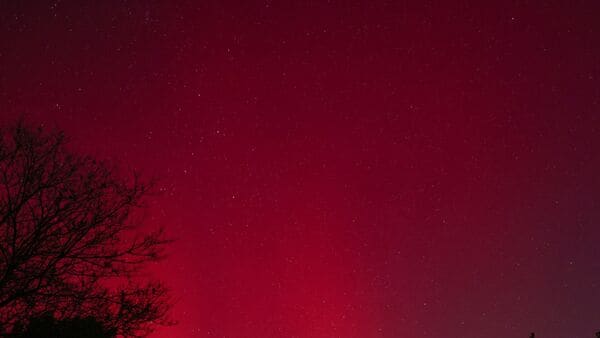
Rare Red Aurora Lights Up Ladakh Skies During Major Solar Storm
A powerful solar storm painted the skies of Ladakh a stunning crimson red on May 10-11, a rare sight for the Himalayan region. The intense G5-class geomagnetic storm pushed the auroral display far south, allowing it to be captured from the Indian Astronomical Observatory in Hanle.
Key Takeaways
- Rare Event: A vibrant red aurora was visible over Ladakh, India.
- Cause: A severe G5-level geomagnetic storm triggered by solar eruptions.
- Colour Science: The red hue comes from oxygen atoms at very high altitudes (above 300 km).
- Impact: Such storms can affect satellites and power grids while creating spectacular sky shows.
What Caused the Ladakh Aurora?
A series of coronal mass ejections (CMEs) from the Sun slammed into Earth’s magnetic field, creating the strongest solar storm in over 20 years. This force expanded the auroral oval, making the lights visible at unusually low latitudes like Ladakh.
“A severe geomagnetic storm hit Earth yesterday. The auroral oval extended to lower latitudes than usual, leading to a magnificent display over Hanle, Ladakh!,” the Indian Institute of Astrophysics (IIA) posted on X.
Why Red Instead of Green?
Aurora colours depend on which atmospheric gases are excited by solar particles and at what altitude.
Green Auroras: The common green glow comes from oxygen molecules located 100-300 km above Earth. Collisions with solar particles here produce green light.
Red Auroras: The rare red spectacle, like Ladakh’s, is also from oxygen—but at altitudes above 300 km. Here, the atmosphere is thinner. Excited oxygen atoms take about 110 seconds to emit red light, and if they collide during this time, no light is produced. This makes red auroras a rarity.
“The red colour is from atomic oxygen at high altitudes (around 200-400 km) where the atmosphere is very thin… This is why red auroras are rare and only seen during intense geomagnetic storms,” IIA explained.
Impact and Significance of the G5 Storm
Classified as a G5 event—the highest on the scale—this storm highlights the Sun’s growing activity as it nears the peak of its 11-year cycle around 2025. While such storms pose risks to technology, they also gift the world with breathtaking auroral displays far from the poles.
The Ladakh event serves as a vivid reminder of our planet’s connection to solar activity and the beautiful phenomena it can generate.


