
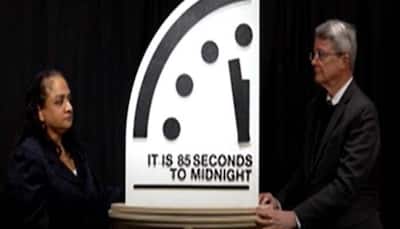
Doomsday Clock Stuck at 90 Seconds to Midnight for 2024
Humanity remains perilously close to self-annihilation, according to scientists who have kept the symbolic Doomsday Clock at 90 seconds to midnight for 2024. This marks the second consecutive year at this historically dangerous setting.
Key Takeaways
- The Doomsday Clock remains at 90 seconds to midnight for 2024.
- This is the closest to “doomsday” the clock has ever been.
- Major threats include nuclear escalation, climate change, and unregulated AI.
- In 1991, the clock was at its safest point: 17 minutes to midnight.
A Stark Warning, Not Stability
“Make no mistake: resetting the clock at 90 seconds to midnight is not an indication that the world is stable. Quite the opposite,” said Rachel Bronson, president and CEO of the Bulletin of the Atomic Scientists. “It’s urgent for governments and communities around the world to act.”
Bronson noted the Bulletin finds hope in younger generations leading the charge for change.
Why the Clock Hasn’t Moved
The decision to hold the clock steady underscores persistent, severe global threats:
- Nuclear Risk: Conflict hot spots threaten escalation.
- Climate Crisis: Already causing widespread death and destruction.
- Disruptive Tech: AI and biological research are advancing faster than safeguards.
“Leaving the clock unchanged is, on the one hand, a relief. On the other hand, it’s not good news,” Bronson added.
History of the Doomsday Clock
The clock was created in 1947 by atomic scientists from the Manhattan Project, including Albert Einstein. It is set annually by the Bulletin’s Science and Security Board with input from Nobel laureates.
The clock’s safest point was in 1991 at 17 minutes to midnight, following the US-Soviet Strategic Arms Reduction Treaty (START) that slashed nuclear arsenals. The contrast with today’s 90-second setting is a stark measure of escalating global peril.


