
Largest Solar Storm in 20 Years Sparks Global Auroras, Disruption Warnings
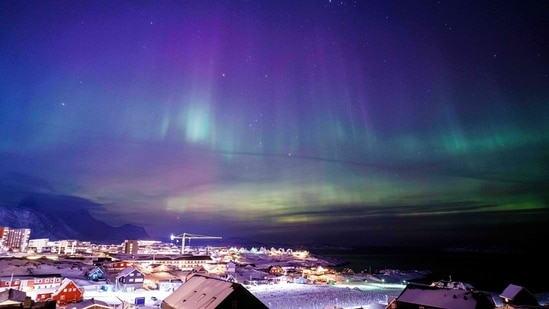
Earth was struck by the most powerful solar storm in over two decades on Friday, painting skies worldwide with dazzling auroras while raising alerts for potential satellite and power grid disruptions expected to continue through the weekend.
Key Takeaways
- Historic Event: First “extreme” geomagnetic storm since 2003, triggered by multiple coronal mass ejections (CMEs).
- Global Display: Northern Lights visible from Europe to Tasmania, stunning observers.
- Risk Advisory: Satellite operators, airlines, and power grids warned of potential disruptions.
- Ongoing Activity: More solar eruptions expected as the Sun nears peak activity in its 11-year cycle.
Spectacular Light Shows Worldwide
Social media flooded with images of vibrant auroras from Tasmania to Britain. “We’ve just woken the kids to go watch the Northern Lights in the back garden! Clearly visible with the naked eye,” said Iain Mansfield from Hertford, England.
Photographer Sean O’ Riordan captured “absolutely biblical skies” in Tasmania at 4 a.m., sharing the moment online. The phenomenon was reported from Mont Saint-Michel in France to Payette, Idaho, in the United States.
Science Behind the Storm
The storm originated from a sunspot cluster 17 times wider than Earth. The National Oceanic and Atmospheric Administration (NOAA) confirmed the first CME—an expulsion of solar plasma and magnetic fields—arrived just after 1600 GMT.
Unlike fast-traveling solar flares, these CMEs move at about 800 km per second. NOAA’s Brent Gordon advised the public to use phone cameras to capture the auroras, as they can reveal more than the naked eye sees.
Potential Impacts and Precautions
Authorities have alerted critical infrastructure operators. Geomagnetic storms can induce currents in power lines and pipelines, risking blackouts and technical faults. Satellite and spacecraft systems face radiation hazards, though Earth’s atmosphere shields the surface.
NASA monitors astronaut safety on the International Space Station, potentially relocating them to more shielded areas. High-frequency radio signals may also experience temporary loss on the sunlit side of Earth.
Even animal navigation is affected; pigeon handlers report fewer birds returning home during such storms due to disrupted biological compasses.
Historical Context and Preparedness
The most severe recorded storm, the 1859 Carrington Event, caused telegraph equipment to catch fire. While current technology is more resilient, officials recommend standard power outage preparedness: flashlights, batteries, and radios.
With the Sun approaching its activity cycle peak, space weather monitoring remains crucial for mitigating risks to our technology-dependent world.



