24.1 C
Delhi
Monday, December 1, 2025

Lost Prehistoric Pit Circle Discovered Near Stonehenge

Massive Prehistoric Pit Circle Discovered Near Stonehenge

Archaeologists have confirmed the existence of a massive ring of pits near Stonehenge, potentially making it Britain’s largest prehistoric structure. The discovery reveals sophisticated planning capabilities of Neolithic people 4,500 years ago.

Key Findings

  • Over 20 pits forming a mile-wide circle around Durrington Walls and Woodhenge
  • Some pits measure 10 meters deep and 5 meters wide
  • Multiple scientific techniques confirm human construction
  • Could represent earliest evidence of counting in Neolithic Britain

The Monumental Discovery

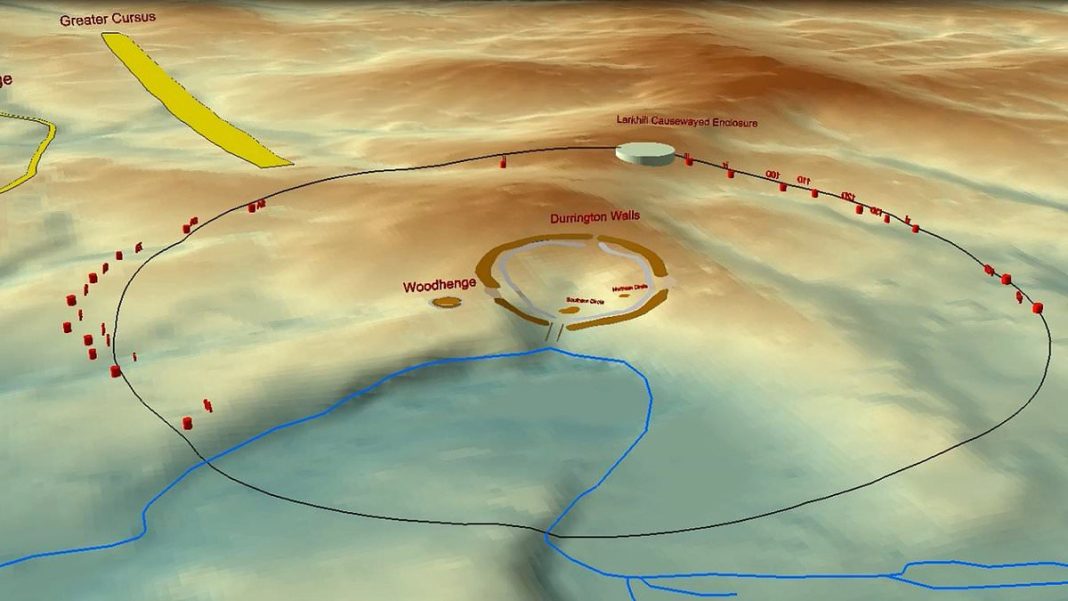
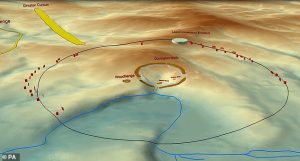
The ring of more than 20 pits extends in an arc more than a mile across, with some reaching 10 meters deep and five meters wide. At the center lie the ancient sites of Durrington Walls and Woodhenge, located 1.8 miles northeast of Stonehenge, where ritual feasts were held by henge builders.

Scientists have proven the existence of a lost ring of pits nearby Stonehenge, which is likely the UK's largest prehistoric monument
The pits surround ancient sites of Durrington Walls and Woodhenge, 1.8 miles (2.9 kilometres) northeast of Stonehenge (pictured). These sites are believed to be where the Stonehenge builders held ritual feasts

First discovered in 2020, the pit circle further cements the Salisbury Plain’s reputation as a uniquely important religious site for Britain’s Neolithic people. The area contains interconnected ceremonial structures, stone circles, and cemeteries from the Stone Age.

Scientific Verification

Researchers used multiple techniques to prove the pits were human-made rather than natural formations. Professor Vincent Gaffney from the University of Bradford described the structure as a ‘cosmological statement.’

The pits encircle the ancient sites of Durrington Walls and Woodhenge. Woodhenge was an enormous timber monument built around 2500 BC, consisting of six concentric rings of posts of varying size forming an oval monument 40 metres across. Pictured: Stone pillars marking the locations of Woodhenge's timber posts
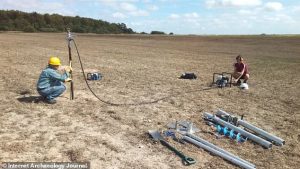
Scientists had questioned whether the pits were really man-made. So scientists used an array of scientific tests to work out their exact shape and structure

The research team employed electrical resistance tomography, radar, magnetic imaging, and sediment core analysis. They used optically stimulated luminescence to determine when soils were last exposed to sunlight and extracted plant and animal DNA directly from the dirt.

‘This in itself did not prove these features to be man-made,’ Professor Gaffney explained. ‘So sediment cores were extracted and an array of techniques, including novel geochemistry, were used to characterise the nature of the soils.’

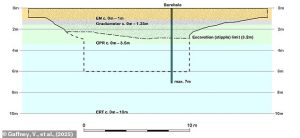
The researchers used a technique called electrical resistance tomography, which measures changes in electrical resistance at the surface to work out the size of underground structures (illustrated)
The researchers found that the pits had a consistent pattern of layers and even contained DNA of cattle and sheep. This suggests that they were deliberately built by humans

Historical Significance

The discovery reveals that Neolithic society was capable of complex planning and mobilizing large numbers of people for religious purposes. The near-perfect circular arrangement suggests the pits were laid out by pacing, indicating early numerical counting capabilities.

‘It confirms that this structure – probably the largest prehistoric monument in Britain at least – is a purposefully constructed monument in a landscape which is itself exceptional,’ Professor Gaffney stated.

However, researchers acknowledge we will ‘probably not’ ever know exactly why these massive pits were constructed.

Stonehenge Construction Timeline

The current Stonehenge monument represents the final stage of a four-part building project completed about 3,500 years ago.

  • First stage (3100 BC): Earthwork comprising ditch, bank and Aubrey holes
  • Second stage (2150 BC): Transportation of 82 bluestones from Wales
  • Third stage (2000 BC): Arrival of larger sarsen stones from Marlborough Downs
  • Final stage (1500 BC): Rearrangement of bluestones into current formation
Stonehenge (pictured) is one of the most prominent prehistoric monuments in Britain

The discovery of the pit circle adds another layer of complexity to our understanding of Britain’s ancient ceremonial landscape and Neolithic engineering capabilities .

Latest

Monsoon Apocalypse Kills Over 900 Across Sri Lanka, Indonesia, Thailand

Catastrophic floods and Cyclone Ditwah leave hundreds dead and missing. Get the latest on rescue efforts and official response across three nations.

Micron to Invest $9.6 Billion in Japan AI Memory Chip Plant

Micron Technology plans a $9.6 billion HBM chip plant in Hiroshima with Japanese subsidies, targeting AI demand and production diversification from Taiwan.

Elon Musk Failed to Dissuade Trump on Tariffs, Reveals Impact

Elon Musk says he tried to talk Trump out of tariffs, calling them disruptive. See how the 50% duties hit India's exports and Musk's AI job prediction.

Elon Musk Reveals Partner’s Indian Roots, Son’s Name Tribute

Elon Musk shared on Nikhil Kamath's podcast that partner Shivon Zilis is half-Indian and their son's middle name 'Sekhar' honors Nobel physicist Chandrasekhar.

Netflix Warner Bros Bid Faces White House Antitrust Scrutiny

Trump administration officials raise competition concerns over Netflix's potential acquisition of Warner Bros Discovery, warning of major antitrust investigation.

Topics

Rupee Hits Record Low, Nears ₹90 Amid Trade Deficit & RBI Hold

Indian rupee plunges to historic low as trade deficit, FPI outflows, and RBI non-intervention push it toward ₹90. Key levels and market outlook explained.

Antarctica’s Ocean May ‘Burp’ Heat, Delaying Climate Recovery by Centuries

New study warns the Southern Ocean could abruptly release stored heat long after emissions stop, causing a sudden warming pulse that impacts global climate goals.

India Mandates Preloaded Cyber Safety App on All New Smartphones

Smartphone makers must preinstall India's undeletable Sanchar Saathi app in 90 days, a move challenging Apple's policies and aiming to curb phone theft.

Sitharaman Tables Two Bills for Tobacco Cess in Lok Sabha

Finance Minister introduces bills to levy a cess on tobacco to fund national security and public health, facing opposition over health warnings and citizen burden.

Sensex, Nifty Hit Record Highs as GDP Growth Boosts Markets

Indian stock markets surge to fresh lifetime highs after strong 8.2% GDP growth. Get the latest on top gainers, expert analysis, and market drivers.

HSBC Partners with Mistral AI to Supercharge Banking with Generative AI

HSBC signs multi-year deal with Mistral AI to deploy generative AI tools for automation, productivity gains, and enhanced client services across global operations.

RBI MPC Meeting: Will RBI Cut Rates or Hold on December 5?

RBI to announce monetary policy decision Friday. Experts split between rate cut and status quo amid strong 8.2% GDP growth and low 0.25% inflation.

India Mandates Undeletable Govt Security App on All New Smartphones

Smartphone makers have 90 days to pre-install India's Sanchar Saathi app. Users cannot delete it, raising privacy and compliance concerns, especially for Apple.
spot_img

Related Articles

Popular Categories

spot_imgspot_img