Iranian Parliament speaker Ghalibaf asserts that Lebanon must be included in any peace agreement between Iran and the U.S., emphasizing its importance for regio
India's Ambassador Harish P raised concerns at the UN over threats to commercial shipping in the Strait of Hormuz, urging for safe navigation and calling for de
According to Russia’s state news agency TASS, Kremlin spokesperson Dmitry Peskov confirmed that the president will take part in the BRICS summit hosted by Ind
Japan, the United States and the Philippines are preparing for one of the largest joint military exercises, with Japanese troops set to train for combat oversea
The White House is considering nominating attorney Michael Murray, who worked in the previous Trump administration, to lead antitrust enforcement at the US Just
The Bengaluru-based firm said it will repurchase 600 million shares at ₹250 apiece, a 19% premium to Thursday’s closing price of ₹210.2. The buyback com
Kalanithi Maran claims SpiceJet owes over ₹400 crore in arbitration, far exceeding the airline's stated ₹144.5 crore. The Delhi high court is reviewing Sp
The European Commission proposed measures for Google to comply with the Digital Markets Act, by allowing third-party search engines access to search data. A fin
Akhilesh Yadav has stressed that the Samajwadi Party welcomes the Women's Reservation Bill, which will reserve one-third of seats in Parliament for women, but s
The government is planning to implement the women's reservation ahead of the 2029 General Elections by bringing in an amendment to the 2023 Act and a constituti
Parliament Special Session Highlights: PM Modi addressed the Lok Sabha on Thursday. He said, ‘those who oppose women quota bill will pay a price for a long ti
OpenAI’s David Lehane urges responsible discussions around AI, highlighting risks of extreme narratives and stressing the need for balanced public understandi
WhatsApp reportedly working on a new feature to reduce spam and clutter. The purported feature will help users organise business messages and keep personal chat
Iranian Parliament speaker Ghalibaf asserts that Lebanon must be included in any peace agreement between Iran and the U.S., emphasizing its importance for regio
India's Ambassador Harish P raised concerns at the UN over threats to commercial shipping in the Strait of Hormuz, urging for safe navigation and calling for de
According to Russia’s state news agency TASS, Kremlin spokesperson Dmitry Peskov confirmed that the president will take part in the BRICS summit hosted by Ind
Japan, the United States and the Philippines are preparing for one of the largest joint military exercises, with Japanese troops set to train for combat oversea
The White House is considering nominating attorney Michael Murray, who worked in the previous Trump administration, to lead antitrust enforcement at the US Just
The Bengaluru-based firm said it will repurchase 600 million shares at ₹250 apiece, a 19% premium to Thursday’s closing price of ₹210.2. The buyback com
Kalanithi Maran claims SpiceJet owes over ₹400 crore in arbitration, far exceeding the airline's stated ₹144.5 crore. The Delhi high court is reviewing Sp
The European Commission proposed measures for Google to comply with the Digital Markets Act, by allowing third-party search engines access to search data. A fin
Akhilesh Yadav has stressed that the Samajwadi Party welcomes the Women's Reservation Bill, which will reserve one-third of seats in Parliament for women, but s
The government is planning to implement the women's reservation ahead of the 2029 General Elections by bringing in an amendment to the 2023 Act and a constituti
Parliament Special Session Highlights: PM Modi addressed the Lok Sabha on Thursday. He said, ‘those who oppose women quota bill will pay a price for a long ti
OpenAI’s David Lehane urges responsible discussions around AI, highlighting risks of extreme narratives and stressing the need for balanced public understandi
WhatsApp reportedly working on a new feature to reduce spam and clutter. The purported feature will help users organise business messages and keep personal chat
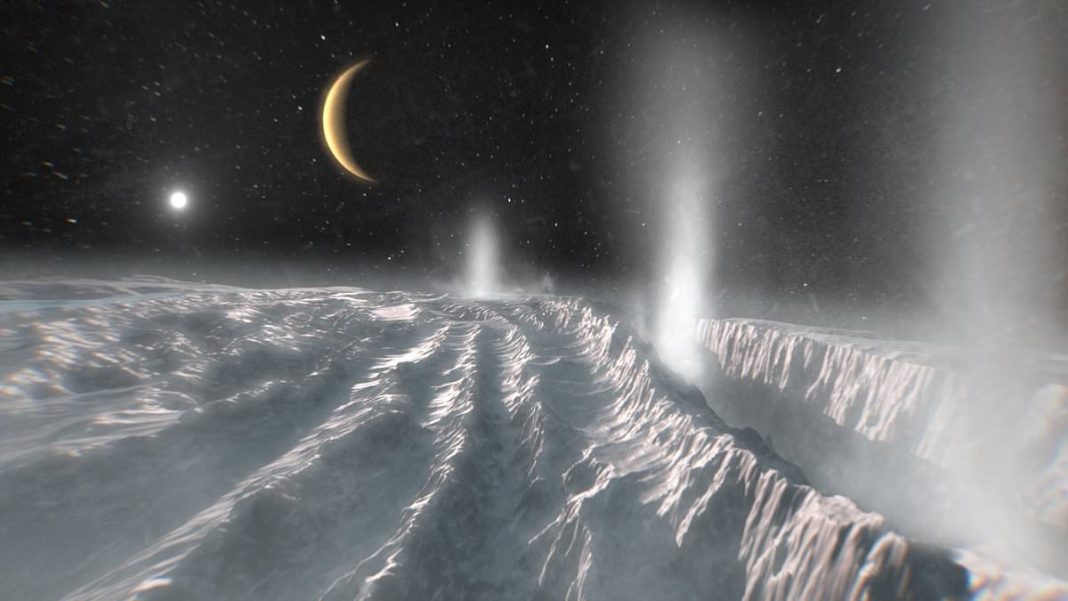
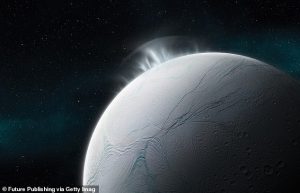
Saturn's Moon Enceladus (artist's impression) might be home to alien life, according to a new study, as researchers find heat escaping from the moon's North Pole
Saturn’s Moon Enceladus Shows Signs of Potential Alien Life
Scientists have discovered compelling evidence that Saturn’s moon Enceladus could harbor alien life. New findings reveal the moon maintains a stable energy balance, creating ideal conditions for life to evolve in its vast underground ocean.
Key Findings
Heat detected escaping from Enceladus’ North Pole indicates stable underground ocean
Energy input and output are perfectly balanced at 54 gigawatts
This stability increases chances for life to develop and survive
Underground ocean contains all necessary ingredients for life
Saturn’s Moon Enceladus (artist’s impression) might be home to alien life, according to a new study, as researchers find heat escaping from the moon’s North Pole
The Energy Balance That Could Support Life
Enceladus, Saturn’s sixth-largest moon at 310 miles wide, maintains a delicate energy balance through tidal heating. Saturn’s gravitational pull squeezes and stretches the moon, generating internal heat that prevents its underground ocean from freezing.
Dr Carly Howett from the University of Oxford explains the significance: “If Enceladus is losing more energy than gaining, then eventually the whole moon will cool and Enceladus’ ocean is going to freeze – which is obviously bad for life! If it’s gaining more energy than losing, then the ocean will heat and melt the ice shell from the bottom – which will change both the ocean’s temperature and chemistry.”
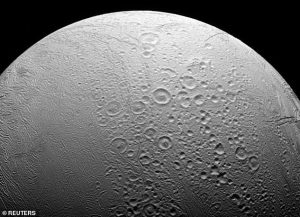
Although Enceladus looks barren on the surface, beneath the ice, there is a vast liquid water ocean which has all the ingredients for life. Pictured: Enceladus as seen by the Cassini spacecraft
Breakthrough Temperature Measurements
Using NASA’s Cassini spacecraft data, researchers detected the North Pole was approximately 7°C warmer than expected. This subtle temperature difference revealed the moon loses 46 milliwatts of energy per square meter, totaling 35 gigawatts from the North Pole alone.
Combined with known energy loss from the active South Pole’s “tiger stripe” fissures, Enceladus’ total energy loss reaches 54 gigawatts – almost exactly matching the energy input from tidal warming.
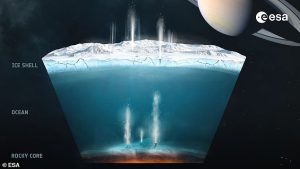
Scientists have calculated how much heat is escaping through the North Pole from the warm ocean below. This reveals that the planet is losing as much energy as it gets from the gravitational pull of Saturn
What Life on Enceladus Might Look Like
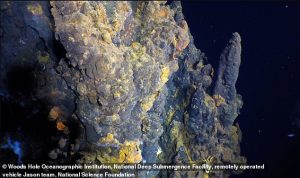
While scientists cannot confirm whether life exists, they speculate it might resemble Earth’s deep-sea hydrothermal vent ecosystems. Dr Howett suggests: “It’s possible life on Enceladus looks a little like that around the deep hydrothermal vents of the Earth. There we see things that look like shrimp, crabs and lobsters. So perhaps like that – but maybe not like that at all!”
Scientists don’t know yet whether the planet hosts life, but any life that does exist might look similar to that found around hydrothermal vents in Earth’s deep oceans
Future Exploration
The next crucial step involves determining how long Enceladus’ oceans have existed. If proven sufficiently ancient, this could justify sending new missions to search for chemical signatures of life in the moon’s icy plumes or even directly sampling the underground ocean.
Dr Howett concludes: “We think life likes stability to survive – so showing Enceladus’ energy is stable means its sub-surface environment probably is too.”
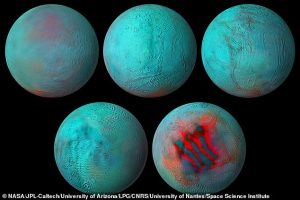
What is Enceladus? Enceladus is Saturn’s sixth–largest moon, at 313 miles wide (504 kilometres).It is an icy satellite with hydrothermal activity – a rare combination – with vents spewing water vapour and ice particles out from a global ocean buried beneath the moon’s frozen crust. According to NASA observations, the plume includes organic compounds, volatile gases, carbon dioxide, carbon monoxide, salts, and silica. Microbes on our planet either produce these compounds or use them for growth, leading some to speculate that tiny organisms live in Enceladus’ hidden ocean.In 2005, the Cassini spacecraft discovered striking tectonic faults at the south pole known as ‘tiger stripes’ (bottom right), which allow water from the inner ocean to escape. Analysis found that this water contained complex molecules associated with the origins of life
Saturn’s Moon Enceladus (artist’s impression) might be home to alien life, according to a new study, as researchers find heat escaping from the moon’s North Pole
Although Enceladus looks barren on the surface, beneath the ice, there is a vast liquid water ocean which has all the ingredients for life. Pictured: Enceladus as seen by the Cassini spacecraft
Scientists have calculated how much heat is escaping through the North Pole from the warm ocean below. This reveals that the planet is losing as much energy as it gets from the gravitational pull of Saturn
Since Enceladus’ energy is balanced, scientists say that its oceans are likely to be stable and long-lived. This increases the chances that the planet might have developed life
In 2005, the Cassini spacecraft discovered striking tectonic faults at the south pole known as ‘tiger stripes’ (bottom right), which allow water from the inner ocean to escape. Analysis found that this water contained complex molecules associated with the origins of life
Scientists don’t know yet whether the planet hosts life, but any life that does exist might look similar to that found around hydrothermal vents in Earth’s deep oceans
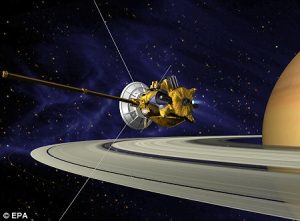
An artist’s impression of the Cassini spacecraft studying Saturn
Cassini didn’t just study Saturn – it also captured incredible views of its many moons. In the image above, Saturn’s moon Enceladus can be seen drifting before the rings and the tiny moon Pandora. It was captured on Nov. 1, 2009, with the entire scene is backlit by the Sun
Despite the incoming system, temperatures across north and central India are forecast to remain high. Meteorologists warn that the limited rainfall will not be
India is making considerable progress in ensuring that its satellites are not adding to the increasing levels of space debris. Instead, these satellites entered
The Parker Solar Probe has uncovered a surprising clue about how solar storms form, revealing new particle behaviour that could improve space weather prediction
Scientists estimate that there are billions of planets orbiting stars outside our solar system, with more than 6,000 confirmed exoplanets discovered so far.
India doesn't need 307 more MPs to crowd a bigger chamber. What India needs at this moment is the right policies to drive growth, and not more policymakers. It
With CBSE declaring the Class 10 results, students across India are celebrating their scores and planning their next academic steps. At PM SHRI Kendriya Vidyala
The BSE Sensex was trading at 78,030.99, up 42.31 points or 0.05% at around 9:43 am. The Nifty 50, however, slipped marginally by 6.85 points or 0.03% to 24,189
Kerala SSLC and Plus Two Result 2026 dates have been officially announced, giving students clarity on when to expect their scores. The state has also rolled out
Prime Minister Narendra Modi’s Nagercoil visit blended politics and personal warmth as he reunited with veteran educationist Gomatam Veeraraghavan Girija afte
Iranian Parliament speaker Ghalibaf asserts that Lebanon must be included in any peace agreement between Iran and the U.S., emphasizing its importance for regio