
9.1 C
Delhi
Friday, January 16, 2026

Four Solar Storms Approach Earth, May Disrupt Technology and Create Auroras

Key Takeaways

  • Four powerful solar storms are approaching Earth, potentially causing technology disruptions
  • NOAA has issued a moderate G2 geomagnetic storm watch for Thursday
  • The northern lights may be visible across multiple northern US states
  • Power grid and communication systems could experience minor impacts

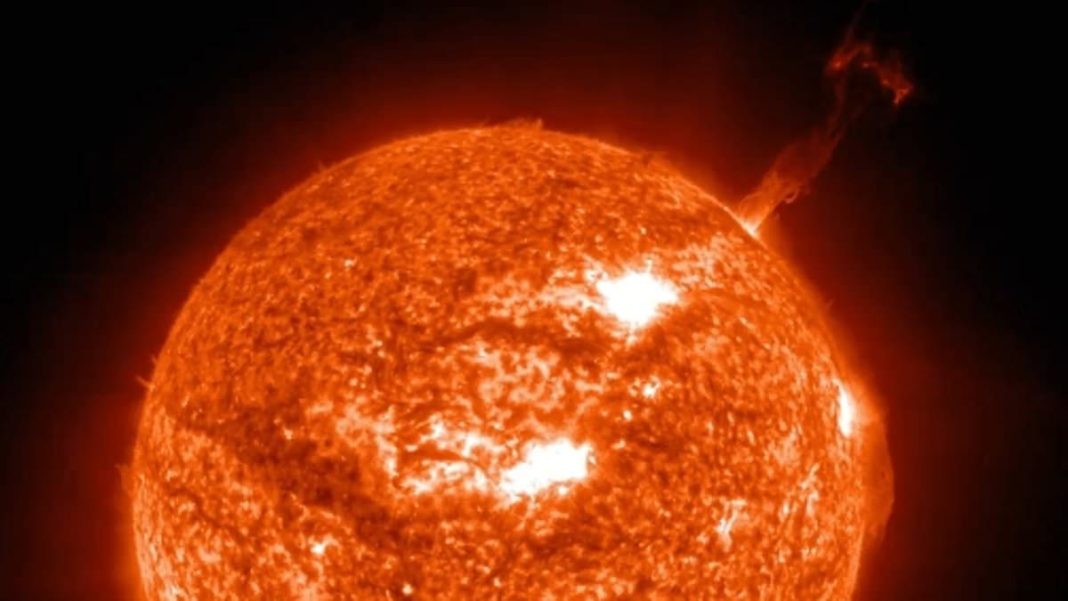
Earth is preparing for significant solar activity as four powerful bursts of solar energy race toward our planet. The National Oceanic and Atmospheric Administration (NOAA) has issued a moderate G2 geomagnetic storm watch, warning of potential disruptions to power grids, radio signals, and GPS navigation systems.

Timeline and Impact of Solar Storms

Space weather scientist Tamitha Skov stated: ‘Storms 2 to 4 arrive starting midday on October 15.’ She added: ‘We could be dealing with their effects until early October 17, assuming the sun doesn’t send any more Earth-directed storms.’

Skov explained that the first coronal mass ejection (CME) will likely bring only a ‘mild disturbance,’ but warned that the next three are ‘pancaked together,’ potentially amplifying their effects when they arrive in quick succession. A weaker G1 geomagnetic storm could linger into Friday with limited impact.

Solar Activity Source and Effects

The solar activity originates from a massive, tangled cluster of dark spots on the sun called Region AR4246. These sunspots are areas where the sun’s magnetic field is especially active and twisted, causing explosions of energy known as solar flares.

This region has already produced several M-class flares – mid-level eruptions powerful enough to disrupt radio signals and create bright auroras on Earth. One M2.7 flare that erupted on October 13 launched a CME now speeding toward our planet.

Northern Lights Visibility and Regional Impacts

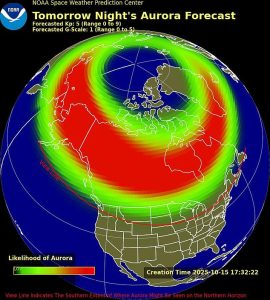
The northern lights, or aurora, could be visible across the northern and upper Midwest, from New York to Idaho. States including Maine, Michigan, Wisconsin, Minnesota, North Dakota, and Montana may witness the spectacular display.

During stronger solar activity, the aurora might extend slightly farther south to areas like Iowa or northern Illinois.

Technology and Infrastructure Concerns

Power grid effects are expected to be minor, mostly occurring in high-latitude regions including Alaska and northern US states bordering Canada. Impacts would likely be limited to small voltage fluctuations rather than widespread outages.

Radio and GPS signals could experience temporary interference, particularly at high latitudes and on aircraft or polar flight routes. Effects would be less noticeable in southern regions.

Scientists note that since 2008, the sun’s solar wind has strengthened with increases in speed, density, temperature and magnetic field strength. This trend suggests more powerful solar storms may regularly hit Earth, causing increased disruptions.
Latest

ISRO Grounds PSLV After Second Consecutive Launch Failure

PSLV launches halted after January 2026 failure destroys 16 satellites. Investigation begins as ISRO's 2026 schedule faces major delays.

KID Capsule Survives ISRO PSLV Rocket Failure, Transmits Data

Spanish Orbital Paradigm's experimental KID capsule became the lone survivor of a failed ISRO launch, transmitting crucial re-entry data after the PSLV malfunctioned.

Flash Fog in Delhi: Science Behind the Sudden Zero-Visibility Event

Understand how a sudden 'flash fog' engulfed Delhi-NCR in minutes on Makar Sankranti 2026, its causes, dangers, and why meteorologists warn it may happen again.

Mysterious Dying Star Creates Colourful Cosmic Shockwave

Astronomers are puzzled by a white dwarf star ejecting gas and creating a vibrant, long-lasting shockwave in space, defying current scientific explanations.

PSLV-C62 Failure: Why 16 Satellites Were Lost After Launch

An ex-ISRO engineer explains the third-stage anomaly that caused the PSLV-C62 mission to fail, detailing the fate of its 16 satellites including the Anvesha Earth observatory.

Topics

6.0 Magnitude Earthquake Hits Oregon Coast, No Damage Reported

A significant 6.0 magnitude earthquake struck off the Oregon coast. Get the latest details on location, depth, and initial impact reports.

Billionaire Warns US Taiwan Chip Strategy Risks Chinese Invasion

Howard Lutnick says making Taiwan a semiconductor capital makes it a target for China, urging US to focus on domestic production instead.

Noida, Greater Noida Schools Closed Till Jan 17 Due to Cold Wave

Gautam Buddh Nagar district administration extends school closure for classes up to 8 due to severe cold and dense fog. Check details here.

Delhi AQI Hits 354: Air Quality ‘Very Poor’ Amid Fog and Cold Wave

Delhi's air quality deteriorates to 'very poor' with AQI at 354. IMD predicts dense fog and cold wave conditions for North India. Get the latest updates.

India’s Scramjet Success: Why Fighter Jets Still Use Conventional Engines

India joins the hypersonic club with scramjet tech. We explain why this breakthrough won't power fighter jets yet and what it means for missiles and space travel.

Mustafizur Rahman Visa Row: A Strategic Signal in India-Bangladesh Ties

How India's visa denial to a Bangladeshi cricketer reflects a broader, more assertive foreign policy under S. Jaishankar and impacts bilateral relations.

15 Hindus Killed in Bangladesh in 45 Days, Rights Group Reports

A rights group reports escalating violence against Hindus in Bangladesh, with 15 killed in 45 days. Urgent government action and legal reforms are demanded.

The Hidden Human Cost of Aggressive Business Targets

Explore why management strategies focused solely on outcomes, like 10-minute deliveries, are causing burnout and are unsustainable for long-term business success.
spot_img

Related Articles

Popular Categories

spot_imgspot_img

