
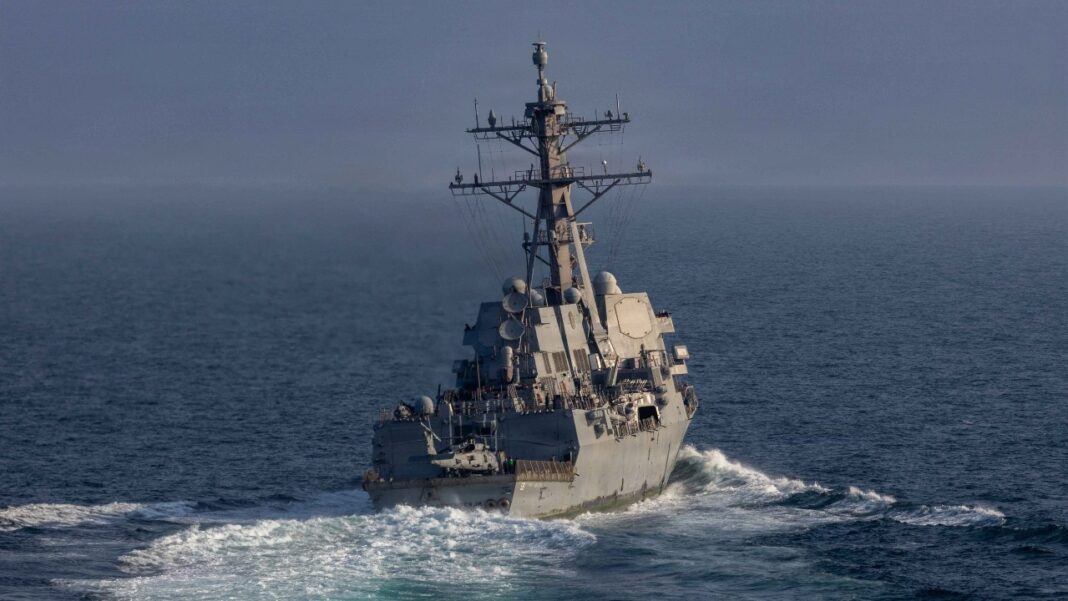
Even as top negotiators from the US and Iran talked diplomacy in Islamabad on Saturday, the Strait of Hormuz crackled with brinkmanship as American warships sliced through contested waters, leading to a tense standoff with Iranian forces.
According to The Wall Street Journal (WSJ), two US Navy guided-missile destroyers attempted to transit the choke point, drawing a sharp challenge from Iran’s Islamic Revolutionary Guard Corps Navy. A radio exchange of the charged moment was reportedly captured by a nearby civilian vessel.
“This is the last warning. This is the last warning,” Iranian forces said.
“Passage in accordance with international law. No challenge is intended to you, and I intend to abide by rules of our government’s cease-fire,” a US ship replied.
The guided-missile destroyers crossed the strait without incident, the WSJ reported, a first since the war erupted nearly six weeks ago and Iran effectively closed off the crucial waterway.
Tehran, which has stipulated that any ship trying to transit Hormuz must coordinate with it for safe passage, was not informed prior to the US mission, per Axios.
US PUSH TO REOPEN HORMUZ
For weeks, Iran has used missiles and drones to choke traffic through the key maritime route, through which about 20 per cent of global crude passes. The warships’ foray comes after Trump said the US had begun “clearing out” the strait amid a fragile ceasefire.
After the showdown at sea, US Central Command said the two destroyers, USS Frank E Peterson and USS Michael Murphy, started efforts to reopen Hormuz to commerce, including deploying underwater drones to clear mines laid by the Iranian regime. It said the mission was a signal that Washington does not accept Iran’s control of the strait.
“Today, we began the process of establishing a new passage and we will share this safe pathway with the maritime industry soon to encourage the free flow of commerce,” said Admiral Brad Cooper, commander of CENTCOM.
In contrast, Iranian media claimed its forces coordinated their response with negotiators in Islamabad and that the US ships turned around after the confrontation.
US media reported that Tehran may have lost track of some mines in Hormuz, complicating clearance efforts. According to officials, Iran’s forces lay mines “haphazardly”, and now they lack the equipment to locate or remove the explosives.
With the route effectively constrained, ships face a costly workaround — transiting Iranian waters, where Tehran has proposed a $2 million toll per vessel as part of a 10-point negotiating demand.
Meanwhile, an off-ramp to the war was thrown in doubt after the high-stakes talks in Pakistan broke down. After marathon negotiations, US Vice President JD Vance said Iran rejected the US’s “best and final offer”. Tehran blamed US demands for the talks failing to yield a deal.


