
India’s port-led development push is entering a high-capacity phase. Under the Sagarmala programme, as many as 845 projects worth Rs 6.06 lakh crore are under implementation, with 315 already completed at an investment of Rs 1.57 lakh crore. Capacity addition is beginning to show on the ground—seven new coastal berth projects alone have added 9.84 million tonnes per annum. This comes as major ports clock a record 915 million tonnes of cargo in FY2025–26. The next leg, Sagarmala 2.0, backed by Rs 85,482 crore, is designed to crowd in investments of up to Rs 3.6 lakh crore and deepen India’s maritime logistics network.
India’s maritime sector plays a central role in shaping its trade and economic activity. The country has a coastline of about 11,099 kilometres, along with nearly 14,500 kilometres of potentially navigable waterways. Coastal regions are home to major ports that connect India with global shipping routes and facilitate the movement of goods and passengers. Around 95% of the country’s trade by volume and about 70% by value is handled through maritime routes.
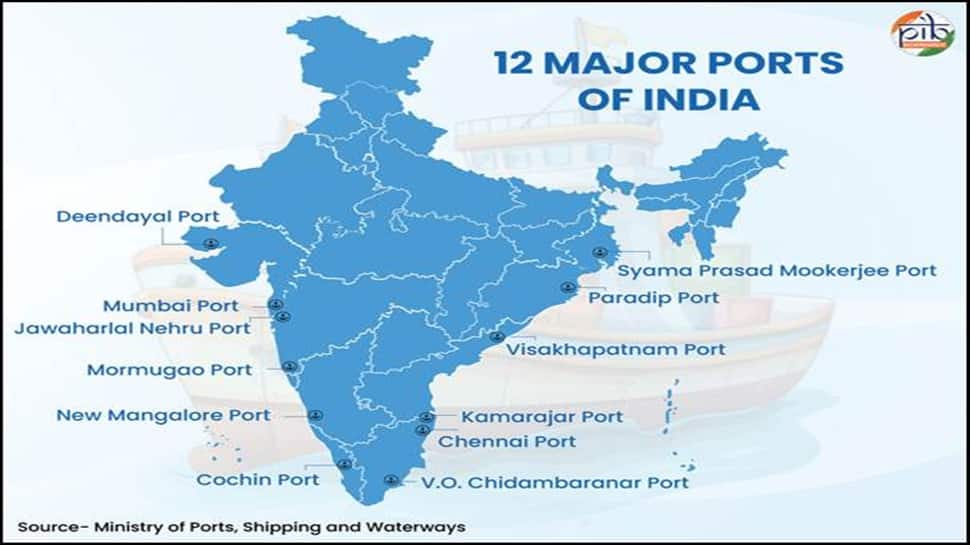
India has 12 major ports and over 200 non-major ports. While the major ports are under the administrative control of the Ministry of Ports, Shipping and Waterways, the non-major ports are under the jurisdiction of the respective State Maritime Boards/ State Government. These ports handle a wide range of cargo, including crude oil, coal, containers, fertilizers, and agricultural commodities, making ports and shipping central to the country’s trade logistics.
Building on this, the Sagarmala Programme was launched in March, 2015 to promote port-led development. It aims to improve logistics efficiency, reduce transportation costs, and support trade by increasing the use of coastal shipping and inland waterways alongside existing road and rail networks. It focuses on modernizing and building ports, improving port connectivity while encouraging investment from both the public and private sectors.
The Sagarmala programme consists of several key components aimed at transforming India’s maritime sector. The overall set of projects under the Sagarmala Programme are divided into 5 pillars and 24 categories as given below.
Port Modernization and New Port Development
This pillar focuses on upgrading existing ports and developing new ones to expand capacity and improve operational efficiency. It includes addressing infrastructure gaps and introducing modernization, mechanization, and digital systems in port operations.
Port Connectivity Enhancement
This component aims to strengthen connectivity between ports and the hinterland to facilitate faster and more cost-efficient cargo movement. It includes the development of multimodal transport networks, integrating road, rail, coastal shipping and inland waterways for seamless logistics.
Port-Led Industrialization
The programme promotes the development of industrial clusters in port-proximate areas to support manufacturing and economic activity. Proximity to ports helps reduce logistics costs and improves access to domestic and international markets.
Coastal Community Development
This pillar focuses on improving livelihoods and promoting sustainable development in coastal regions. It includes skill development programs, support for fisheries and coastal tourism, and initiatives aimed at enhancing economic opportunities for coastal communities.
Coastal Shipping and Inland Waterways Transport
This component encourages greater use of coastal shipping and inland waterways for cargo movement. These modes offer cost-effective and environmentally sustainable alternatives to road and rail transport while helping reduce congestion on existing transport networks.
Over the past eleven years, the Sagarmala Programme has delivered measurable outcomes. The cumulative progress highlights its scale and long-term impact on maritime infrastructure development. Around 845 projects, estimated at Rs 6.06 lakh crore, have been taken up under the programme. As of 24th March 2026, 315 projects worth Rs 1.57 lakh crore have been completed, while 210 projects are currently under implementation, and 320 projects are in the planning stage.
The following initiatives reflect sustained progress in strengthening port infrastructure, improving connectivity, and supporting economic activity across coastal regions.
Significant progress has been achieved in strengthening coastal infrastructure and expanding cargo-handling capacity through targeted investments.
Fishing Harbour Development: A total of 11 fishing harbour projects, costing Rs 1,057 crore, have been completed, directly benefiting more than 30,000 fishermen. In Karnataka, the third-stage expansion and modernization of the fishing harbour at Malpe have been completed, with the development of the fishing harbour at Kulai under implementation.
Coastal Berth Development: 7 coastal berth projects, valued at Rs 494 crore, have been completed, adding 9.84 million tonnes per annum (MTPA) of cargo-handling capacity.
The renovation of the historic Bascule Bridge at Syama Prasad Mookerjee Port, Kolkata, is being undertaken to preserve the port’s heritage while upgrading critical infrastructure. Once completed, the modernized bridge is expected to enable safer, faster, and more efficient movement of cargo and vehicles within the port premises, thereby enhancing logistics efficiency at one of India’s oldest and busiest ports.
A project for the augmentation of firefighting facilities at Pir Pau Terminal of Mumbai Port is under implementation, with a cost of Rs 52.69 crore, focusing on strengthening safety infrastructure at the port.
The transformation under the programme is underscored by improved operational performance and stronger global competitiveness of Indian ports.
Record Cargo Handling: India’s major ports have collectively handled a record 915.17 million tonnes (MT) of cargo during FY 2025–26, surpassing the annual target of 904 MT. This marks a year-on-year growth of 7.06% demonstrating sustained growth in maritime trade.
Operational Efficiency: Average vessel turnaround time declined significantly from 96 hours in 2014 to 49.5 hours in 2025, indicating improved port efficiency and faster cargo handling.
Global Recognition: Indian ports have strengthened their global presence, with 9 ports ranking among the world’s top 100, including Visakhapatnam Port, which ranks among the top 20 ports for container traffic.
Growth in Inland Waterways: Cargo movement through inland waterways increased from 18.10 MTPA in FY 2013–14 to 145.50 MTPA in FY 2024-25, representing a growth of about 700%, contributing to a more efficient and diversified logistics system.
The programme has also supported the expansion of passenger and vehicle movement through coastal and inland waterways, improving connectivity and reducing travel time.
Ro-Pax and Ferry Services: A total of 29 Ro-Pax (a ship that carries both vehicles and passengers) and passenger ferry projects, with an investment of Rs 1,233 crore, have been taken up to strengthen urban waterway transport systems. Out of these, 17 projects worth Rs 706 crore have been completed, benefiting more than 35 lakh passengers by providing faster and more efficient transport options.
Improved Travel Efficiency: The Ghogha–Hazira Ro-Pax service reduced travel time from nearly 10 hours by road to about 4 hours by sea, enabling the movement of over 36,000 trucks, 61,000 cars, and nearly 4 lakh passengers. The Mumbai–Mandwa ferry service has eased road congestion by replacing a 109-kilometre road journey with an 18.5-kilometre sea route, substantially reducing travel time.
Coastal Livelihoods and Skill Development
Beyond infrastructure, the programme has contributed to improving livelihoods in coastal communities through targeted skill development initiatives.
Under the Deen Dayal Upadhyaya Grameen Kaushalya Yojana (DDU-GKY) convergence initiative, more than 7,600 candidates have received skill training, with over 3,100 individuals successfully placed in maritime and allied sectors.
The Sagarmala Programme has estimated a cumulative employment potential of around 1 crore jobs, including 40 lakh direct and 60 lakh indirect employment opportunities, driven by port-led industrialization and the expansion of maritime and related infrastructure.
Sagarmala 2.0
Sagarmala 2.0 is proposed as the next phase of the Sagarmala Programme launched in March 2015, building upon its achievements while adopting a broader and more integrated national vision for the maritime sector outlined in MIV (Maritime India Vision) 2030 and MAKV (Maritime Amrit Kaal Vision) 2047. The scheme aims to position India as a global maritime hub through comprehensive modernization of ports, promotion of port-led industrialization, improvement in coastal and hinterland connectivity to ports, enhancement of inland waterways & coastal shipping services, development of island and coastal communities, and fostering innovation aligned with sustainable development objectives.
Sagarmala 2.0 is also envisioned as a key enabler of inclusive economic growth, employment generation, and logistics cost reduction, in alignment with the national vision of Viksit Bharat 2047. The proposed scheme envisages total budgetary support of Rs 85,482 crore with total investment of Rs 3.6 lakh crore, to be utilized for identified interventions across ports, inland waterways & coastal infrastructure, maritime services, coastal development, research & development and institutional strengthening during the scheme period.
India’s maritime sector has seen significant expansion in capacity, connectivity, and operational efficiency over the past decade. The Sagarmala Programme has contributed to the modernization of ports, the development of coastal and inland waterway infrastructure, and the enhancement of cargo handling capabilities. Completed projects have added measurable capacity, reduced vessel turnaround times, and supported port-led industrial and coastal community development. Collectively, the initiatives provide a structured approach to sustaining growth and strengthening India’s maritime infrastructure for trade and industrial activities.


