
The tabla does not merely mark the beat with a thud. It sings.
Strike the right-hand drum of a tabla set and the sound that rises is unlike anything else in the world of percussion, which are instruments you play by hitting, striking or shaking.
The tabla has a pitch, a clear musical note. It has a body, a richness of tone. The notes hang in the air with a warmth that belongs more to a sitar than to any drum.
Seasoned listeners at a Hindustani concert will tell you the tabla breathes with the vocalist, following the melody like a second voice.
What they do not always know is that this should be impossible.
According to the physics understanding of that era, circular drums were thought to be limited to rhythm alone, incapable of producing the clear musical notes needed for melody.
Yet Indian craftsmen built singing drums centuries before anyone understood how they worked.
THE DRUM THAT BROKE THE RULES OF SOUND
Most drums are, in the language of physics, acoustically defective.
This is not an insult, but a precise description of what happens when you strike a drumhead, the tight skin stretched across the drum’s opening.
When that skin vibrates after being struck, it does not move in one clean pattern.
Instead of a single clear note, the skin wobbles in several different ways at once. Imagine throwing a handful of pebbles into a pond; the ripples clash and overlap, creating a messy surface. Each pattern is called a mode.
Each mode vibrates at its own speed, measured in something called frequency, the number of times per second it completes a full wobble or vibration.

Frequency is measured in Hz, short for Hertz. One Hz means one complete vibration per second.
This is where the problem begins.
In string instruments like the sitar or violin, these frequencies fall into a neat, orderly sequence called a harmonic series.
In simple terms, harmonic overtones are the fainter, higher-pitched notes that ring alongside the main note.
When these overtones follow a mathematical pattern of doubling and tripling in frequency, they create the rich, musical sound we associate with melody instruments rather than the harsh clash typical of drums.
Imagine a musical ladder where each rung is exactly the right distance from the next. This perfect spacing is what makes a string sound rich and musical rather than noisy.

If the lowest note vibrates at 100 Hz, the layers above it sit at exactly 200 Hz, 300 Hz, 400 Hz and so on.
These are clean whole-number multiples: 1, 2, 3, 4. This orderly stacking is what makes a string sound rich and musical rather than noisy.
A circular drumhead behaves completely differently. Left to its own devices, a circular skin is mathematically chaotic. Its vibration patterns move at awkward, uneven speeds that do not line up.
These vibrations follow mathematical curves called Bessel functions, which are complex equations that describe how waves behave in circular shapes. The frequency ratios they produce come out as roughly 1:1.59:2.14:2.30:2.65.
These are not clean whole numbers. To our ears, these uneven gaps sound like a clash because the notes are tripping over each other. They match no musical scale anywhere in the world.

Acoustics experts call dissonance, which is a harsh, unmusical sound. Perfect for marking rhythm, hopeless for carrying a melody.
Hermann von Helmholtz, the 19th-century German physicist whose work on how humans perceive sound remains essential today, concluded that percussion instruments were musically limited by their very nature.
Nobody, it seems, had listened carefully to Indian drums.
THE PHYSICIST WHO HEARD WHAT OTHERS MISSED
In 1919, C.V. Raman was 31 and working at the Indian Association for the Cultivation of Science in Calcutta.
Attending classical concerts, he noticed something that the physics of his time said was impossible: the tabla and mridangam sounded pitched, and their higher notes, called overtones, blended with the sitar and vocalist in perfect musical harmony.
Working with his colleague Sivakali Kumar, Raman began measuring this systematically using scientific instruments.

On January 15, 1920, their findings appeared in Nature, one of the world’s most prestigious scientific journals, in a paper titled “Musical Drums with Harmonic Overtones.”
The result was unambiguous. Indian drums produced overtones in clean whole-number ratios like 1:2:3:4:5. This created a perfect harmonic series in a drum, a feat previously thought physically impossible.
The question was how.
THE GENIUS OF THE BLACK PASTE
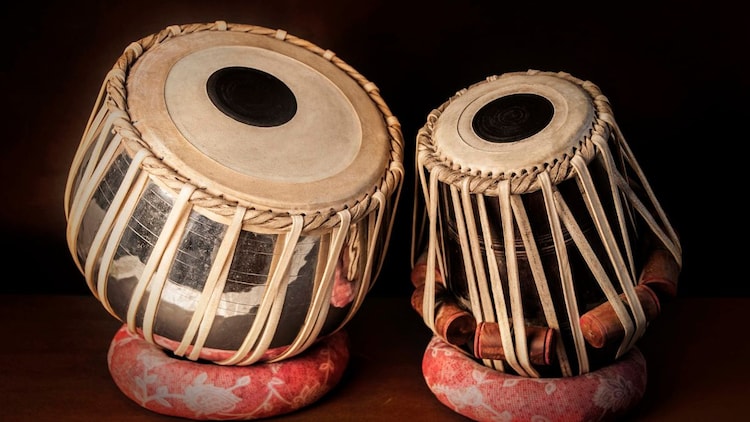
The answer lies at the centre of every tabla and mridangam drumhead: the syahi, a dark disc of paste built up in concentric rings directly onto the skin.
The syahi’s principal ingredient is iron oxide, the same reddish compound that creates rust, mixed with starch and water.
It is applied in carefully graduated layers, thickest at the very centre and growing progressively thinner towards the rim, like a gentle hill rising from the drumhead.
This graded weight distribution is the entire secret.

On a plain drumhead, all those simultaneous vibration patterns run independently at their clashing frequencies, creating musical chaos.
The syahi breaks that disorder by adding concentrated weight at the centre.
Because the centre is now heavier, it acts as an anchor. It forces those messy, decimal-point frequencies to slow down and snap into place.
It effectively retunes the drumhead so the vibrations line up perfectly.
The outcome is extraordinary: the first several vibration patterns of the drumhead are reorganised to produce clean musical tones in perfect harmonic sequence.

For some of those tones, multiple vibration patterns end up tuned to exactly the same frequency by the syahi’s carefully distributed weight.
When that happens, they reinforce rather than clash, a phenomenon called superposition, where waves combine to create something stronger and clearer.
The ear hears one sustained, musical note instead of a jumble of noise.
THE SOLUTION THAT SCIENCE COULD NOT HAVE INVENTED
No one who developed the syahi studied mathematical wave functions or vibration theory. The technique was perfected entirely by ear over centuries.
Craftsmen struck the drum, listened intently, added a thin layer of paste, struck again, adjusted where the material sat, listened once more, and passed the refined method to the next generation.
Through hundreds of years of accumulated listening and correction, they converged on a solution to a problem that Western science had not yet even recognised existed.

Researchers at the Indian Institute of Technology Madras have since confirmed Raman’s findings using modern computer analysis, with techniques that can pull apart complex sounds into their individual frequency components, the way a prism splits white light into its rainbow colours.
The harmonic peaks are exactly where Raman measured them in 1920.
The craftsmen’s answer was not approximate. It was mathematically perfect.
WHEN TRADITION OUTPACED THEORY
At a classical concert today, when the tabla player’s fingers find the sweet spot and a note rings out with that clean, suspended, liquid sustain, you are hearing centuries of empirical acoustic engineering.
Not guesswork, but engineering.
The syahi represents one of humanity’s most elegant solutions to a complex physics problem, developed without laboratories, equations or computers.

It took the world’s best scientists until 1920 to understand what Indian craftsmen had already built by hand, guided only by their ears and an uncompromising dedication to perfect sound.
Physics arrived, eventually, to explain what had already been perfected.