
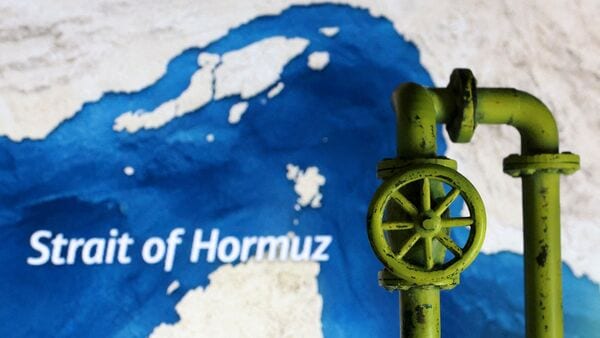
Middle East conflict: Why is Bahrain leading the campaign to reopen Strait of Hormuz?

Bahrain’s Foreign Minister, Abdullatif bin Rashid Al Zayani, warned that the ongoing crisis in the Strait of Hormuz, driven by tensions with Iran, is threatening global stability by pushing millions into poverty and food insecurity.

He emphasised that this is a global emergency, not a regional dispute, with 4 million in the Arab world potentially affected.

“Closing the Strait does not target any one party but constitutes a direct threat to the Global South, whose populations will bear the heaviest burden,” Al Zayani stated, according to The Jerusalem Post.

Bahrain on failed UN resolution

A Bahrain-backed UN Security Council resolution addressing the crisis was blocked by Russia and China on Tuesday. A draft resolution put forward by Bahrain and backed by the United States secured 11 votes in favour, with two opposed and two abstentions.

Bahrain is the current chair of the UN Security Council.

Al Zayani said Gulf nations “regret” the result.

Speaking on behalf of oil-exporting Gulf countries, Al Zayani warned that the failure to adopt the resolution “sends the wrong signal to the world”.

“This signals that the threat to international waterways can pass without any decisive action by the international organization responsible for the maintenance of international peace and security,” he mentioned.

US Ambassador Mike Waltz stated that the United States stands in solidarity with Bahrain and the people of the Gulf “at this moment of reckoning.” Addressing the Council, he noted that 47 years ago, the Iranian regime’s first major action was the hostage-taking of dozens of Americans.

He stated, “Now it’s taking the Strait of Hormuz hostage, and with it, attempting to take the world’s economy hostage. Well, colleagues, that may be its last act. We’ll see”, noting that “the Strait of Hormuz is too vital to the world to be used as hostage, to be choked, to be weaponized by any one State.”

Since the conflict began on 28 February, Iran has largely restricted access to the Strait, causing a spike in global oil prices. The Strait of Hormuz, a narrow waterway about 34 km wide between Iran and Oman, serves as a crucial link connecting the Gulf to the Indian Ocean. It is a key transit route for roughly one-fifth of the world’s oil supply, along with other essential goods such as fertilisers.

Meanwhile, according to Russia’s state news agency TASS, citing an unnamed senior Iranian official, Tehran has agreed under a ceasefire deal with the United States to permit a maximum of 15 ships per day to pass through the Strait of Hormuz.

Key Takeaways
  • A Bahrain-backed UN Security Council resolution addressing the crisis was blocked by Russia and China on Tuesday.
  • Al Zayani warned that the failure to adopt the resolution “sends the wrong signal to the world”.
  • Since the conflict began on February 28, Iran has largely restricted access to the Strait.

Latest

Lebanon, Israel hold first contact, agree to US-mediated meeting on April 14

The exchange involved ambassadors in Washington with U.S. participation, reflecting active mediation efforts, as both sides prepare to outline terms for a cease

Inside Tehran’s strategy: Why Iran picked JD Vance for crucial peace talks

Iran quietly preferred JD Vance to lead US talks, viewing him as anti-war, as high-stakes negotiations begin in Islamabad with deep divisions and uncertain pros

Iran delegation lands in Pakistan, says talks start only if US meets preconditions

Iranian delegation led by Speaker Mohammad Baqer Qalibaf arrives in Islamabad for US talks, saying negotiations will begin only if Washington accepts Tehran’s

Trump buying time before ground op: Ian Bremmer on US-Iran ceasefire talks in Pak

Bremmer suggested Trump may prefer de-escalation amid mounting domestic scrutiny, seeking to deflect blame for rising geopolitical tensions and economic fallout

AI warfare: Why CDS General Anil Chauhan says decision-making must get faster

Chief of Defence Staff (CDS) General Anil Chauhan said this demands seamless tri-service integration and innovative thinking; therefore, the focus has now shift

Topics

Bessent, Powell warned bank CEOs about Anthropic model risks, sources say

USA-BANKS-ANTHROPIC-CYBERSECURITY:Bessent, Powell warned bank CEOs about A

Lebanon, Israel hold first contact, agree to US-mediated meeting on April 14

The exchange involved ambassadors in Washington with U.S. participation, reflecting active mediation efforts, as both sides prepare to outline terms for a cease

Inside Tehran’s strategy: Why Iran picked JD Vance for crucial peace talks

Iran quietly preferred JD Vance to lead US talks, viewing him as anti-war, as high-stakes negotiations begin in Islamabad with deep divisions and uncertain pros

Look at the ball, not the bowler: Sooryavanshi’s mantra vs Bumrah, Hazlewood

Vaibhav Sooryavanshi revealed that his mantra is to “play the ball” and “not the bowler” after taking apart Josh Hazlewood in a successful 202-run chase

Iran delegation lands in Pakistan, says talks start only if US meets preconditions

Iranian delegation led by Speaker Mohammad Baqer Qalibaf arrives in Islamabad for US talks, saying negotiations will begin only if Washington accepts Tehran’s

Boaz Weinstein Scores Win After UK Trust Backs SpaceX Proposal

A Baillie Gifford & Co. trust that placed an early bet on SpaceX recommended a proposal backed by activist investor Boaz Weinstein after losing a key shareholde

Trump buying time before ground op: Ian Bremmer on US-Iran ceasefire talks in Pak

Bremmer suggested Trump may prefer de-escalation amid mounting domestic scrutiny, seeking to deflect blame for rising geopolitical tensions and economic fallout

AI warfare: Why CDS General Anil Chauhan says decision-making must get faster

Chief of Defence Staff (CDS) General Anil Chauhan said this demands seamless tri-service integration and innovative thinking; therefore, the focus has now shift
spot_img

Related Articles

Popular Categories

spot_imgspot_img
