
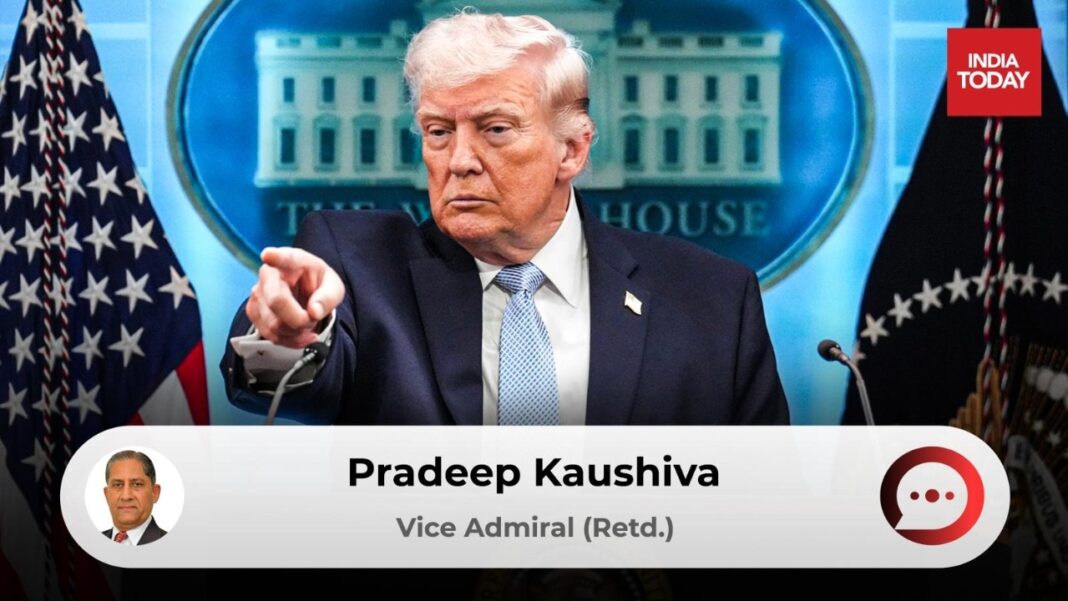
Earlier this month, US President Donald Trump, in a national address, vowed to bomb Iran hard enough to send “them back to the Stone Ages where they belong”. The imperious proclamation brought back a tidal wave of memories.
In 2007, when I was Commandant of the National Defence College, I led a delegation to China. During the call-on on the Deputy Chief of General Staff (Dy CGS), People’s Liberation Army (PLA), I prefaced my opening remarks with these lines, “While admiring the nearly 10% growth rate averaged by China over three decades, we are watching with great professional concern the massive funding allocations being made to the PLA in general and to PLA Navy in particular”.
The PLA official responded, “Insofar as funding of the PLA is concerned, at first glance it may appear to be somewhat large, but we have neglected quality of life issues for a very long time. So a lot of expenditure is being incurred on that account”.
A couple of days later, when visiting the Army General Staff College at Nanjing, the commandant there very proudly took us around the living accommodations of the trainees. The quality of construction, layout, furniture, and facilities provided was easily “five-star+” standards. While thanking the commandant, I complimented him on the very impressive infrastructure and casually asked him to confirm if such high-standard accommodation was being provided to each PLA trainee.
The good General vigorously shook his head and emphatically said, “No, no, no. These are exclusively for our foreign trainees”. It was now obvious to me that the Deputy Chief of General Staff’s order, to put on display the veracity of his remark, had been passed down the line without elaborating its context.
So, it was only left for me to request the commandant that my question and his answer may please be reported up the line “because the Dy CGS appears to be under a somewhat different impression”. I also requested our Dy Military Attache, who was accompanying me, to simultaneously convey the gist of this conversation to the Dy CGS, PLA, through the proper channel.
In 2009, well after my retirement, I represented the United Services Institute at a symposium in Beijing on ‘Water Security: China and the World’. In my presentation, I had criticised the reported Chinese plans to divert the River Brahmaputra northwards at the bend where it forms the world’s longest and deepest canyon just before entering India.
China’s former minister for water resources, Wang Shucheng, who was present at the symposium, sought to rebut the reports. “China does not need to divert Brahmaputra waters; it was not feasible, it was not scientific, and it would take 600 years,” Shucheng said.
But since the Director of the Yellow River Water Conservancy Committee was already on public record as having stated that the mega plan enjoyed official sanction, I asked Shucheng point-blank whether he was denying the plans only because Brahmaputra was planned to be diverted far upstream in Tibet, where it was called Yarlung Tsangpo? There was a fair bit of back and forth between him and the interpreter, but no comprehensible response.
WHEN US GAVE PAKISTAN ‘STONE AGE’ THREAT
It so happened that in 2011, I met Richard Armitage, former US Deputy Secretary of State, at a Track 1.5 dialogue in Washington. During an informal interlude, I said that I would like to ask him a question “from one naval officer to another”.
He smiled and asked if it was about his remark, “bomb back to the Stone Age”, referring to President Pervez Musharraf’s allegation that the US had threatened to bomb Pakistan back to the Stone Age in 2001 if it did not cooperate in the US-led war on terror. I said that my question did not relate to it, and he said, “Good, because I have denied it.”
My question was, “How do you deal with the Chinese, as they brazenly lie between their teeth with a straight face and, when caught out, seek refuge in language and translation gaps?”
He shot back, “You mean, if their lips are moving, they are lying?” Amused, I said that it was a good description and I should remember it. He continued with a smile, “We used to say that for the Pakistanis.” I smiled wider and remarked, “This is brilliant, and I must quote you.” He laughed and said, “Go right ahead, I will deny it!” So, there we were — or so I thought.
Come 2016, and the language of political discourse assumed new hues. This, however, remained largely confined within the US for the next four years, and the rest of the world watched with some amusement and not a little trepidation.
January 2025, however, changed the very tone and tenor of international dialogue, as the established norms of diplomatic exchanges and international parleys in public view were reset. The contemporary, unrestrained recourse to muscular lexicon —making no distinction between alliance partners and sworn enemies when name-calling, whimsically suspending operative parts of treaty clauses, mutual agreements and tacit understandings and then reversing them, taking one’s nation to war without parliamentary sanction, and globally expanding its scope without United Nations Security Council authorisation — is all now par for the course.
Embedded deep is the chicanery from north and west of us, even as the world is fast-moving towards a 21st-century global order where the alliances and partnerships of yore will no longer be operative, and artificially propped power centres will go with them.
When the dust settles on the ongoing ‘shamal’ (sandstorm) in West Asia, and the haze clears, nations will forge flexible nodes of convenience driven not by ideologies or colour of skin or religion, but by sheer economic sense.
Partners in one field will compete in another, all for the betterment of their people. Artificial intelligence, natural stupidity, natural resources, artificial islands — every conceivable asset and all perceived liabilities will be leveraged as never before. Like it or not, the knife has been dug in too deeply not to come out with a bleeding sore, hopefully only to heal thereafter.
Meanwhile, it is clear that Donald Trump does not hold exclusivity or copyright over threatening a sovereign state in the 21st century with Stone Age consequences; Richard Armitage has it. Ironically, the latter denies it while the former gloats in it.
Historians in the distant future will objectively judge and compare the dignity, self-respect and conduct in the face of extreme adversity by the two intended target nations — Pakistan, with its fractured history of less than a century, and Iran, with a civilisational history of thousands of years.
(The author is a retired Vice Admiral and former commandant, National Defence College, New Delhi)


