In 1974, a young electrical engineering graduate from IIT Kanpur was learning how to design circuits, analyse signals, and build systems. Decades later, he would help decode the most complex system known to humanity, the human brain.
That student was Professor Mriganka Sur.
His journey didn’t just cross institutions like IIT, Vanderbilt, Yale, and MIT, it crossed disciplines. He moved from electrical engineering to neuroscience, from silicon chips to neural circuits, and from building machines to understanding thought itself.
At a time when careers were expected to stay linear, Sur chose a different path. He realised that the brain is the ultimate computing machine, one that learns, adapts, and rewires itself. That idea would shape his life’s work and place him at the forefront of modern brain science.
WHERE DID PROFESSOR MRIGANKA SUR’S JOURNEY BEGIN?
Prof. Sur completed his BTech in Electrical Engineering from IIT Kanpur in 1974. He then pursued higher studies at Vanderbilt University, earning both his MS and PhD in electrical engineering. His early academic path pointed clearly toward a career in engineering research.
But during his research years, a new question began to dominate his thinking: How does the brain build intelligence?
That curiosity pulled him toward neuroscience, a field where engineering principles could help decode biological computation.
WHY DID HE SHIFT FROM ENGINEERING TO NEUROSCIENCE?
Rather than leaving engineering behind, Sur applied it to the brain. He saw neurones as circuits, the cortex as architecture, and learning as adaptive computation.
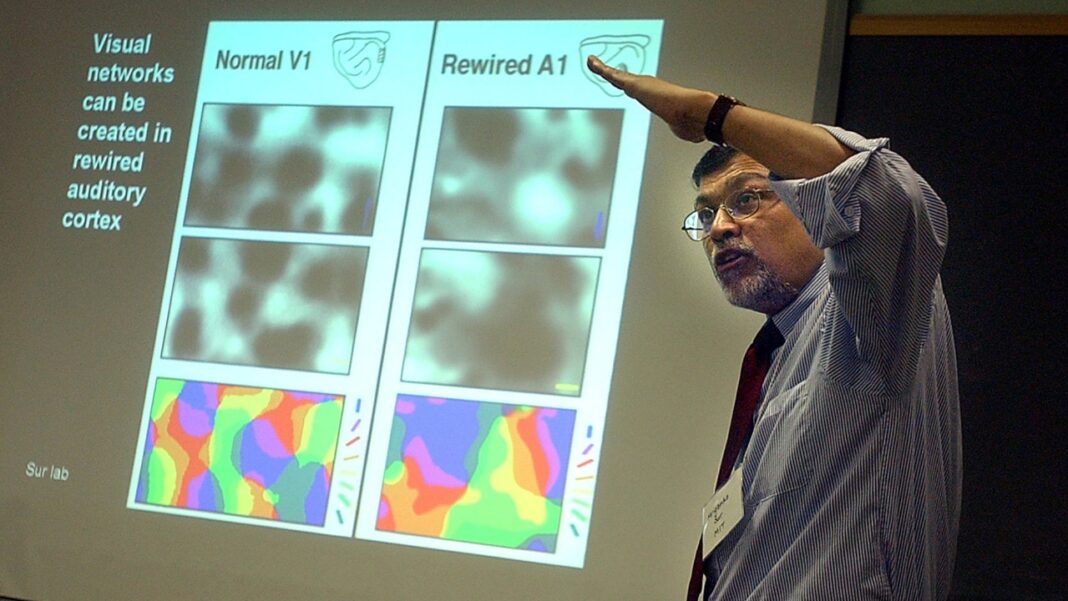
This perspective led him to focus on brain plasticity, the brain’s ability to reorganise itself. His work explored how genes and neural activity shape the cerebral cortex, how learning rewires neural networks, and how experiences alter brain structure.
These insights would later influence research in learning, memory, and neurodevelopmental disorders.
WHAT ROLES DOES HE HOLD TODAY?
Professor Mriganka Sur holds several prominent academic and research positions across leading institutions. He serves as the Newton Professor of Neuroscience at MIT and is the Director of the Simons Centre for the Social Brain.
He is also an Investigator at the Picower Institute for Learning and Memory.
In India, he is associated with IIT Madras as Visiting Faculty in the Department of Computer Science and Engineering, where he also holds the N.R. Narayana Murthy Distinguished Chair in Computational Brain Research.
His work bridges neuroscience, artificial intelligence, and computational modeling, contributing to advances in understanding the brain and intelligent systems.
WHAT DOES HIS LAB STUDY?
Professor Sur’s lab investigates how the brain organises itself from infancy to adulthood. His team studies the development of the cerebral cortex, neural circuit plasticity, learning and memory formation, and how the brain rewires itself through experience.
The research also focuses on autism and other developmental disorders, along with brain imaging and computational models. Understanding these mechanisms could help design more effective therapies for brain injuries and learning disorders.
HOW IS HE BUILDING BRIDGES BETWEEN IIT AND MIT?
Professor Sur actively collaborates with Indian institutions, particularly IIT Madras, where he contributes to computational brain research. His efforts bring together engineers, neuroscientists, and AI researchers.
This interdisciplinary collaboration reflects the future of science, where breakthroughs emerge at the intersection of fields.
WHAT RECOGNITION HAS HE RECEIVED?
His contributions have earned global recognition, including the Distinguished Alumnus Award from IIT Kanpur, Fellowship of the Royal Society, membership in the US National Academy of Medicine, and fellowships of the American Academy of Arts and Sciences and the World Academy of Sciences. These honours reflect decades of pioneering work in brain plasticity and neural development.
WHAT CAN WE LEARN FROM HIS JOURNEY?
Prof. Sur’s career shows that skills are transferable across disciplines. An electrical engineer can become a neuroscientist. A circuits expert can study cognition. A systems thinker can decode intelligence.
His story encourages students and professionals to explore interdisciplinary paths and rethink conventional career boundaries.