
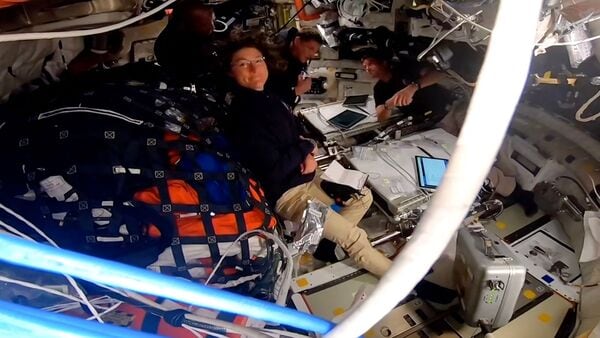
Artemis II Lunar Flyby LIVE Updates: The four astronauts of NASA’s Artemis II – Mission commander Reid Wiseman, pilot Victor Glover, mission specialist Christina Koch and Jeremy Hansen of the Canadian Space Agency – onboard the Orion, entered the the moon’s gravitational “sphere of influence” earlier today and will soon begin their lunar flyby at around 11 pm IST. The Artemis II lunar flyby will take them to over the shadowed, farthest side of the moon.
By 5:35 am India time, the astronauts will reach the mission’s maximum distance from Earth of roughly 252,757 miles, 4,102 miles beyond the record held by the Apollo 13 crew for 56 years. Stay tuned for Artemis II flyby LIVE Updates.
Meet The Artemis II Crew
The astronauts – including three Americans and one Canadian – who are running the Artemis II flyby are Commander Reid Wiseman, pilot Victor Glover, Christina Koch and Canada’s Jeremy Hansen.
Artemis II uses a “Free-Return Trajectory.” This means lunar gravity acts like a natural bungee cord, pulling Orion around and flinging it back to Earth without needing a massive engine burn.
The crew will reach a maximum distance of 252,760 miles from Earth – about 4,105 miles further than Apollo 13.
The crew celebrated Flight Day 5 (yesterday) by hiding “dehydrated scrambled eggs” around the cabin for an Easter egg hunt!
When would the lunar observation begin?
The lunar observation will begin at 11 pm India time.
NASA Live Coverage
The Artemis II flyby will be broadcast LIVE by the National Aeronautics and Space Administration (Nasa). The event will be run on YouTube, Amazon and Netflix.
Watch it here
Artemis II Live: Lunar scientists thrilled as crew reports color nuances from moon flyby
The Artemis II crew is sending continuous science observations throughout the Moon flyby.
Mission control’s Science Evaluation Room received the updates, including grins, nods, and chatter.
The crew reported subtle color nuances on the lunar surface, aiding scientific study.
Human-visible shades of brown and blue help reveal a feature’s mineral composition and age.
The science team is updating the observation plan in real time based on crew reports.
At the start of the observation window, as Orion approaches the Moon’s near side (the side visible from Earth), people in parts of the eastern hemisphere will be able to see some of the same features the crew will observe.
Lunar flyby has officially kicked off. Crew to work in shifts to take images of the Moon
The Artemis II moon mission crew on Monday commenced their intensive lunar targeting plan during their seven-hour flyby of the Moon.
As per media reports, for the first five hours, astronauts will split into pairs and rotate observation duties, allowing each team a brief mental break roughly every hour.
NASA Astronaut Commander Reid Wiseman, who’s leading the Artemis II moon mission, has been giving an update of the view that his crew is seeing from the spacecraft’s window, BBC reported.
“The earth is a small crescent out there. It’s magnificent, I got a picture of it…such a majestic view out here,” he said.
The Artemis II mission has set a new record for the farthest distance from Earth traveled by humans.
The Artemis II crew consists of NASA astronauts Reid Wiseman, Victor Glover, Christina Koch, and CSA astronaut Jeremy Hansen.
Artemis II surpassed Apollo 13’s previous record of 248,655 miles set in 1970.
This marks the first human lunar flyby since Apollo 17 in 1972.
Artemis II LIVE: The flyby to begin soon, Artemis II astronauts make their closest approach to moon
Artemis II LIVE: The Artemis II astronauts have made their closest approach to the moon and the flyby is expected to begin soon.
Artemis II LIVE: ‘Welcome to my old neighbourhood,’ says Apollo 13 astronaut Jim Lovell – Listen in
“Welcome to my old neighborhood.” Our @NASAArtemis II astronauts woke up on the sixth day of their mission to a special message recorded in 2025 by astronaut Jim Lovell, the pilot of Apollo 8. pic.twitter.com/XA4Dc2yQm5
— NASA (@NASA) April 6, 2026
Artemis II LIVE: Orion astronauts get message from Apollo 13 astronaut
Artemis II LIVE: Astronauts of Artemis II, who died last year, have received a pre-recorded message from Jim Lovell of Apollo 13.
Here is what it said:
“Hello, Artemis 2, this is Apollo astronaut Jim Lovell. Welcome to my old neighborhood. When Frank Borman and Bill Anders and I orbited the moon on Apollo 8, we got humanity’s first up close look the moon, and got a view of the home planet that inspired and united people around the world.”
“I’m proud to pass that torch on to you as you swing around the moon and play the groundwork for missions to Mars for the benefit of all. It’s a historic day, and I know how busy you’ll be, but don’t forget to enjoy the view. So, Reid, Victor and Christina and Jeremy, and all the great teams supporting you, good luck and Godspeed from all of us here on the good Earth.”
Artemis II LIVE: Artemis II astronauts – flying at over 400k km away – become most distant humans in history
Artemis II LIVE: The Artemis II flyby will begin at 11 pm (India time). Just before Orion kicks off the fly-around and begin the observations, the four astronauts – flying over 400,171 kilometers – are set to become the most distant humans in history. They broke the record set by Apollo 13 in April 1970.
Artemis II LIVE: How far are the Artemis crew from Earth?
Artemis II LIVE: The Orion capsule will swing around the Moon, placing the crew on track to reach an estimated record distance of 406,772 kilometers from Earth before beginning the journey back.
This will exceed the record set by Apollo 13 in 1972 by 4,102 miles.
Artemis II LIVE: Artemis II flyby livestream to begin soon
Artemis II LIVE: Artemis II flyby will begin around 11 pm. The NASA livestreaming, showing each and every step towards to flyby, will begin inabout 50 minutes.
Artemis II LIVE: Apollo legend Jim Lovell’s message greets Artemis II crew ahead of flyby
As the crew of Artemis II has begun preparations for a historic lunar flyby, marking the first time humans have approached the Moon since Apollo 17 in 1972, they received a recorded message from Jim Lovell, who commanded Apollo 13 and earlier orbited the Moon on Apollo 8.
In the message, Lovell welcomed the Artemis II astronauts to his “old neighborhood” and encouraged them to carry forward the legacy of lunar exploration, calling the mission a stepping stone toward future journeys to Mars.
Artemis II LIVE: See how Artemis II astronauts are preparing for flyby
Artemis II LIVE: When does NASA livestream begin?
Artemis II LIVE: The Artemis II flyby will start at 11 pm (India time) and the NASA livestream of the event in another 1 hour 55 minutes.
Artemis II LIVE: NASA reveals menu of 4 astronauts
Artemis II LIVE: The NASA has revealed what the four astronauts are having in space. In a post, NASA said, “@NASAArtemis II crew has quite a selection to choose from for midday meals.”
Artemis II LIVE: Events to follow today – from flyby to Orion’s solar eclipse period
Artemis II LIVE: These are the events to watch today in the flyby period:
8:20 PM IST: Crew wake-up
10:30 PM IST: NASA lunar flyby coverage begins
11:00 PM IST: Artemis II lunar flyby observation period begins
11:26 PM IST: Apollo 13 distance record broken
12:15 AM IST (next day): Lunar observation period begins
4:17 AM IST: Loss of communications (approx. 40 minutes)
4:32 AM IST: Closest approach to the Moon
4:35 AM IST: Maximum distance from Earth
6:05 AM IST: Orion enters solar eclipse period
6:50 AM IST: Lunar observation period ends
7:02 AM IST: Solar eclipse period concludes
Artemis II LIVE: What happens after the Artemis II flyby?
Artemis II LIVE: A day after the Artemis II flyby, the Orion will leave the lunar “sphere of influence”. After a while, the cew will also speak with the the astronauts aboard the International Space Station in an audio-only conversation.
The Artemis II crew debriefing with science officials about lunar flyby will begin, following which, the return trajectory will begin.
Artemis II LIVE: Artemis II to take same maneuver as Apollo 13
Artemis II is using the same maneuver that Apollo 13 did after its “Houston, we’ve had a problem” oxygen tank explosion wiped out any hope of a moon landing.
The trajectory is known as a free-return lunar trajectory. This trajectory takes ‘no-stopping-to-land’ route, taking advantage of Earth and the moon’s gravity.
The trajectory is also known to reduce the need for fuel.
Artemis II LIVE: Flyby schedule
Artemis II LIVE:
11:26 PM IST: Artemis II crew surpasses the Apollo 13 distance record
12:15 AM IST: Lunar observation period begins
4:17 AM: Predicted loss of communications as Artemis II heads behind the moon (roughly 40 minutes)
4:32 AM IST: Artemis II’s closest approach to the Moon
4:35 AM: Artemis II reaches its furthest distance from Earth
Artemis II LIVE: How to watch Artemis II live?
Artemis II LIVE: NASA will be running the event LIVE on its YouTube channel. The event will begin at 10 pm (India time). During the flyby, the astronauts will sail around the far side of the Moon. They will also photograoh the side of the moon which has never been seen before. At their closest point, they’ll pass roughly 4,000 miles above the lunar surface.
To catch the Artemis II LIVE, go to the NASA YouTube page and look for official broadcast. You can also watch it here at Mint.
Artemis II LIVE: Who are the astronauts of Artemis II mission?
Americans Reid Wiseman, Victor Glover and Christina Koch along with their Canadian colleague Jeremy Hansen, were launched to space on April 1. Today, they will perform the flyby.
The journey will last around 10 days. The flyby will take the astronauts on a loop around the Moon, though they will not land on its surface.
Artemis II LIVE: What can happen during a flyby?
When the Artemis II performs the lunar flyby, the crew shall plunge into darkness and brief communications blackouts as the moon blocks them from NASA’s Deep Space Network.
How long will the flyby last? The flyby will last about six hours, during which the astronauts will use professional cameras to take detailed photos through Orion’s window of the silhouetted moon. The images will show a rare and scientifically valuable vantage point of sunlight filtering around its edges in what will effectively be a lunar eclipse.
They will also get the opportunity to capture a rare sight: their home planet appearing small against the vastness of space, rising above the Moon’s horizon as their capsule emerges from the far side—an extraordinary twist on the familiar moonrise seen from Earth.


