
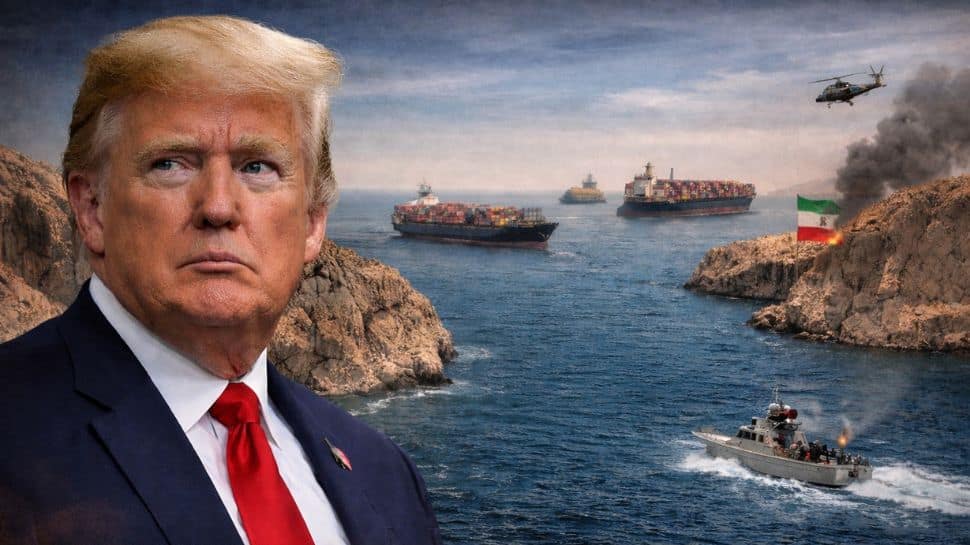
As the US-Israel war with Iran enters its sixth week in April 2026, the Strait of Hormuz, the narrow chokepoint through which roughly one-fifth of the world’s oil flows, remains largely closed to international traffic. According to reports, ships that once numbered 135 per day now trickle through in single digits, mostly Iranian tankers or those from friendly nations.
Iran has imposed transit fees as high as $2 million and barred vessels linked to the United States, Israel, and their allies. As a result, the Iraq’s oil export have reportedly plunged 80 percent, Saudi Arabia has rerouted crude through its east-west pipeline at near capacity (about 7 million barrels per day) but still saw exports drop, and the International Energy Agency has called the disruption the largest supply shock in global oil market history.
President Donald Trump has responded with a mix of threats and limited assurances that have rattled allies and shipping markets alike.
In a televised address on April 1, he declared: “The countries of the world that do receive oil through the Hormuz Strait must take care of that passage. They must cherish it. They can do it easily.”
He has repeatedly suggested the United States might step back from its decades-long role securing the waterway, demanding that major importers, China (which receives nearly 38 percent of Hormuz oil exports), Japan, South Korea, India, and European nations, deploy their own naval forces.
Although, Trump ordered the United States Navy to begin escorting oil tankers through the Strait of Hormuz if necessary, yet the dominant message from Trump has been one of the burden-sharing, America will no longer shoulder the cost alone.
This stance marks a sharp departure from post-World War II US policy. For nearly eight decades, the US Navy, currently with nearly 300 ships—has acted as the de facto guardian of the high seas.
This stance marks a clear departure from post-World War II US policy. For nearly eight decades, the US Navy, currently with nearly 300 ships, has acted as the de facto guardian of the high seas.
It deterred attacks during the 1980s “Tanker War” between Iran and Iraq, suppressed Somali piracy in the 2000s and 2010s, conducted freedom-of-navigation operations in contested waters, and led multinational efforts in the Red Sea after Iran-backed Houthi attacks from late 2023 through 2025.
Maritime transport remains the backbone of the $35 trillion global goods trade.
According to the Fortune report, Retired Vice Adm. John W Miller, who commanded US naval forces in the region, warned that failure to uphold freedom of navigation in Hormuz “puts global freedom of navigation everywhere at risk.”
European and Asian officials, speaking anonymously to Bloomberg, say the episode has already eroded confidence in Washington’s reliability as protector of the high seas. Energy prices have spiked, insurance war-risk premiums have soared from 0.15 percent to as high as 10 percent of a vessel’s value, and governments are quietly reassessing security calculations for other critical chokepoints, the Strait of Malacca, the Bab el-Mandeb, and the South China Sea.
One Southeast Asian analyst noted that a perceived US withdrawal could embolden China’s navy, the world’s largest by hull count, to press territorial claims more aggressively. Philippine foreign-policy expert Lucio Blanco Pitlo III added that Iran controlling Hormuz post-war “would be a game-changer” for US credibility.
The economic ripple effects are already visible. Global supply chains face higher fuel costs, delayed deliveries, and renewed inflation fears. Gulf producers outside Iran have curtailed output by at least 10 million barrels per day. The United Arab Emirates has urged the United Nations to authorise force to reopen the strait, while the United Kingdom convened more than 40 allies on April 2 to explore non-military pressure on Tehran.
Trump’s “America First” approach echoes his longstanding complaints about NATO and trade partners freeloading on US security guarantees. Critics argue that the US itself benefits enormously from secure sea lanes: American consumers enjoy lower energy prices, US exporters reach global markets, and the dollar’s dominance is reinforced by the stability Washington provides.
As of April 5, Hormuz remains contested. Iran earns nearly $139 million daily from its own oil exports through the strait—more than before the war due to higher prices, while the broader region suffers.
Whether Trump’s pressure yields a reopened waterway or a lasting vacuum remains uncertain. What is clear is that even the threat of American retrenchment has shaken a pillar of the postwar economic order. The world’s oceans have never been more vital, or more vulnerable.


