
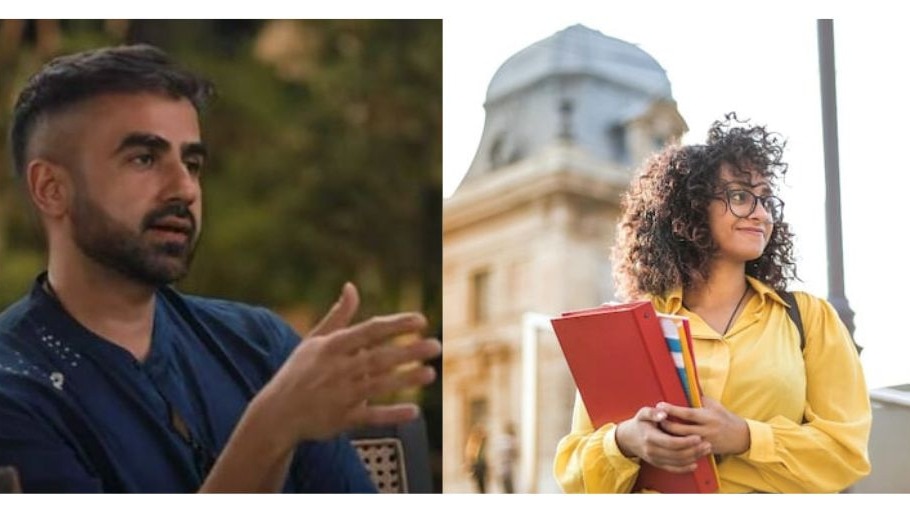
For decades, the MBA has been sold as a predictable equation: invest heavily in tuition, graduate with a prestigious credential, and unlock a higher salary and faster leadership track. But as tuition soars and knowledge becomes widely accessible, that equation is being challenged.
A recent exchange involving Zerodha co-founder Nikhil Kamath at Columbia Business School has sharpened the debate, suggesting that the real value of an MBA may no longer lie in what you learn, but in who you sit next to.
During a candid interaction, Kamath, who previously criticised MBA degrees, was asked why he attended a business school event if he didn’t see value in the degree.
Blending humour with blunt realism, Kamath pointed out that with an MBA costing roughly $300,000, a room of around 500 students effectively represents a collective investment of nearly $90 million.
He added that being in such a space offers him a chance to get to know what he described as the “rich kids of India of tomorrow,” suggesting that this access itself carries future value, which, he said, was precisely why he chose to attend.
That remark reframed the MBA not as a “return on investment,” but as a “return on access.”
IS AN MBA STILL ABOUT ROI OR ABOUT ACCESS TO POWER NETWORKS?
For decades, MBA ROI has been measured by salary increases, promotions, and career pivots. Today, however, rising tuition costs and the democratisation of knowledge via the internet have weakened that equation. Kamath has previously argued that much of what is taught in MBA programs is available online, making traditional degrees less relevant in a skills-first economy.
Yet his Columbia remark highlights a different kind of value: proximity. Elite MBA cohorts often include future founders, investors, policymakers, and heirs to family businesses. The classroom becomes less about lectures and more about long-term relationship building.
As Dr Umesh Kothari, Assistant Dean, GMBA/MGB and GCGM Dubai, Assistant Professor at SP Jain School of Global Management, notes, “the idea that an MBA is a ‘return on access’ is not entirely new, but it is becoming more explicit.”
He adds that this shift reflects a changing understanding of value, where curated peer environments themselves become part of the learning experience.
In this context, the MBA transforms into a curated peer group, a lifelong alumni network, a trust-based deal pipeline, and a credibility shortcut. The “return” is no longer an immediate salary; it is an optionality.
DOES THE USD 90 MILLION CLASSROOM IDEA ACTUALLY HOLD UP?
Kamath’s reference to a room collectively spending tens of millions underscores a harsh reality: elite MBA programs are powerful filtering mechanisms. High tuition fees, selective admissions, and global mobility create concentrated networks of influence.
Historically, many business deals, venture partnerships, and startup co-founder relationships originate from MBA cohorts. In that sense, the classroom is less academic and more like a future cap table waiting to form.
Dr Kothari points out that “the classroom today is one of the few structured environments where individuals are placed in proximity with a highly curated, ambitious, and diverse peer group,” a proximity that often evolves into collaboration, intellectual exchange, and, in some cases, capital and opportunity.
Founders pursue MBAs to meet co-founders, investors recruit from alumni pools, consulting and private equity firms treat top MBAs as talent pipelines, and family business heirs build global partnerships within these networks. The return becomes probabilistic; you don’t know which classmate becomes the next unicorn founder.
IF KNOWLEDGE IS FREE, IS NETWORK THE ONLY PREMIUM LEFT?
With YouTube lectures, AI tools, and open courses replicating classroom learning, the knowledge moat around MBAs has eroded. What remains scarce are trust-based relationships, elite signalling, social capital, and access to opportunity flow.
However, Dr Kothari cautions that “reducing an MBA purely to network value would be an oversimplification.” He emphasises that the real strength lies in the interplay between structured learning and peer access.
In economic terms, the MBA is gradually shifting from creating human capital to creating social capital, but not exclusively.
SO, IS KAMATH RIGHT?
His argument reflects a growing shift in how elite business education is perceived. With knowledge widely available and career paths becoming less dependent on formal degrees, the traditional ROI of an MBA, higher salary and faster promotions, has weakened.
What remains highly valuable, however, is access to ambitious peers, future founders, investors, and business heirs. A classroom collectively investing $90 million in tuition represents more than academic learning; it becomes a curated network of influence.
Yet, as Dr Kothari frames it, “access without capability has limited shelf life, and capability without access can remain under-leveraged.” The degree continues to hold relevance because it creates a dense ecosystem where both can compound over time.
THE NEW MBA EQUATION: ACCESS OVER CURRICULUM?
Kamath’s comment crystallises a broader shift. The MBA is no longer just a degree; it is a membership. The value lies in who sits next to you, not just what is taught to you.
But the final takeaway may be more nuanced. Dr Kothari concludes that “the question is not whether an MBA is a return on investment or access, but how effectively an individual converts that access into insight, and that insight into meaningful outcomes.”
And that’s why, despite rising costs and criticism, the MBA remains coveted.
You may not know what you’ll learn in class, but you might meet the person who changes your career, funds your startup, or becomes your future partner. In the end, the MBA’s real promise may no longer be a higher salary, but a seat in the room where future power networks are quietly formed.


