A plane has two seats, one for the pilot and one for the copilot. A copilot is supposed to assist the pilot for a flight. You may believe that Microsoft’s Copilot does the same job, one assistant that can help you do tasks. However, a former McKinsey partner Tey Bannerman has found that the Redmond giant has a total of 78 Copilot products scattered across its various services.
Bannerman shared a chart that showcases all 78 Copilot products on his website. The chart shows different apps, features, platforms as well as the Copilot laptop key and the entire Copilot Plus category of PCs.
What is Microsoft Copilot?
Copilot is essentially Microsoft’s AI assistant that uses AI models such as OpenAI’s GPT to help you do tasks. Copilot comes in-built with Windows 11 with some PCs now getting a dedicated Copilot Plus button on the keyboard.
Tey Bannerman claimed that to find out the entire list, he could not find any complete source, including that Microsoft website. He wrote,“I went looking for the full list. No single source had all of them. Not even Microsoft’s own website or documentation.”
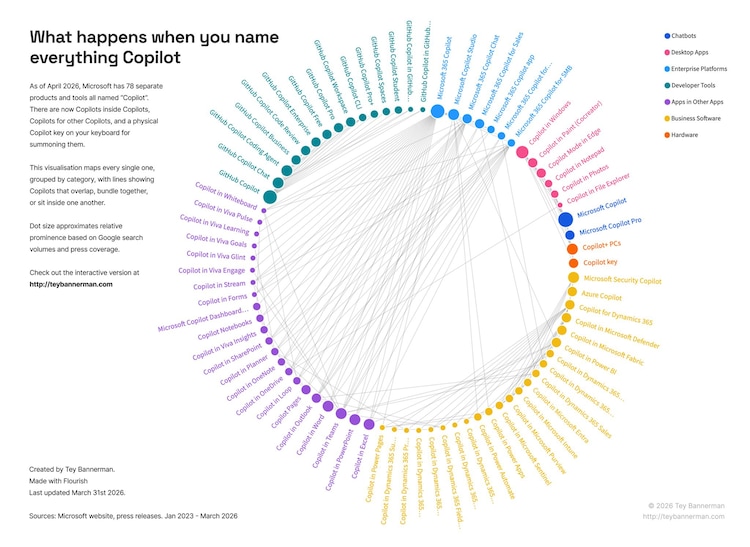
Instead, Bannerman undertook a massive research mission online, going through various announcements and product pages to finally land in on every Microsoft Copilot product. He wrote, “So I pieced it together from product pages, launch announcements, and marketing materials.”
Having 78 copilots for a single user may seem confusing, but there may be some method to this madness.
How does Copilot work?
Going by the chart, there is a lot of repetition when it comes to Copilot products. While you may find one Microsoft 365 Copilot for entreprise as a product, it then gets split across dozens of individual Copilots for each of the Microsoft 365 apps, be it Outlook, PowerPoint or Excel.
Similarly, Microsoft Copilot for consumers also gets subdivided into the likes of Copilot in Windows, Copilot in Paint, Copilot in File Explorer and so on and so forth. Confused? There is more.
Without getting into further detail, Microsoft essentially uses Copilot as an umbrella term for its various AI products, which also include AI tools for its cloud platform Azure and developer platform, Github.
Is this strategy working?
While using one term does make it confusing for many simply due to the sheer extent of AI tools Microsoft provides, it may also make it easier on the surface to recognise an AI tool from the company.
According to a report from Bloomberg, Microsoft CEO, Judson Althoff, said in an internal meeting that the company hit “some pretty big audacious goals” when it comes to selling Copilot products in the previous quarter. For context, Microsoft stated in January this year that only about 3 per cent of its customers were paying for Copilot.