
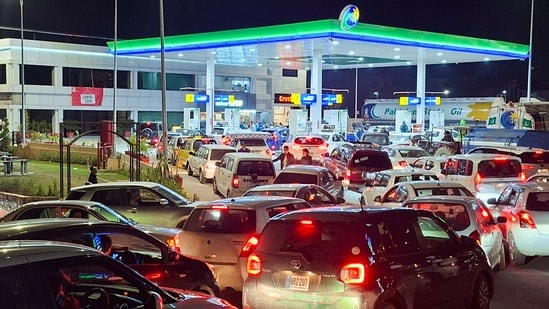
The global fuel crisis and the ongoing Iran-US war seems to have taken a big toll in Pakistan, with fuel prices surging as the country attempts to manage the impact of the global crude shock.
According to news agency Reuters, price of diesel would be raised by 54.9% to 520.35 PKR (Pakistani rupees) per litre, and petrol by 42.7% to 458.40 PKR per litre. According to news agency PTI, the price of kerosene was also increased by ₹34.08 per litre to ₹457.80.
“It was inevitable to raise the prices due to the international market prices going out of control after the US-Iran war,” Pakistan’s petroleum minister, Ali Pervaiz Malik, reportedly said, as he announced the hike in fuel rates.
In an attempt to soften the blow of this big surge in prices, Pakistan has reportedly hiked the levy on petrol to ₹160 per litre from ₹105, and reduced it to zero on diesel from ₹55.
This is the second hike in petrol and diesel prices seen in Pakistan in less than a month, indicating the big impact the West Asia conflict has left on India’s neighbour.
In March, Pakistan raised consumer prices for diesel and petrol by about 20% and has further hiked it by around 55% and 43%, respectively.
Like many countries in Asia, Pakistan is also heavily reliant on the Strait of Hormuz for its oil supply and imports energy mainly from Saudi Arabia and the UAE. However, with the key waterway blocked for many vessels and dampening hopes of a ceasefire between Iran and the US forcing a surge in oil prices, Pakistan is also feeling the heat.
Notably, Pakistan offered to mediate the negotiations between the two sides recently, with prime minister Shehbaz Sharif extending the offer. Several news reports also suggested that Islamabad could be the venue for talks between Iran and the US but there has been little to no development to that end ever since.
Pakistan’s petroleum minister, who announced the hike in fuel rates, reportedly also said that the country was no longer able to afford the subsidy of 129 billion rupees handed out in the past three weeks. “Since the resources are limited and there is no end to this war in sight, there was no way to continue with a blanket subsidy,” he said, according to a Reuters report.
Meanwhile, India recently announced a cut in the special additional excise duties on diesel and petrol to ₹3 per litre and zero. While there hasn’t been any significant impact on fuel prices in India, prices of commercial and domestic LPG saw a rise, and the government has been pushing people to opt for piped natural gas (PNG) instead.


