
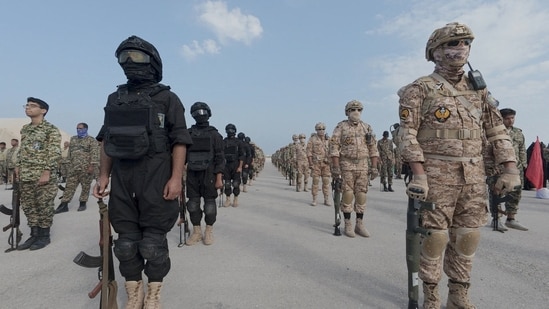
The ongoing US-Iran conflict has taken an ugly turn, with Amnesty International releasing a report, on Thursday, alleging that Iran is recruiting children as young as 12 into the military to strengthen its forces.
In its report published on April 2, Amnesty International stated that Rahim Nadali, a deputy in the IRGC’s Mohammad Rasoul Allah Corps of Greater Tehran, announced a recruitment campaign titled ‘Homeland-Defending Combatants for Iran’. The campaign reportedly aims at to volunteers aged 12 and above in Iranian miliart as Basijs.
Iranian news outlet Defapress quoted Nadali as saying that those interested can register at Basij bases in mosques across Tehran by filling out the required form to join the ‘homeland-defending combatants’. Nadali emphasised that the campaign accepts volunteers aged 12 and added that, additional registration booths will be set up in major city squares, key gathering points for pro-Hezbollah supporters, to make it easier for citizens to join the campaign.
Accusing Iran of committing a grave war crime by recruiting children in its conflict with the US, Erika Guevara-Rosas, senior director for research, advocacy, policy and campaigns, Amnesty International said, “As US and Israeli strikes hit thousands of IRGC sites, including Basij facilities, across the country, including through drone attacks targeting security patrols and checkpoints, the deployment of child soldiers alongside IRGC personnel or in their facilities puts them at grave risk of death and injury. Iranian authorities must immediately stop their criminal assault on children’s rights and prohibit the recruitment of anyone under 18 by the armed forces.”
Who are Basijs
The report also cited the case of 11-year-old Alireza Jafari, who was killed while accompanying his father, a Basij member, to a checkpoint. His mother said that her husband took the child along due to a shortage of personnel.
It further included accounts from several witnesses who reported seeing children below the age of 16 stationed at checkpoints.
According to the IRGC Recruitment Regulations Law, personnel are divided into two categories: official guards and Basij members. While official guards serve as the primary combat forces, Basij members provide support during times of personnel shortage. Their roles include patrolling, checkpoint duties, logistical support, distribution of supplies, and assistance with food, medical, and relief efforts.
Basij members are further classified into three categories: ordinary, active, and special. Under the law, children aged 12 to 15 are categorised as ordinary Basij members. Active Basij members are those aged 15 and above, while special Basij members are individuals who ‘possess the qualifications of an (official) guard and, after completing the required training, commit to being available full-time to the IRGC when needed.” Article 16 allows individuals as young as 16 to become special Basij members.
“Under customary international humanitarian law, which is legally binding on Iran, conscripting or enlisting children under the age of 15 into armed forces or groups, or using them to participate actively in hostilities, constitutes a war crime,” the report stated.


