
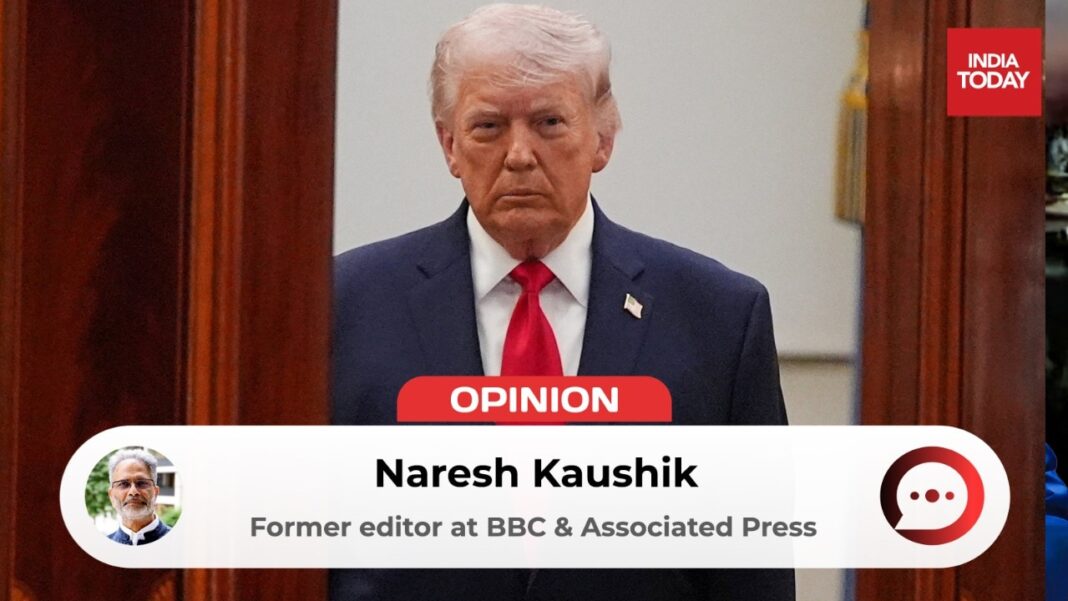
Days after the United States dropped atomic bombs on Japan’s Hiroshima and Nagasaki, Emperor Hirohito announced Tokyo’s surrender, which led to the end of the Second World War in the Pacific. On Wednesday, in his first address to the nation since he started the war five weeks ago, President Trump threatened Iranians that the US was “going to hit them extremely hard to bring them back to the Stone Age, where they belong.”
A day after this address, Trump shared a video on social media of a strike on a bridge in the Iranian city of Karaj, with a warning that Iran should “make a deal” before there is “nothing left.” Hours earlier, US-Israeli strikes hit Tehran’s historic Pasteur Institute, a century-old pillar of the country’s public health system. It was one of the oldest, most prestigious research and public health centres in Iran — and the entire Middle East.
Vali Nasr, an Iranian-American professor of international affairs and Middle East studies at Johns Hopkins University’s School of Advanced International Studies, described the institute as “an icon of Iran’s health care system, a symbol of modern Iran.”
“Destroying it could have no other purpose than assaulting Iran’s history, erasing the history of its modernisation and development — take Iranians back to the Stone Age,” he wrote on X.
FROM ‘HELPING WITH FREEDOM’ TO ‘THREATS OF STONE AGE’
Trump’s threat comes amid rising attacks on the country’s civilian and economic infrastructure during the conflict, along with relentless bombings of military targets, which have failed to diminish Tehran’s resolve to continue fighting. However, his latest threat to strike its civilisation appears to have gone too far even by Trump’s standards.
And it marks a stark departure from Trump’s previous offer to support Iranian demonstrators in January in their fight to free themselves from the Islamic regime. Even Iranian dissidents residing in the West have criticised Trump. “Threats to send Iran ‘back to the Stone Age’ are inhumane,” said Nazanin Boniadi, a British-Iranian actress who has long campaigned against the Islamic Republic, in a post.
Trump’s outrageous comment exposes his frustration at not achieving what he was led to believe would be a quick victory by Israeli Prime Minister Benjamin Netanyahu. Iran’s resilience, resistance, and escalation of the war beyond its borders with retaliatory strikes on its Gulf neighbours — attacks on US bases in the region — and the creation of a global financial and energy crisis by blocking the Strait of Hormuz have trapped Trump in a conflict he is desperate to escape.
NO ENDGAME IN SIGHT
A day before his Fool’s Day address to the nation, Trump promised he would withdraw the US from Iran within four to six weeks, even without a deal. However, in his speech, he did not confirm that, nor did he indicate whether he intended to escalate with a ground invasion to end the war swiftly. In fact, he didn’t say anything new.
In his February 28 video, Trump promised that the US would “destroy their missiles and raze their missile industry to the ground.” But even after five weeks of the war, Iran is still able to fire missiles daily towards its Gulf neighbours and Israel.
Trump and Netanyahu both suggested that day that they wanted regime change in Iran. Trump asserts that the regime has already changed in Tehran, and he calls it “reasonable”. The reality is that the Islamic regime is not only firmly in place, but it is now more radical and less inclined to compromise than the regime led by Ali Khamenei, who was killed on the first day of the war.
NUCLEAR THREAT
The war’s other main aim was to halt Iran’s ability to develop a nuclear weapon. The country still possesses about 450 kg of 60 per cent-enriched uranium, believed to be concealed in Isfahan, sufficient to make 10 nuclear bombs after achieving 90 per cent enrichment. In his Wednesday speech, Trump said he “didn’t care” about this because it was “so far underground” at a location monitored by satellite.
That would make Israel very nervous. If Trump pulls out, leaving Iran with a large stockpile of enriched uranium, it could be a nightmare scenario for Israel. The current Iranian leadership under Ali Khamenei’s son, Mojtaba, would be far more determined to seek revenge and might attempt to develop a bomb.
The irony is that the Israeli and US military’s targeted killings of Iran’s leaders have wiped out Iran’s moderate figures, who would have been more willing to compromise on the nuclear programme. Oman, which mediated talks between Iran and the US when Trump and Netanyahu decided to start the war, has confirmed that Iran was willing to make significant compromises. The US and Israel may have lost that opportunity now.
ALIENATING ALLIES
Trump’s decision to invade Iran may have caused the blockade of the Strait of Hormuz, but he now expects others to manage it. He reiterated this in his speech, stating that countries importing oil from the Gulf via Hormuz should take the lead in pressuring Iran to reopen the passageway. Trump overlooked the fact that the US also imports some oil and fertilisers from the Gulf, which pass through the strait.
Earlier, he threatened Iran with bombings of its energy infrastructure over Iran’s blockade, but withdrew his threats after Tehran made it clear it would retaliate in kind in the Gulf. Britain has been trying to form an international coalition to reopen the Strait of Hormuz, but the task is difficult because the US is not part of it.
Trump has been unhappy with America’s NATO allies, especially the Europeans, for not joining the war. On Tuesday, Trump told the British newspaper The Telegraph that he was considering withdrawing the US from the military alliance because Europeans were not supporting the US in Iran. Although this is not the first time Trump has made such a threat, its timing is significant. One of the beneficiaries of the Iran conflict has been Russia, which Europe views as its main threat, particularly after the invasion of Ukraine.
The war in Iran is deeply unpopular among the European public, as it is with most of the world. European leaders have argued that NATO is a defensive alliance and cannot justify joining Trump’s war of choice. They have also further upset Trump by refusing US military planes access to their airspace or bases.
In the past few days alone, France, Italy, and Austria have rejected such requests from the US. Although it’s not possible for Trump to withdraw the US from NATO without Congress’s approval, which is unlikely to agree, his repeated threats are forcing Europe to prepare for that possibility.
IRAN’S LONG GAME
Trump and Netanyahu may have started the war, but Iran appears to hold the power to determine its length. It has denied negotiating with the US and strongly rejected Trump’s claims that Tehran is seeking a ceasefire. Iran is wary of agreeing to a ceasefire deal that could later allow the US and Israel to attack it. With his decision to invade Iran, Trump has given the Islamic Republic an opportunity to successfully try out its military doctrine.
As China realised a year ago, the strategic importance of critical minerals as leverage against the United States, Iran has identified the Strait of Hormuz as its crucial weapon. It has also exposed the Gulf states’ vulnerability during this conflict, despite — or perhaps because of — the presence of US bases on their territory. Iran’s retaliatory strikes against the Gulf States have not only damaged their economies but also tarnished their reputation as tax-free havens and safe holiday destinations, particularly in the UAE.
HOW THEY PLANNED
Iran has been preparing for this war for decades. Following last year’s 12-day conflict with Israel and the US bombings, its leaders decentralised the military decision-making process to ensure it could operate even if their central leadership was decapitated. That planning helped it to survive and retaliate. Iran also studied US military operations from Vietnam to Afghanistan and drew lessons from them for its own military doctrine.
Trump’s threat of bombing Iran into the Stone Age is unlikely to force the regime to capitulate. The speaker of Iran’s parliament, Mohammad Baqer Qalibaf, has warned that Iran would continue retaliating “until the enemy truly regrets its aggression.” This doesn’t suggest Iran is ready to negotiate a ceasefire deal under any threat.
Qalibaf also hinted at how Iran perceives the war’s outcome. “We believe this war will change many regional relationships, and we will not return to the conditions that existed before it. We are prepared to conclude lasting security agreements with countries in the region that can provide mutual guarantees and create stable, sustainable security for investors.”
The question is, will Trump, Netanyahu and the Gulf leaders agree to make a deal with Iran on those terms? That’s unlikely, which means the war is not going to end “very shortly” as Trump has promised to Americans.
(Naresh Kaushik is a former editor at the BBC and Associated Press. He is based in London. Views expressed are personal.)


