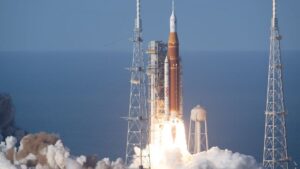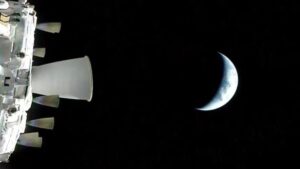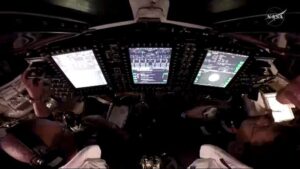
In the first 12 hours since the Space Launch System (SLS) rocket roared off into the skies on April 2, ferrying four astronauts towards the Moon, the Artemis-II Moon mission has accomplished key mission tests.
As the Orion spacecraft, now officially named Integrity, circles Earth in a high elliptical orbit, the four-member crew is busy proving that humans are ready to return to the lunar vicinity.
This mission is not just a flight; it is a rigorous stress test of hardware that will eventually land the next generation of explorers on the lunar surface.
You can explore the journey of the four astronauts in this detailed Artemis II interactive story.
WHAT HAPPENED ON DAY 1 OF THE ARTEMIS-II LAUNCH?
The mission began with a flawless liftoff from the Kennedy Space Center on April 2 at 4:05 am IST.
The SLS rocket, the most powerful booster ever built by Nasa, delivered 8.8 million pounds of thrust to propel the Orion spacecraft into orbit.
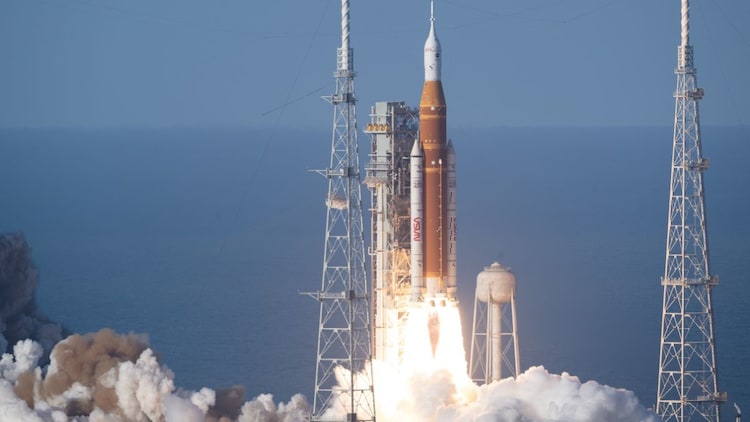
This launch was a historic milestone as it carried the most diverse crew in space history, including the first woman, the first person of colour, and the first international partner of the US to fly toward the Moon.
The initial ascent reached speeds of nearly 28,000 kilometres per hour, successfully shedding the solid rocket boosters and the core stage within minutes.
HOW DID THE ASTRONAUTS ADJUST THE PATH OF THE SPACECRAFT?
Once in orbit, the crew did not simply coast. They performed a series of engine firings, or manoeuvres, to shape their path. First was the apogee raise burn, which is a timed engine blast to increase the highest point of their orbital loop.
This was followed by a critical perigee raise. This manoeuvre acted like a calculated nudge, using the service module engine for 43 seconds to lift the lowest point of the orbit.
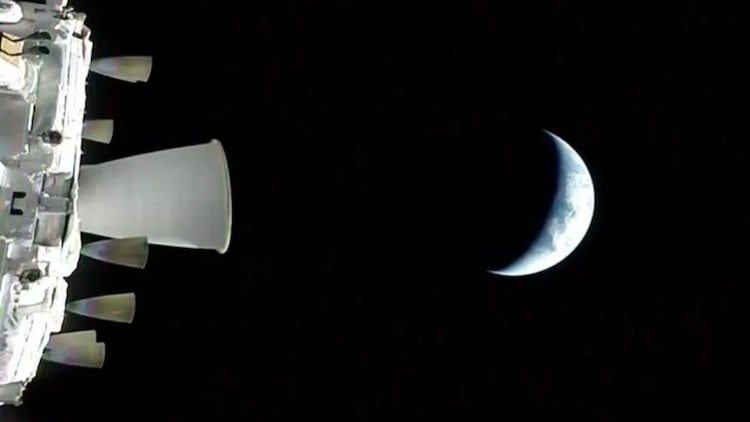
By doing so, the team ensured Integrity was in a stable high Earth orbit, perfectly aligned for its upcoming exit from Earth’s gravity.
While the crew monitored these systems, ground controllers in Houston confirmed that the solar arrays had deployed perfectly, providing the 25-ton vehicle with a steady stream of power from the Sun.
HOW DID THE CREW SPEND THEIR FIRST DAY IN SPACE?
Life inside the cabin has been a mix of technical drills and essential maintenance.
Commander Reid Wiseman and Pilot Victor Glover conducted proximity operations, where they manually piloted Orion to within nine metres of the spent upper stage of the SLS rocket.
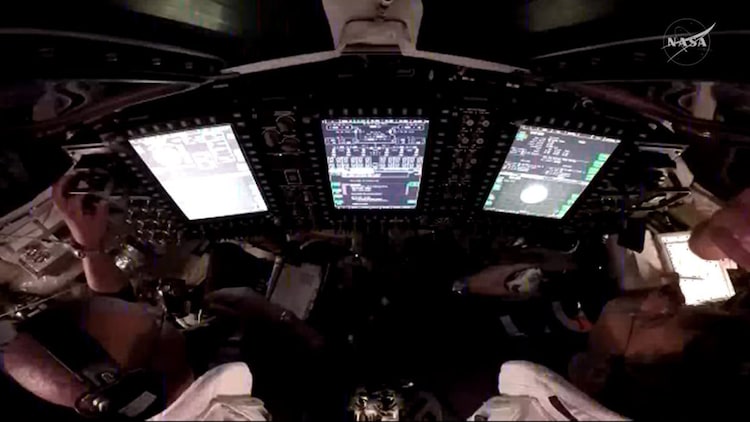
Think of this as a high-speed parallel parking test in space to ensure the spacecraft responds accurately to manual steering.
Even the minor challenges were handled with professional ease; Mission Specialist Christina Koch successfully repaired a blinking fault light on the waste management system, or toilet, ensuring all life support remains at 100 per cent capacity.
Following these intense tests, the crew took a well-deserved four-hour nap, being awakened at 4:36 pm IST to the song “Sleepyhead” by Young and Sick.
WHAT IS THE NEXT STEP FOR THE ARTEMIS-II MISSION?
The mission is currently approaching its most defining moment: the Translunar Injection.
This is a massive six-minute engine burn that will catapult the crew away from Earth’s “pull” at speeds exceeding 40,000 kilometres per hour.
Unlike the Apollo missions, Artemis-II will not enter a low lunar orbit. Instead, it will follow a free-return trajectory.
This means the spacecraft uses the gravity of the Moon like a slingshot, looping around the far side and naturally falling back toward Earth without needing a second major engine blast.
This 10-day journey is the ultimate rehearsal for Artemis-IV, which aims to put boots back on the lunar soil.