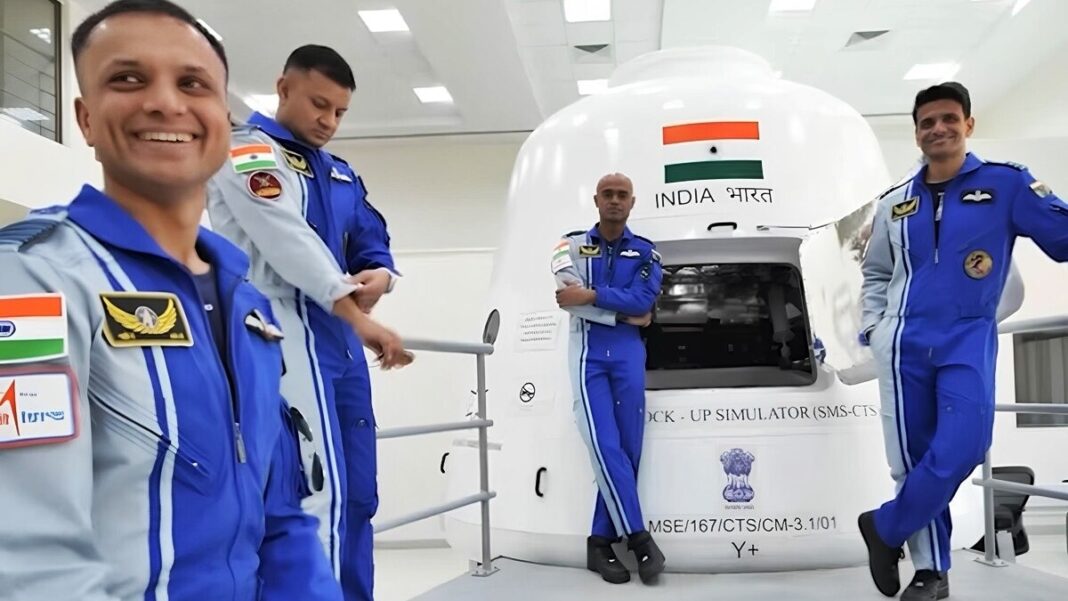
India’s human spaceflight ambitions have taken a crucial step forward as four astronauts selected for the Gaganyaan Mission began a unique high-altitude experiment in Ladakh under a programme called Mission Mitra.
The initiative, led by the Indian Space Research Organisation’s (Isro) Human Space Flight Centre (HSFC), aims to simulate the harsh conditions of deep space on Earth.
WHAT IS MISSION MITRA?
Mission Mitra, short for Mapping of Interoperable Traits & Reliability Assessment, is being conducted in the rugged, high-altitude terrain of Ladakh.
Known for its freezing temperatures, low oxygen levels and isolation, Ladakh is an ideal terrestrial analogue for space-like conditions.
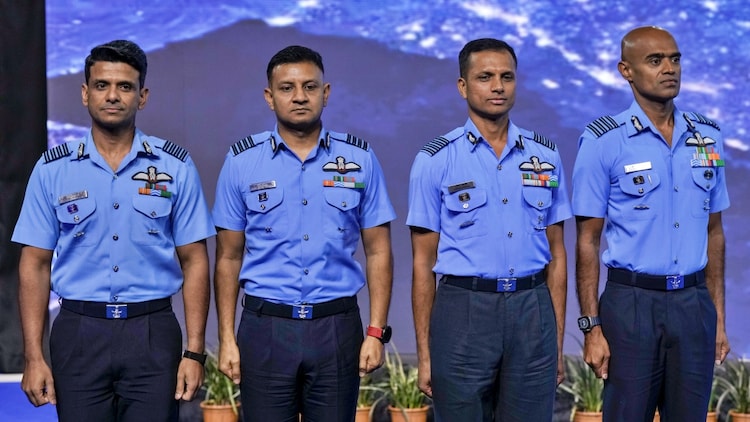
The mission involves India’s four designated Gaganyaan astronauts, supported by a multidisciplinary team of scientists, engineers, medical experts and psychologists.
The four astronauts, including Group Captain Shubhnashu Shukla and P Balakrishnan Nair, had reached Leh earlier this week for acclimatisation before the beginning of the mission.
Unlike traditional training focused on spacecraft systems, Mitra shifts attention to what experts call the human machine, the psychological and behavioural resilience required for space travel.
WHAT WILL ASTRONAUTS DO DURING MISSION MITRA?
At its core, Mission Mitra seeks to understand how individuals function as a team under extreme stress.
One of its primary goals is to evaluate interpersonal cohesion, examining how astronauts and ground teams maintain coordination and trust in challenging conditions.
Researchers are also closely monitoring stress resilience, studying real-time psychological responses to cold, hypoxia and prolonged isolation.
Another key component is integrated logistics, which tests communication protocols between the field crew in Ladakh and mission support teams. These simulations mirror the constraints of deep space missions, where delays, isolation and limited resources can significantly impact decision-making.
The findings will play a vital role in shaping India’s future human spaceflight missions, especially those involving longer durations in orbit or beyond.
Sources at the HSFC said that insights from Ladakh’s extreme environment will help ensure astronauts are equipped not just physically, but psychologically for space.
The mission draws inspiration from the European Space Agency’s Caves experiment or the Cooperative Adventure for Valuing and Exercising human behaviour and performance Skills program, which is a unique astronaut training initiative that uses deep underground cave systems to simulate space mission conditions on Earth.
Instead of a laboratory experiment, it is a hands-on mission where astronauts spend days living and working in total darkness, isolation, and confined environments, conditions similar to space.
As India prepares for more advanced missions under the Gaganyaan programme, Mitra is expected to lay the groundwork for a comprehensive framework to assess team dynamics and mental endurance.
The data gathered here could ultimately determine how well astronauts perform in the isolation of space.
With Mission Mitra underway, India is not just building rockets, it is building resilient human systems capable of thriving far beyond Earth.