
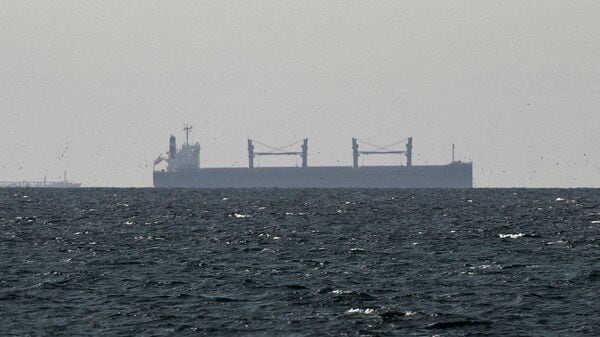
The Gulf Cooperation Council (GCC) on Thursday urged the United Nations Security Council (UNSC) to sanction the use of force to safeguard the Strait of Hormuz from Iranian aggression.
Tehran has effectively blocked this critical maritime corridor — endangering global fuel stocks and destabilizing the world economy — as a reprisal for US-Israeli strikes that ignited the month-long conflict in the Middle East.
“Iran has closed the Strait of Hormuz, prevented commercial vessels and oil tankers from transiting, and imposed conditions on some to pass through the Strait,” said Jassem al-Budaiwi, secretary-general of the GCC.
“We call upon the Security Council to assume its full responsibility and take all necessary measures to protect maritime routes and ensure the safe continuation of international navigation,” al-Budaiwi said.
These remarks were delivered in New York during the inaugural Security Council session focused on collaboration with the GCC, which includes Saudi Arabia, the UAE, Bahrain, Qatar, Kuwait, and Oman. Bahrain has introduced a draft resolution that would authorize nations to employ “all necessary measures” to guarantee unimpeded passage through the Strait.
Nevertheless, the proposal has fractured the 15-member Security Council. Diplomatic insiders indicate that veto-holding members Russia, China, and France remain staunchly opposed, even after several revisions to the draft.
“We want a Security Council decision that addresses the situation comprehensively with the root causes, and not one-sided and unbalanced,” Anna Evstigneeva, deputy representative of Iran-allied Russia, said on Wednesday.
French President Emmanuel Macron has characterized any military intervention to reopen the Strait as “unrealistic.”
A fifth iteration of the draft was circulated to member nations on Thursday. Under normal conditions, approximately 20% of the world’s oil and liquefied natural gas (LNG) is transported through the Strait of Hormuz. Its current near-complete shutdown is severely disrupting global supplies of oil, LNG, and fertiliser, triggering a dramatic spike in energy costs.
Britain gathers 41 countries to press Iran to reopen Strait of Hormuz
The United Kingdom on Thursday accused Iran of holding the global economy hostage during a diplomatic summit where representatives from over 40 nations discussed strategies to compel Tehran to reopen the Strait of Hormuz.
The United States was notably absent from the virtual conference, following President Donald Trump’s assertions that protecting the strategic waterway is not a primary American responsibility.
UK Foreign Secretary Yvette Cooper said the talks, which focused on political and diplomatic rather than military means, showed “the strength of our international determination” to reopen the strait.
Trump also criticised European allies for their lack of support in the conflict and reiterated his threats to withdraw the US from NATO.
The participating 41 countries represented every continent except Antarctica, illustrating the worldwide instability caused by a war that has triggered widespread shortages of fertiliser and fuel.
“We have seen Iran hijack an international shipping route to hold the global economy hostage,” Cooper said at the start of the meeting.


