
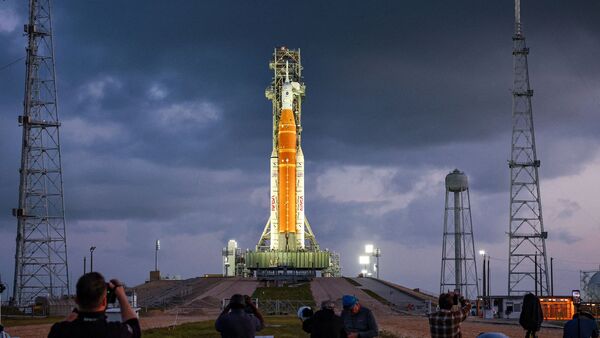
NASA had a trouble-free countdown for the Artemis II mission on Tuesday, on the eve of astronauts’ first trip to the moon in more than half a century, after weeks of fuel leaks and other issues.
Officials reported the moon rocket was doing well on the pad, and the weather looked promising. Forecasters put the odds of favourable conditions at 80%.
“Everybody’s pretty excited and understands the significance of this launch,” said senior test director Jeff Spaulding.
Artemis 2 is scheduled to take off from Florida as early as April 1 at 6:24 pm EST (3:54 AM IST on April 2).
The four astronauts — Reid Wiseman, Victor Glover, Christina Koch and Jeremy Hansen — will become the first lunar visitors since Apollo 17 in 1972.
The journey marks a series of historic accomplishments: it will send the first person of colour, the first woman and the first non-American on a lunar mission.
During their 10-day journey, the astronauts will zip around the moon without landing or even orbiting, and come straight back.
Why won’t Artemis II land on the lunar surface?
Artemis II won’t land on the lunar surface “because it doesn’t have the capability,” CNN reported, quoting Patty Casas Horn, deputy lead for Mission Analysis and Integrated Assessments at NASA. “This is not a lunar lander.”
Horn said that throughout the history of NASA, “everything that we do is a bit risky, and so we want to make sure that that risk makes sense, and only accept the risk that we have to accept, within reason.”
“So we build out a capability, then we test it out, then we build out a capability, then we test it out. And we will get to landing on the moon, but Artemis II is really about the crew,” she added.
NASA launched an uncrewed debut mission, Artemis I, which orbited the moon in November 2022.
The upcoming Artemis II flight is the first time that people will be on board. The Orion capsule will carry the four astronauts around the moon, and the SLS rocket will launch it into Earth orbit before the crew continues deeper into space.
“Now, with our four humans on board, we’ll be testing out a lot of new capabilities that were not there for Artemis I,” Horn said. Explaining through an example, the NASA scientist said that the space agency has to keep the vehicle thermally stable because humans need to be comfortable.
“But when you add people to a spacecraft, you add a lot of moisture to the air, too. They also need food. They need water. They need toilets. We … also have some exercise devices on Orion this time that we’re going to be testing,” she said.
NASA’s priorities for Artemis II are clear, Horn said, adding that there’s plenty to do without touching the lunar surface.
She also noted that crew safety and health come first, which includes getting the astronauts back home. “Vehicle safety and health are secondary, and the mission objectives — such as testing navigation, propulsion and other onboard systems — come after that.”
(With agency inputs)


