
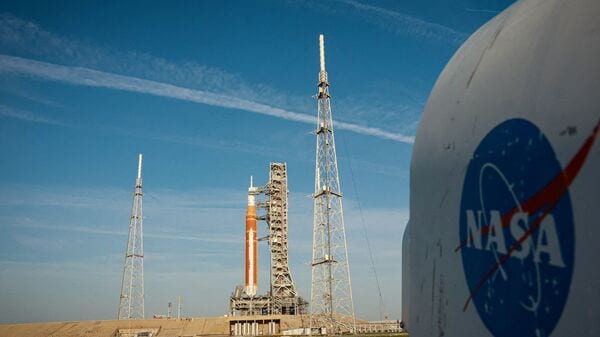
The countdown is underway at the National Aeronautics and Space Administration (NASA)’s Kennedy Space Center as it prepares for the liftoff of Artemis II, which will send four astronauts around the moon and back.
This is the first crewed lunar mission since 1972, and experts say that despite extensive preparations, safety systems, and built-in redundancies, human spaceflight remains inherently risky, ABC News reported.
Danny Olivas, former NASA astronaut and engineer, said, “I think it’d make everybody feel comfortable to say that all the risk was knocked down to zero.” However, he added that the truth is the risk is not knocked down to zero, and it never will be.
How NASA plans to ensure crew safety from launch to splashdown:
Lifesaving suits: According to the report, the four astronauts will wear customized spacesuits called Orion Crew Survival System (OCCS) suits from launch through re-entry into Earth’s atmosphere. NASA says these Artemis II suits are fire-resistant, have cooling capabilities, and can protect against depressurization. They can also provide breathable air while removing carbon dioxide, keeping astronauts alive for nearly six days in emergencies.
Launch Abort System: NASA’s launch abort system is a 44-foot-tall structure mounted on top of the Orion spacecraft, designed to protect astronauts during emergencies at liftoff. If a problem occurs with the rocket, three powerful motors can rapidly pull the crew capsule away and carry the astronauts to safety within seconds.
Radiation monitoring: Once the Orion spacecraft leaves Earth’s protective magnetic field, astronauts are exposed to higher levels of space radiation. The spacecraft includes six radiation sensors as part of the Hybrid Electronic Radiation Assessor system, measuring radiation dose rates across the cabin. Astronauts also have personal radiation trackers that can alert them if levels become too high.
Staying in contact: To maintain communication, NASA uses several systems, including the Deep Space Network, its international array of giant radio antennas, and the Near Space Network, made up of Earth-based ground stations and space relays. These overlapping systems ensure that if one connection drops, another can restore communication. The only expected blackout during Artemis II is about 41 minutes, when the spacecraft passes behind the moon.
Built-in path home: The Artemis II mission includes a free-return trajectory, a path that uses gravity to swing the Orion spacecraft around the Moon and send it back toward Earth with minimal propulsion. NASA describes this as a built-in safeguard if the main engines fail. The concept dates back to the Apollo era and helped save the crew of Apollo 13 after an oxygen tank explosion crippled its power and life-support systems.
Emergency egress system: In the event of an emergency on the launch pad, astronauts and nearby crew can escape using a cable system, similar to a ski lift, that can carry them away from the rocket.
Artemis II mission
Artemis II is the opening step in NASA’s broader plan to establish a permanent moon base. The programme is targeting a moon landing near the lunar south pole in 2028. NASA leaders have emphasized that the mission is a flight test, as it marks the first time a crew will fly on the selected rocket configuration.
The space agency is using the 10-day mission to test several systems, including communications and life-support systems for the crew.


