
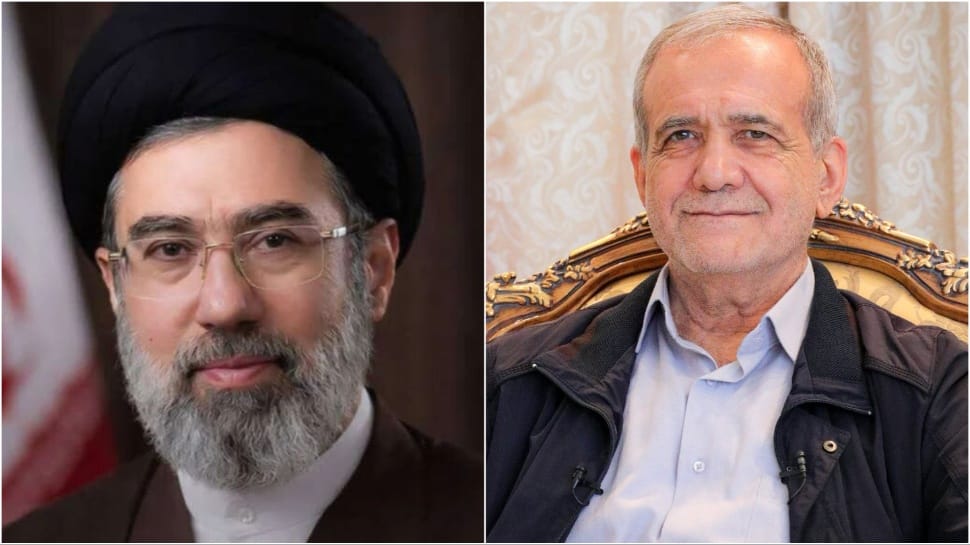
The political structure of Iran has shifted enormously as the Islamic Revolutionary Guard Corps (IRGC) has taken over the Iranian state, according to recent reports from Iran International. According to multiple reports from the IRGC, President Masoud Pezeshkian has been marginalised by the paramilitary force and is now in a total political dead end as the IRGC continues their power struggle over the void left by the diminished clerical leadership of the country.
While US President Donald Trump has publicly suggested that there are negotiations occurring with “moderate” Iranian officials, the internal situation in Iran suggested that it is controlled by hardline factions and that the IRGC now controls military and domestic policies in Iran.
How much power does Mojtaba Khamenei have?
An instantaneous leadership crisis is evident as no supreme leader is visibly apparent to the regime, but only the leaders of the brigades and divisions continue to execute the current offensive against Iran’s enemies. Following the death of Ayatollah Ali Khamenei and most of the Iranian leadership in the initial attacks, the Ayatollah’s 2nd son, Mojtaba, has no doubt, taken the Ayatollah’s position and succeeded him. However, there seem to be no public accounts of any kind coming from this individual since he has assumed his title.
There are many questions surrounding Mojtaba Khamenei’s condition: Is he in a coma?
The Secretary of Defense in the United States recently made a statement suggesting that he was in a coma. Is Mojtaba Khamenei in disfigurement? But a report from President Trump seems to support this suggestion.
Mojtaba’s security cordon: Senior IRGC officers enforce security around Mojtaba
Reports indicated that a “military council,” led by senior IRGC officers, has placed a restrictive security cordon around Mojtaba, effectively blocking the incoming flow of information from any government officials to him.
The military council takes control
With the supreme leader incapacitated/isolated, the IRGC has extended its control from its origins as a paramilitary force to fulfilling key governmental functions that were formally under the control of the Supreme Leader. According to reports, President Pezeshkian’s attempts to meet with Mojtaba have all been denied by the Guard.
Military veto of civilian political appointments
The IRGC has begun to veto civilian political appointments as well.
An intelligence standoff: Pezeshkian’s attempt to appoint Hossein Dehghan as Minister of Intelligence was blocked by IRGC Chief Commander Ahmad Vahidi.
Direct control of leadership appointments: Vahidi allegedly contended that all sensitive leadership positions should be appointed and managed directly by the IRGC, breaking with the past tradition of allowing the supreme leader’s endorsement of nominees submitted by the president.
US involvement in regional escalation
The military council is substantially divided from President Pezeshkian regarding the conduct of the IRGC’s War. Reports indicate that President Pezeshkian has warned the IRGC that its actions in targeting neighbouring Gulf countries and continuing to blockade the Strait of Hormuz are leading Iran’s economy to absolute collapse.
With ammunition stocks nearly depleted and the national economy in freefall, the IRGC appears unlikely to significantly enhance its direct military assistance to Iran’s regional/forward forces anytime soon.


