
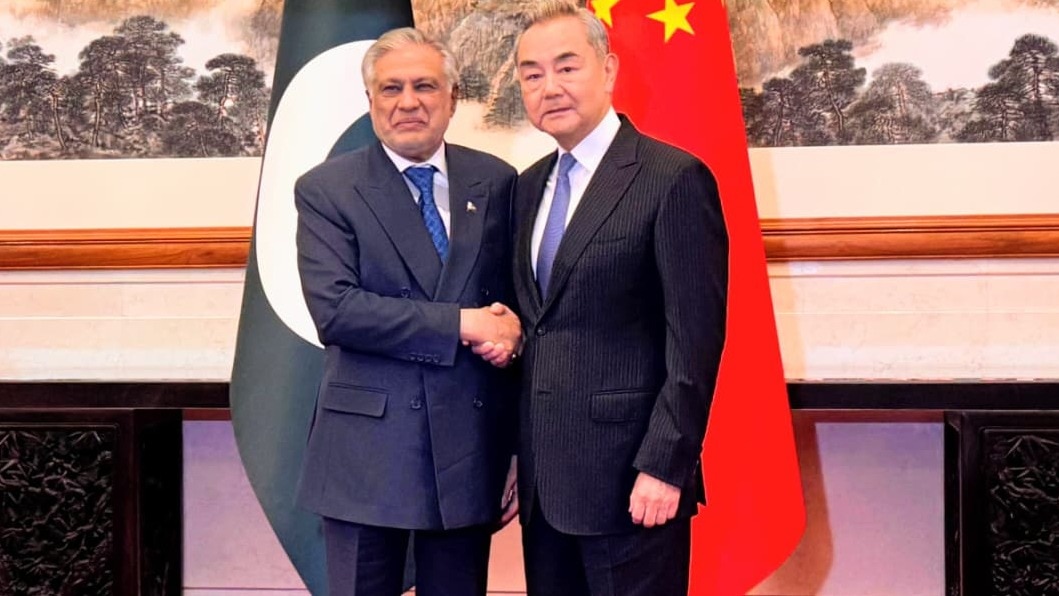
China and Pakistan have jointly proposed a five-point plan to calm the tensions in the wider Middle East, urging an immediate ceasefire and quick diplomatic talks as the US-Israel conflict with Iran continues to escalate. The proposal was drawn up after high-level discussions in Beijing between Chinese Foreign Minister Wang Yi and Pakistan’s Deputy Prime Minister and Foreign Minister Ishaq Dar.
The joint proposal outlines five key steps: an immediate cessation of hostilities, the early start of peace talks, protection of civilians and non-military infrastructure, securing shipping lanes in the Strait of Hormuz, and building an overall peace framework under the United Nations Charter.
In a statement, Pakistan’s Foreign Ministry said, “Sovereignty, territorial integrity, national independence and security of Iran and the Gulf states should be safeguarded. Dialogue and diplomacy are the only viable option to resolve conflicts.”
“China and Pakistan support the relevant parties in initiating talks, with all parties committing to a peaceful resolution of disputes, and refraining from the use or the threat of use of force during peace talks,” it added.

The proposal also calls for strict adherence to international humanitarian law, urging all sides to halt attacks on civilians and critical infrastructure, including energy and nuclear facilities.
CHINA BACKS PAK’S ROLE, BUT IRAN PUSHES BACK
China signalled that it would deepen coordination with Pakistan on the Iran situation. Beijing has openly supported Islamabad’s role in facilitating dialogue.
However, Iran has firmly rejected claims that Pakistan is acting as a mediator in any direct talks with the United States, undercutting Islamabad’s positioning. In a sharp response, Iran’s Consulate General in Mumbai said, “No direct US talks; only excessive, unreasonable demands via intermediaries. US ‘diplomacy’ flips constantly; our stance is clear. Pakistan’s forums are their own; we didn’t participate.”
The statement also added, “Regional calls to end the war are welcome, but remember who started it!” — a pointed remark that shifts the blame narrative back onto US and Israel.
Pakistan’s claim of a mediation role had gained momentum after US Special envoy to the Middle East Steve Witkoff confirmed that a 15-point action list that forms the framework for a peace deal given to Iran has been circulated through Pakistan.
In quadrilateral meetings of foreign ministers of Saudi Arabia, Turkey and Egypt expressed full support for Pakistan’s initiative to host peace talks between the United States and Iran in Islamabad.
With inputs from agencies


