
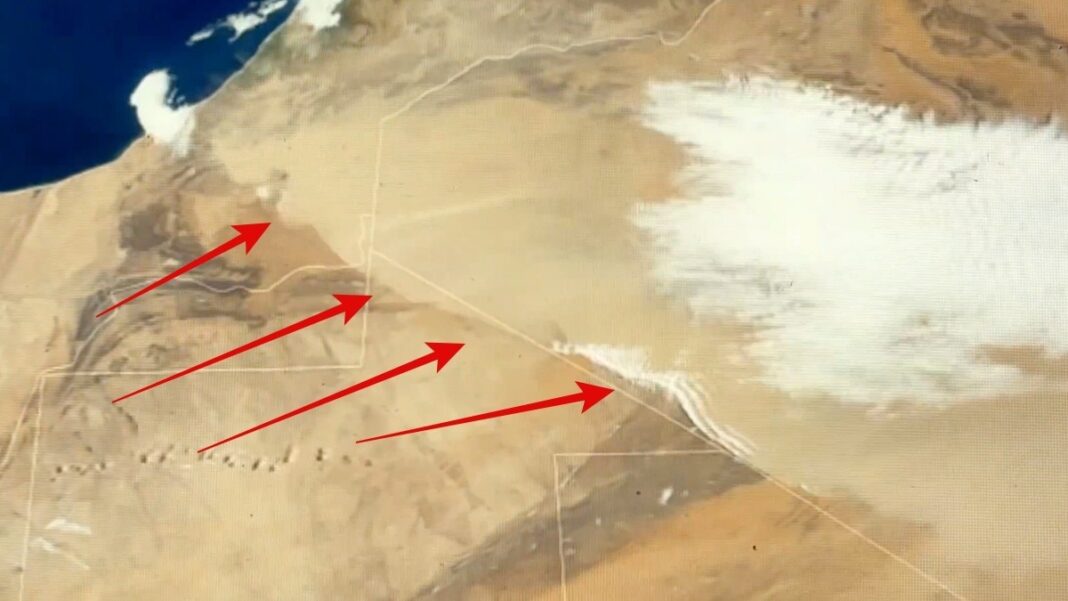
A massive wall of dust stretching nearly 2,000 kilometres has been captured sweeping across the Sahara Desert, as a powerful low-pressure system over Algeria triggered a massive sandstorm visible from space.
Satellite imagery shows a dense, roiling mass of dust spanning roughly 1,200 miles (about 2,000 km), advancing dramatically across the desert landscape.
The storm, driven by strong winds linked to the low-pressure system, is moving southwest at an estimated speed of 48 kilometers per hour, churning up vast quantities of sand and dust into the atmosphere.
The visuals reveal what appears to be a continuous, towering curtain of dust, which is a potentially hazardous phenomenon. Such large-scale dust storms, often referred to as “haboobs,” are not uncommon in the Sahara, the world’s largest hot desert, but events of this scale and intensity remain striking even to seasoned meteorologists.
Experts say the storm was formed as the pressure difference over Algeria intensified wind speeds across the region, lifting loose sand and fine particles high into the air.
Once airborne, these particles can travel hundreds or even thousands of kilometres, sometimes crossing continents and affecting air quality far beyond their origin.
Dust storms of this magnitude can have widespread impacts. In affected areas, visibility can drop sharply, disrupting transportation and posing risks to aviation. Fine dust particles can also aggravate respiratory conditions and reduce air quality, especially for vulnerable populations.
Beyond immediate hazards, Saharan dust plays a complex role in the global climate system. While it can suppress storm formation in some regions, it also carries essential nutrients like iron and phosphorus across the Atlantic, fertilising ecosystems such as the Amazon rainforest.
The latest event highlights the dynamic and powerful nature of desert weather systems. As satellite technology continues to improve, scientists are gaining unprecedented insights into these massive atmospheric events, helping better predict their movement and potential impact.
Authorities in the region are monitoring the situation, as the colossal dust plume continues its southwestward march across the Sahara.


