
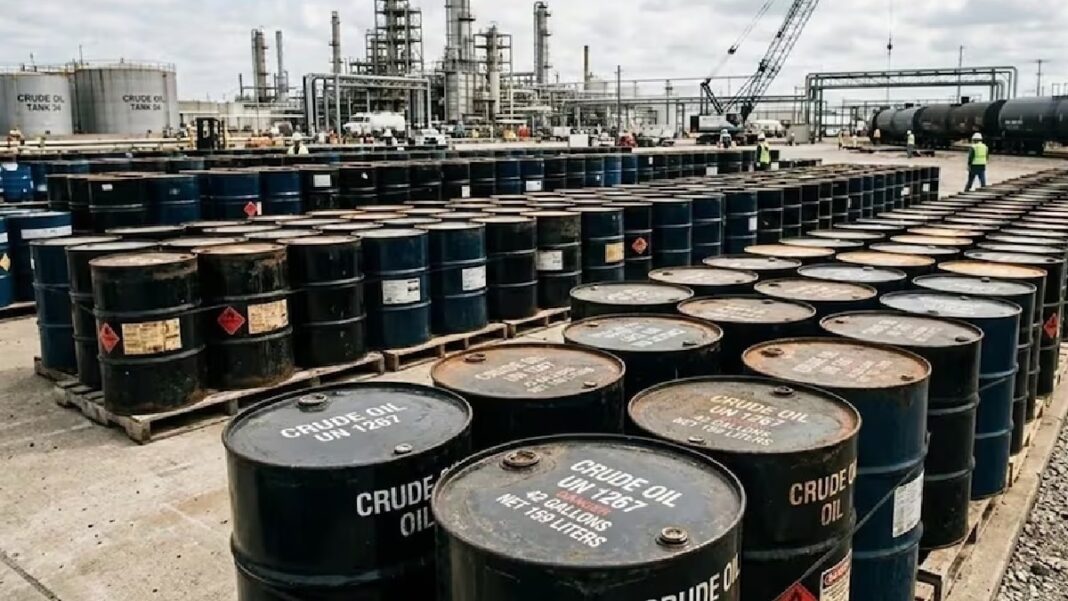
Crude oil prices are holding above $115 per barrel, and what is unsettling markets is not just how high prices are, but why they are not coming down.
Just days ago, there were expectations that oil could cool off after signals of a possible ceasefire in West Asia. Prices briefly dipped below $100, raising hopes that the worst might be over.
That expectation has now clearly been proven wrong.
Instead of easing, prices have climbed back and are now inching closer to $120.
The reason is simple. The risk that pushed oil higher in the first place has not gone away. In fact, it is getting worse.
CRUDE OIL PRICES MAY RISE FURTHER
The conflict in West Asia has entered its fifth week and is showing signs of escalation rather than resolution. New players have joined the conflict, and military activity has intensified. This has shifted market thinking from short-term disruption to a more prolonged risk.
At the centre of these concerns is the Strait of Hormuz, one of the most critical oil transit routes in the world. Nearly one-fifth of global oil supply passes through this narrow stretch. Any disruption here has an immediate impact on global supply.
Even without a full disruption, shipping delays, rerouting and rising insurance costs are already affecting the flow of oil. Markets are reacting not just to what has happened, but to what could happen next.
That is why prices are not falling.
Oil markets operate on tight margins. There is limited spare supply available globally. When even a small portion of supply is seen to be at risk, prices tend to rise sharply.
Right now, traders are not pricing in stability. They are pricing in uncertainty.
SUPPLY-SIDE RISKS
Another key point is that the recent rally is not driven by demand. There has been no sudden surge in global consumption. Instead, prices are being pushed up purely by supply-side fears and geopolitical risk.
This makes the situation more unpredictable. When prices are driven by demand, they tend to stabilise over time. When they are driven by fear, they remain volatile.
There have also been attempts to calm markets. Strategic reserves have been tapped and diplomatic efforts have been made. But none of this has led to a sustained fall in prices.
That tells you something important. The market does not yet believe that the situation is under control.
The impact of this is already visible across financial markets. Equity markets have turned volatile, currencies are under pressure, and inflation concerns are back in focus.
WHAT IT MEANS FOR INDIA
For India, the implications are more direct. The country imports around 85-90% of its crude oil. Higher prices increase the import bill, put pressure on the rupee and push up fuel and transport costs.
This eventually feeds into inflation and affects both businesses and consumers.
In simple terms, when oil stays high, everything becomes more expensive.
The big question now is what happens next.
If tensions escalate further or begin to disrupt actual supply, oil could move beyond $120 per barrel. In more extreme scenarios, the spike could be sharper.
If there is a clear de-escalation, prices may cool. But even then, a sharp fall looks unlikely in the near term because the risk premium has already built up.
That is what makes this moment different.
This is not just a case of oil rising. It is a case of oil refusing to fall despite expectations. And that shift in behaviour is what is keeping markets on edge.
As long as uncertainty in West Asia continues, crude oil prices are likely to remain elevated, and that means the pressure on markets and the economy is not going away anytime soon.


