Water is the most ordinary thing in the world and yet, for over a hundred years, scientists have struggled to explain why it behaves so oddly.
Now, researchers at Stockholm University have cracked one of science’s most enduring puzzles, discovering a hidden “critical point” deep inside supercooled water.
The findings, published in the journal Science, could change how we understand life itself.
WHY IS WATER DIFFERENT THAN OTHERS?
Most liquids shrink as they cool and grow denser. Water does the opposite.
It is densest at 4 degrees Celsius and actually expands as it approaches freezing. That is the reason we often notice that ice floats instead of sinking to the bottom.

Compressibility and heat capacity go haywire at low temperatures.
These quirks have baffled physicists for generations.
One long-standing theory held that a mysterious “critical point” hidden deep in supercooled water was the culprit, but no one had ever proved it existed.
That was, until now.
WHAT IS WATER’S CRITICAL POINT?
Water’s critical point is the specific combination of a temperature of 374 degrees Celsius and pressure of 218 times normal atmospheric pressure. Beyond this point, liquid water and steam can no longer be told apart as they merge into a single, unified state.
Past this point, no amount of pressure can force water to become liquid, and no amount of heat can distinctly turn it to gas.
HOW DID SCIENTISTS STUDY WATER?
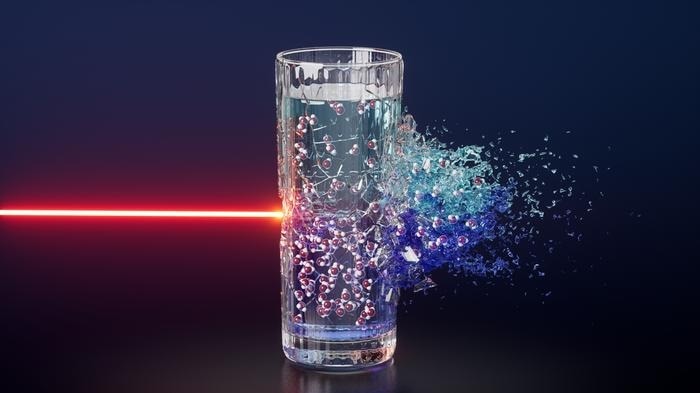
Using powerful X-ray lasers at a facility in South Korea, a team of scientists super-chilled pure water to around -63 degrees Celsius at roughly 1,000 times atmospheric pressure, without letting it freeze.
The X-ray pulses fired so fast they captured the water’s structure in a fraction of a second before ice could form.
What they found confirmed the theory that water can exist as two distinct liquid forms, and the critical point is where those two forms blur into one, causing fluctuations that ripple all the way up to room temperature, and therefore, causing every strange property water is known for.
“What was special was that we were able to X-ray unimaginably fast before the ice froze and could observe how the liquid-liquid transition vanishes and a new critical state emerges,” said Anders Nilsson, professor of chemical physics at Stockholm University. “For decades there has been speculations and different theories to explain these remarkable properties and one theory has been the existence of a critical point. Now we have found that such a point exists.”

WHAT DO THE FINDINGS MEAN?
One of the most thought-provoking observations came from associate professor Fivos Perakis.
“I find it very exciting that water is the only supercritical liquid at ambient conditions where life exists, and we also know there is no life without water. Is this a pure coincidence or is there some essential knowledge for us to gain in the future?” he said.
The team also noted a strange slowdown in molecular motion near the critical point.
“It looks almost that you cannot escape the critical point if you enter it, almost like a Black Hole,” said researcher Robin Tyburski.
Scientists say the next step is to explore how this discovery reshapes our understanding of water’s role in biology, climate, geology, and chemistry.