
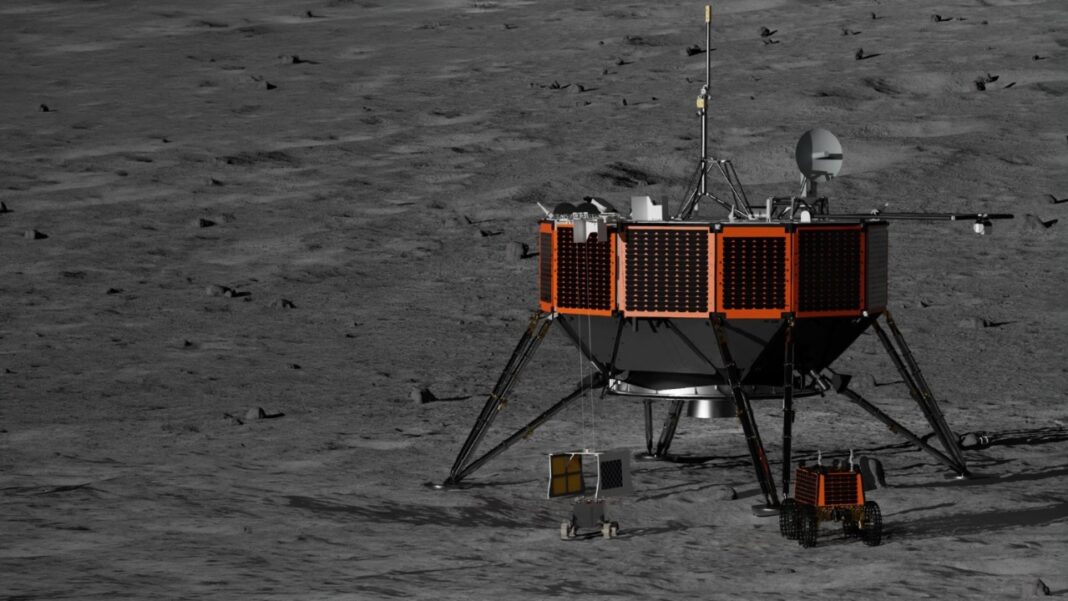
Nasa has awarded a $180.4 million contract to Houston-based Intuitive Machines to deliver science and technology payloads to the Moon as part of its Artemis programme.
The mission, targeted for 2030, will land seven payloads, including five from Nasa itself. The landing will be near the lunar South Pole, helping scientists better understand the Moon’s surface, radiation environment, and chemical makeup ahead of future human missions.
“Nasa continues to progress lunar science and exploration by enabling commercial lunar landings,” said Joel Kearns, deputy associate administrator for exploration at Nasa Headquarters in Washington. “These science and technology investigations aim to support long-term sustainability and contribute to a deeper understanding of the lunar surface, test technologies, and prepare for future human missions at the South Pole.”
This is Intuitive Machines’ fifth contract under Nasa’s Commercial Lunar Payload Services (CLPS) initiative, having already delivered payloads to the Moon on two previous missions.
WHAT ALL IS NASA SENDING TO MOON?
The set of tools, including seven instruments and rovers, weighs a combined 75 kilograms.
These are the innovative tools expected to help humanity understand our lunar surface better:
- Stereo Cameras for Lunar Plume Surface Studies (SCALPSS) will photograph and study the effect of a lander’s engine exhaust on the Moon’s surface soil during landing. This is critical information as heavier spacecraft are sent to the Moon.
- Near-Infrared Volatiles Spectrometer System (NIRVSS) will scan the lunar soil for minerals and potential ice deposits, helping scientists understand where water ice could exist on the Moon.
- Mass Spectrometer for Observing Lunar Operations (MSolo) will analyse gases released after the lander touches down, measuring lightweight chemical compounds that could serve as future lunar resources.
- Lunar Vehicle Radiation Dosimeter system (LVRaD), a set of four radiation detectors, will measure how much radiation the lunar surface receives, and could prove vital for protecting future astronauts.
- Multifunctional Nanosensor Platform (MNP) will track chemical changes across the landing site over time, testing rover mobility and autonomous operation in the process.
- Laser Retroreflector Array (LRA), a compact passive device made of eight quartz prisms, will reflect laser beams from orbiting spacecraft, helping build a permanent network of location markers on the Moon.
- Sanctuary on the Moon, a time capsule of 24 sapphire discs developed in France, carries a curated archive of human civilisation, from science and art to the human genome preserved across 100 billion micropixels of data.
“As NASA prepares to send humans and more robotic missions to the Moon, regular CLPS deliveries will provide a better understanding of the exploration environment,” said Adam Schlesinger, manager of the CLPS initiative at Nasa’s Johnson Space Center in Houston, “accelerating progress toward establishing a long-term human presence on the Moon, setting the stage for eventual human missions to Mars.”


