India’s private space sector took a giant leap forward on Monday, March 30, as the country’s largest 3D printer reached Astrobase Space Technologies.
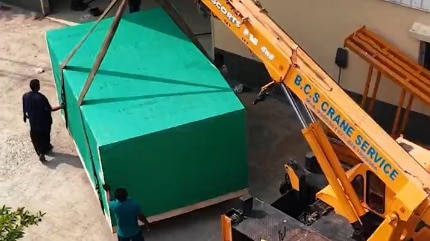
The massive machine, transported on four heavy trucks, was unloaded at the company’s facility in the city, marking the first step in scaling up home-grown rocket engine production without depending on foreign technology.
Astrobase’s co-founder Neeraj Khandelwal took to social media to share his thoughts on the development: “Building India’s first FFSC rocket engine means building the factory that can build the engine. No shortcuts.”
Astrobase Space, a young Bengaluru-based startup, shared the exciting news on social media along with images of workers carefully moving the huge printer parts into the workshop with cranes.
“4 trucks. 1 printer. The largest 3D printer in India, arriving at Astrobase,” the company wrote.
One single printer can now make multiple 80-ton thrust engines every year.
For a startup aiming to build rockets, this is a game-changing moment.
WHAT WILL THE GIANT PRINTER DO?
The new 3D printer will print complex parts for powerful rocket engines right inside Astrobase’s factory.
These are Full-Flow Staged Combustion (FFSC) engines that run on liquid oxygen and liquefied natural gas.
In an FFSC engine, both the fuel and oxidiser are partially burned in separate smaller pre-burners first, and the hot gas produced drives the turbo pumps. All that exhaust gas then feeds into the main combustion chamber for a second, and is burnt again, so nothing is wasted, making it extremely efficient and powerful.
Each engine can deliver 80 tonnes of thrust, which is enough to lift heavy satellites into orbit.
Astrobase plans to produce up to 50 such engines every year. The printer will help make core components faster, cheaper and with better quality.
Instead of waiting for imported parts, the team can now design, print, test and assemble everything under one roof. This will speed up development of India’s first reusable medium-lift rocket.

Founded in 2024 by Khandelwal and former Isro scientist Devakumar Thammisetty, Astrobase is building a fully Indian rocket system. The company has already tested turbo pumps and received clearance for India’s first private high-thrust engine test facility in Andhra Pradesh.
The company’s goal is to carry out the first orbital mission by 2028 or 2029.
This printer is more than just a machine. It is a symbol of India’s growing self-reliance in space. With it, Astrobase can now move quicker from drawings to real hardware, bringing down costs and opening doors for more satellite launches.