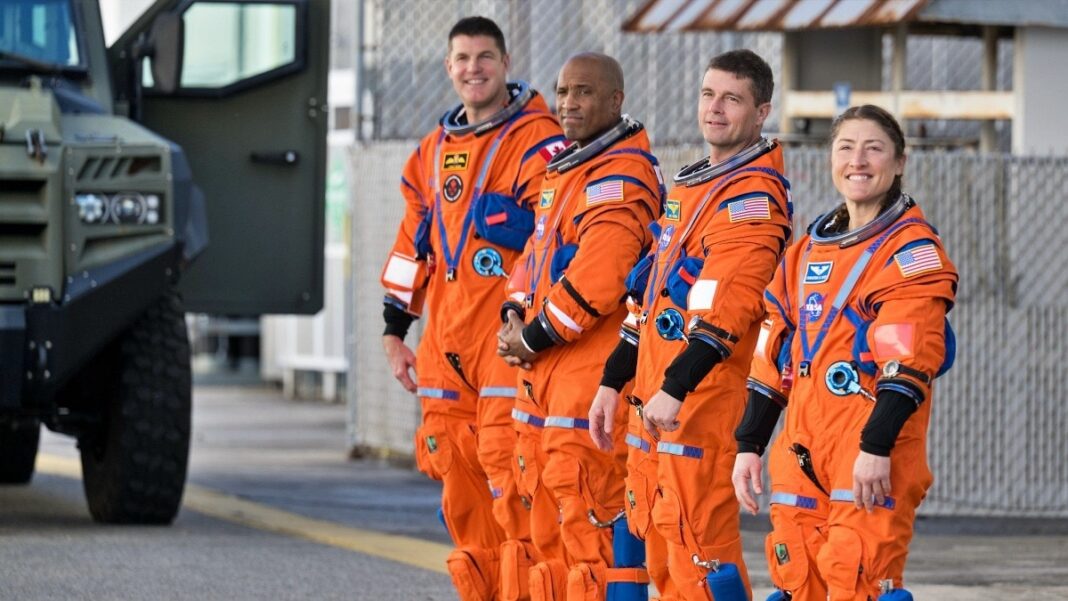
The Artemis II mission is not just a test flight; it is a homecoming. For the first time since the final Apollo mission in 1972, humanity is returning to the vicinity of the Moon.
This 10-day mission will carry four astronauts farther into the deep space vacuum than any human has ever travelled.
While they will not step onto the lunar dust just yet, their journey is the ultimate dress rehearsal for landing the first woman and person of colour on the lunar surface.
HOW WILL THE ARTEMIS II CREW LAUNCH INTO SPACE?
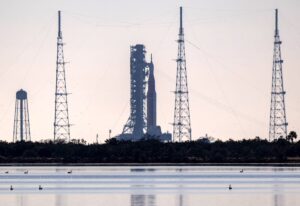
The journey begins at the Kennedy Space Center in Florida.
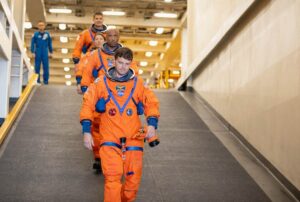
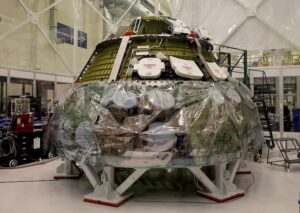
The crew will board the Orion spacecraft, which sits atop the Space Launch System, the most powerful rocket ever built by Nasa.
This massive vehicle provides the 3.9 million kilograms of thrust needed to escape Earth’s gravity.
Once the rocket clears the atmosphere, the initial phase involves a high-Earth orbit.

For the first 24 hours, the crew will stay relatively close to home to ensure every system is working perfectly.
They will perform a proximity operations demonstration, which is a high-tech game of follow-the-leader with the spent upper stage of their rocket.
This manual piloting test ensures that the astronauts can take control if automated systems fail during future lunar dockings.
WHAT ACTIVITIES WILL THE ASTRONAUTS PERFORM IN SPACE?
Beyond flying the ship, the crew will be incredibly busy with scientific and medical duties.
Since Artemis II travels outside the protection of Earth’s magnetic field, the astronauts will serve as research subjects to study how deep space radiation affects the human body.
They will use wearable devices to track their sleep patterns and stress levels, and even perform CPR demonstrations to prepare for medical emergencies in microgravity.

A major highlight is the testing of a new laser communication system. Unlike traditional radio waves, this uses light to beam massive amounts of data back to Earth, allowing for high-definition videos of their journey.
The crew will also spend time reviewing geographical targets on the Moon, preparing their cameras to capture high-resolution imagery of the lunar surface during their closest approach.
WHAT IS THE TRANS LUNAR INJECTION MANOEUVRE?
Once the flight controllers give the go-ahead, the crew performs the translunar injection.
This is a precise engine fire that pushes the spacecraft out of Earth’s orbit and onto a path toward the Moon.
This four-day trek across the cosmic void is where real science happens. The crew will live inside a cabin about the size of a large van. They will monitor radiation levels, as they will be outside the protective bubble of Earth’s magnetic field.

HOW DOES ORION FLY AROUND THE MOON?
Artemis II uses a free return trajectory.
This means the spacecraft will use the Moon’s own gravity as a cosmic slingshot to pull it around the lunar far side and point it back toward Earth.
At their furthest point, the crew will be 10,300 kilometres beyond the Moon.
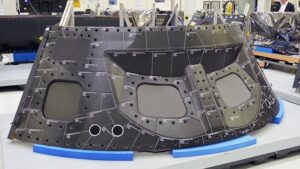
The view from the windows will be legendary. They will witness an Earthrise, where our blue planet appears to climb over the rugged, cratered lunar horizon. After rounding the Moon, the three-day return journey begins.

HOW DO ASTRONAUTS RETURN SAFELY TO EARTH?
Reentry is the most dangerous part of the mission. The Orion capsule will hit the Earth’s atmosphere at 40,000 kilometres per hour.
The heat shield must endure 2,760 degrees Celsius, which is about half the temperature of the Sun’s surface.
Finally, a series of parachutes will slow the craft for a splashdown in the Pacific Ocean, marking the end of a historic 10-day odyssey.