
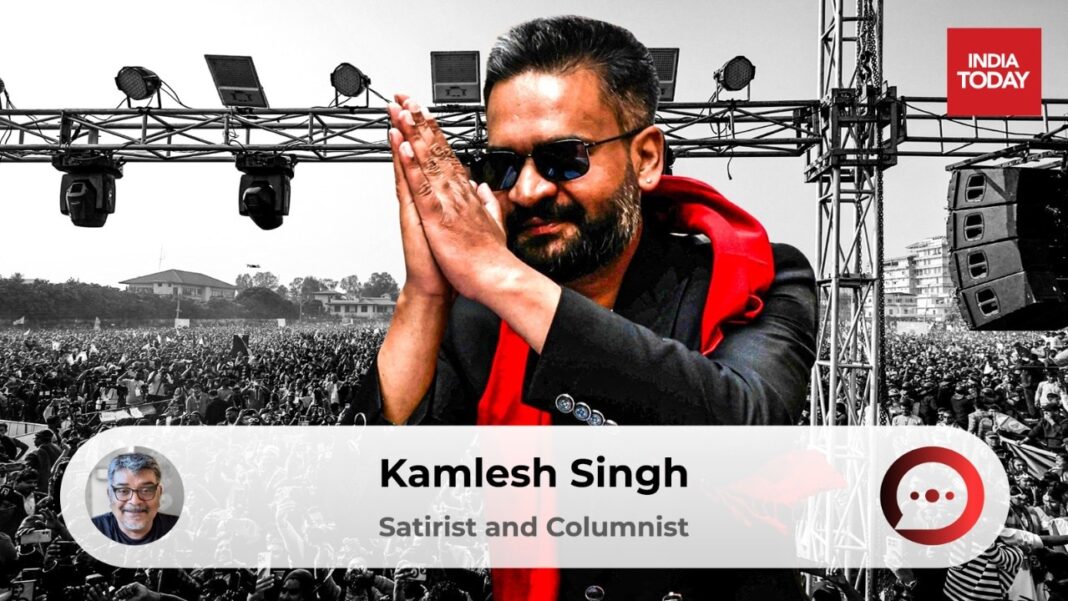
Nepal has a new Prime Minister. He is 35. He raps. He has a master’s degree in structural engineering from a college in Karnataka. He defeated a four-time Prime Minister in that man’s own constituency by nearly 50,000 votes. The kids went wild.
Fair enough.
Balendra Shah, known simply as Balen, rose to national prominence during the 2025 Gen Z protests that shook Nepal’s political establishment to its old, creaking bones. The unorthodox mayor of Kathmandu was popular as Bulldozer Balen for freeing the capital of encroachments and red tape. He was the face on the placards. The voice in the songs. Here was an engineer who understood that a country’s load-bearing walls were not concrete but credibility, and that Nepal’s political system had been crumbling for decades under the dead weight of the same families, the same parties, the same musical chairs played to the same tune. He sang about corruption. He rapped about inequality. His most famous track Balidan, or Sacrifice, critiqued political corruption and connected with younger audiences, becoming widely known online and contributing to his public profile ahead of his political career. This correspondent penned a rap song to honour the rap artiste’s revolution felling the government. Also, predicted he would be the next. Balen is the change Nepal wishes for.
The youth listened. They marched. They voted.
In the March 5 general election, the Rastriya Swatantra Party (RSP) led by former TV anchor Rabi Lamichhane emerged as the dominant force, leading in over 90 constituencies out of 165 directly elected seats. Lamichhane was not the face of this Nayak. He wasn’t Anil Kapoor to KP Sharma Oli’s Amrish Puri. It was Balen. He was the Nayak. In Jhapa-5, Balen defeated former Prime Minister KP Sharma Oli by a humiliating margin. On March 27, Shah was sworn in as Nepal’s Prime Minister, the RSP barely four years old and his only prior political experience a stint as mayor of Kathmandu. The RSP is similar to AAP in India, okay, at least in Delhi.
For Nepal, this was a morning like the morning Sagarika Ghose had posted about Delhi after AAP’s victory. For Nepal, this was the song joined by a chorus of youth, reaching the crescendo.
Then came the first cabinet meeting. Then came the 100-point agenda. And somewhere in that ambitious, reformist, future-forward document sat a decision so spectacularly ironic that you had to read it twice. Then a third time. Then you had to put the paper down and stare at the ceiling for a while.
The Balen Shah government banned political student unions from campuses and prohibited political affiliations among civil servants and teachers. The man who rode a student uprising to the highest office in the land had, in his very first act of governance, told students to stay out of politics.
Read that again.
The rebel had banned rebellion. The protest singer had silenced the protest. The Gen Z icon had looked at Gen Z and said, essentially: now go study. The DJ had pulled the plug.
There is something almost Shakespearean about this. Not quite tragedy, not quite comedy. That uncomfortable third genre. The one where you laugh but the laugh catches in your throat.
Within 90 days, political student groups are to be replaced with student councils. Non-partisan bodies with names like Voice of Students, which is, if you think about it, a deeply political name for an organisation that has been specifically created to not do politics. The voice of students, one supposes, will be permitted to speak about everything except the things that require speaking about.
His supporters, to be fair, have a point. Nepal’s campuses have long been paralysed by affiliated student unions who spent more time organising bandhs than attending lectures. Exam results delayed by months. Academic calendars held hostage to party agendas. The government’s argument is that the move is intended to eliminate political interference and give students a genuine voice. One understands the frustration. One even sympathises with the diagnosis.
But the prescription is the problem.
You cannot cure a fever by removing the thermometer. Student politics in our beloved Jambudweep or Subcontinent has, yes, been captured and corrupted by party machines. It has also produced Prime Ministers, freedom fighters, trade union leaders, and the occasional conscience of a nation. The solution to bad politics is better politics. The solution to co-opted youth movements is not, historically, to ban youth movements. It is to make them harder to co-opt.
Balen Shah knows this. He lived this. He was this.
Shah and the RSP have a historic opportunity to build on the popular 2025 revolt and deliver on the aspirations of young Nepalis, but with that opportunity come risks. Chief among those risks, it turns out, may be the temptation that seizes every revolutionary upon taking power: the belief that the tools of disruption must now be put away, because the right people are finally in charge. This is the oldest story in politics. The outsider gets in. The outsider becomes the insider. The ladder gets pulled up. Not with malice, necessarily. Sometimes with the very best of intentions, which, as every student of history knows, is precisely when you should worry most. I am not going to name the names popping up in your mind right now because what’s the point when you already picture them. The dalliance, or rather, alliance between Balen and RSP founder Rabi Lamichhane is a “marriage of convenience”, as an analyst put it, where Balen needed a party and Rabi needed Balen’s charisma. Marriages of convenience, like most marriages, have a way of defining you in ways you did not anticipate.
Nepal deserves better than what these revolutions have delivered in the neighbourhood and outside. Bangladesh went back to a tried-and-tested family from a tried-and-tested family after a brief revolutionary break. Pakistan reverted to the hybrid mode after the revolutionary went cuckoo in his pursuit of autonomy from the military. Delhi went back to BJP.
Nepal deserves the full promise of its revolution. Balen Shah is young, he is sharp, and he has a mandate that older politicians would sell their grandchildren to possess. The 100-point agenda has much in it that is genuinely bold.
But governing is not engineering. You cannot ban load-bearing structures and expect the building to stand. The young people who brought Balen Shah to power did not march so that one day, a smarter, hipper version of the establishment could tell them to sit down and be quiet. They marched so that no one ever could.


