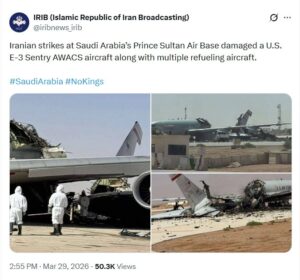
Iran on Friday claimed it had carried out a missile and drone strike on a US-operated air base in Saudi Arabia, alleging damage to key military assets, including a high-value airborne warning and control system aircraft.
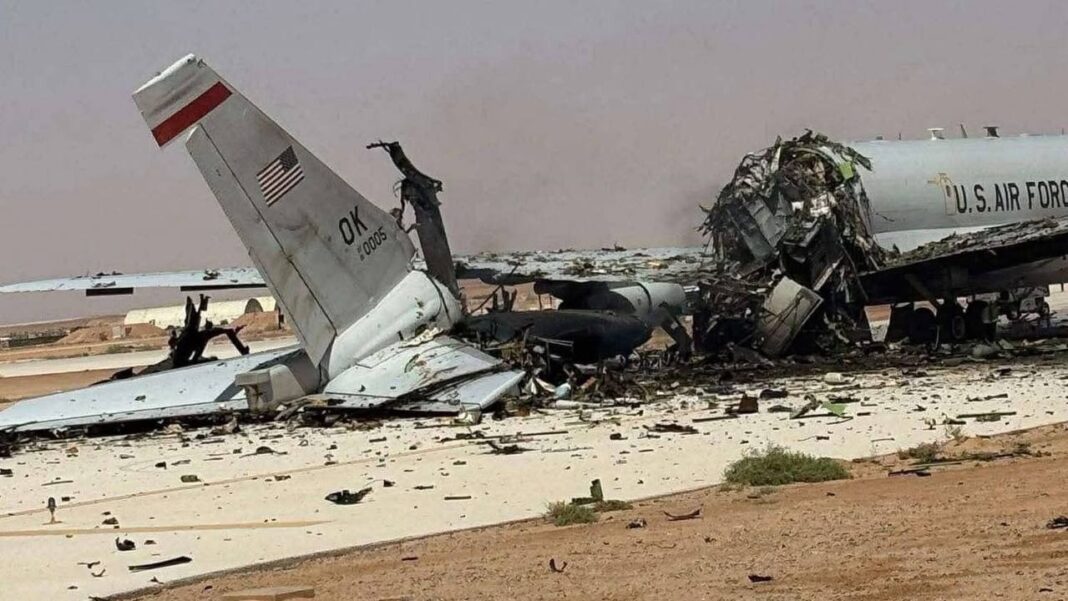
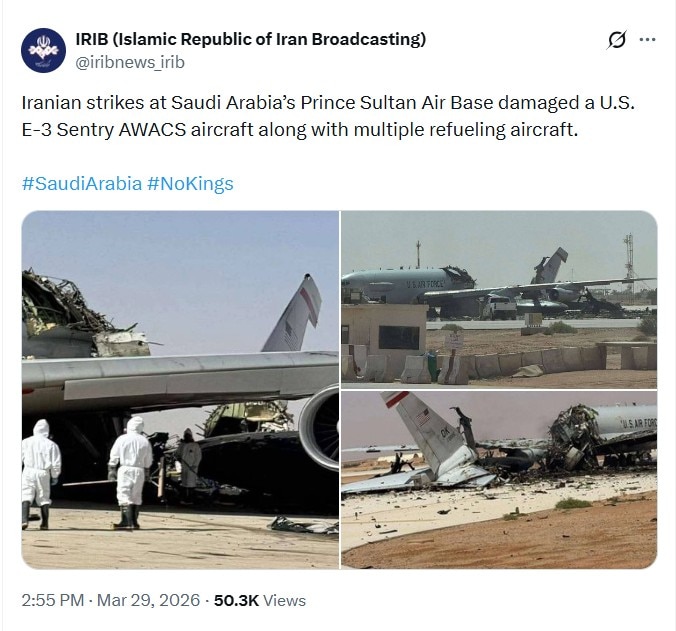
According to Iran’s Press TV, the attack targeted Prince Sultan Air Base, where US forces are stationed. The report said a Boeing E-3 Sentry — an airborne early-warning platform used to track aircraft and missiles and coordinate battlefield operations — was among those hit, along with multiple refuelling planes.
Images released by Press TV purportedly showed visible damage to the aircraft, with reports claiming only parts of the fuselage remained intact. The E-3 Sentry is part of a limited US fleet with no easy replacement and is estimated to cost over USD 700 million, the Wall Street Journal reported.
According to officials cited by the Associated Press, Iran fired six ballistic missiles and 29 drones at the base. At least 15 US personnel were injured in the strike, including five seriously, with two in critical condition.
The Prince Sultan Air Base, located about 96 km from Riyadh and operated by the Royal Saudi Air Force but also used by US troops, has been targeted multiple times since the conflict began nearly a month ago. Earlier in the week, another attack injured 14 US personnel.
However, the United States Central Command has not issued an official statement confirming the extent of the damage or casualties.
US BUILDS UP FORCES
Amid the escalation, the US has moved additional forces into the region. The USS Tripoli, carrying about 2,500 Marines, has arrived in the Middle East after being redeployed from exercises near Taiwan.
The USS Boxer and two other ships, along with another Marine Expeditionary Unit, have also been ordered to the region, bringing additional aircraft and amphibious capabilities.
US Secretary of State Marco Rubio said Washington could meet its objectives without deploying ground troops but added that President Donald Trump must remain prepared for “multiple contingencies.”
The conflict, now in its fifth week, has disrupted global air travel and oil exports, particularly around the Strait of Hormuz, pushing up fuel prices and raising economic concerns worldwide.
President Donald Trump has set an April 6 deadline for Tehran to reopen the key shipping route, saying talks to end the conflict were “going very well”, even as Iran has denied engaging in negotiations.
With agency inputs