
Ladakhi activist Sonam Wangchuk’s recent release from detention may close an immediate confrontation but leaves a larger democratic question unresolved. Wangchuk’s fast had sought constitutional protections for Ladakh’s fragile ecology and political safeguards such as inclusion under the Sixth Schedule after the region’s conversion into a Union Territory. The government’s defence of this rested on the familiar language of national security that Ladakh is a sensitive borderland whose politics cannot be separate from the strategic pressures posed by China and Pakistan.
On paper, such caution appears logical. However, the episode reveals a deeper tension within the grammar of Indian democracy. Governments often engage dissent only after it escalates into confrontation rather than while it can still inform governance.
Political theorists have long argued that dissent is not an aberration within democracy but one of its organising principles. Democratic systems derive resilience from their capacity to absorb disagreement before it hardens into rupture. Protests are an early-warning mechanism through which societies register policy failures and moral anxieties.
Across decades and governments, dissent has often been ignored until it becomes politically costly or tolerated only within carefully defined boundaries set by those in power. The forms, however, have evolved across different phases.
In the early decades post Independence, dissent was acknowledged but carefully contained. Jawaharlal Nehru, as Prime Minister, shepherded the First Amendment in 1951. Criticism was welcomed in arenas the State could domesticate — Parliament, universities, intellectual circles. But when dissent spilled into streets, it was often treated as destabilisation.
By the late 1960s and 1970s, this paternalism hardened into suspicion. Indira Gandhi’s political style increasingly interpreted dissent as potential conspiracy. The railway strike of 1974, one of the largest industrial actions in the world, was treated less as a labour dispute than as a challenge to State authority. During the Emergency, the distinction between dissent and disloyalty collapsed altogether as opposition was criminalised.
Implementation of the Mandal Commission by VP Singh in 1990 faced backlash from upper-caste students including tragic acts of self-immolation. It was handled primarily as a matter of policing than a chance for a sustained national conversation on caste, merit and opportunity. During Manmohan Singh’s tenure, land acquisition conflicts in Singur and Nandigram ended in violence. Villagers opposing the Kudankulam nuclear plant were dismissed as impediments to development.
The pattern is more pronounced in India’s frontier regions where dissent is filtered through the State’s anxieties about sovereignty. Here, protest is rarely treated as democratic negotiation and quickly reframed as a question of national security. The bombing of Aizawl in 1966 during the suppression of the Mizo insurgency reveals how swiftly dialogue could give way to force when unrest emerges in borderlands. In Manipur, Irom Sharmila’s 16-year hunger strike against AFSPA was met with repeated arrests and force-feeding than political engagement. The same reflex has echoed across Kashmir, the Northeast and now Ladakh. Geography reshapes the State’s perception of dissent.
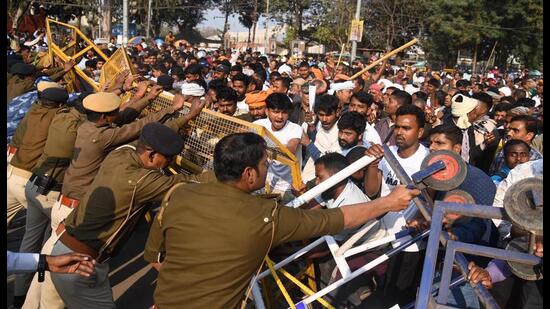
The treatment of dissent in the past decade reflects both continuity and intensification of these tendencies. The Narendra Modi government has increasingly relied on legal and administrative instruments — from sedition provisions to anti-terror legislation — to frame protest as a matter of security than democratic negotiation. Nationwide protests against a constitutionally sound CAA were often treated through a law-and-order lens. Farmers protesting agricultural reforms were initially dismissed. Later, the government entered into negotiations and repealed the laws. Engagement has come only after sustained mobilisation made confrontation unavoidable.
Supporters of such measures often argue that a more assertive State is necessary in an era of geopolitical rivalry and internal fragmentation. But the deeper question — whether dissent is approached as an interlocutor in governance or as an irritant to be managed — remains unchanged. It would be equally mistaken to romanticise protest movements. Activists and campaigners, like all political actors, pursue alignments and calculations. However, the measure of a confident democracy lies precisely in its ability to engage dissent without immediately recasting it as threat.
Protests are democracy’s untidy but essential language — signalling anxieties when institutions fail to listen. When governments respond only after escalation, they expose weak channels for early dialogue. India must treat dissent as democratic intelligence unless it wishes to remain a republic that votes vigorously but listens reluctantly.
Shubhrastha teaches electoral sense making at the School of Global Leadership, Gurugram. The views expressed are personal


