
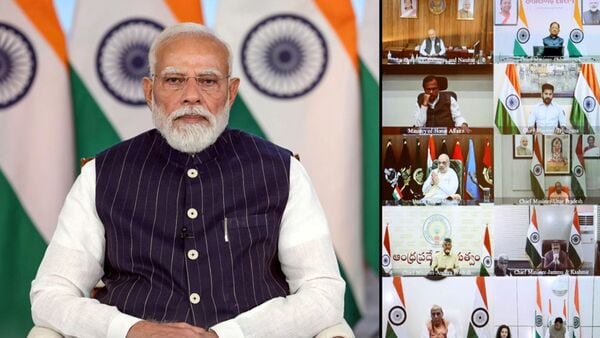
Prime Minister Narendra Modi, on 27 March, chaired a meeting with Chief Ministers and Lieutenant Governors of states and Union Territories to review preparedness in light of the emerging situation arising out of the ongoing war in West Asia and its potential impact on India.
During the virtual meeting, the prime minister said that India has prior experience in dealing with similar global disruption, a government statement said. He also recalled the collective response during the COVID-19 pandemic six years ago, when the Centre and states worked together as “Team India” to mitigate the impact on supply chains, trade, and daily life, the statement said.
This was the first time that the prime minister held such a meeting with the chief ministers on the West Asia war, which started on 28 February with the attack by the US-Israel on Iran.
PM Modi underscored that the same spirit of cooperation and coordination remains India’s greatest strength in navigating the present circumstances.
“The Prime Minister expressed his appreciation for the valuable suggestions shared by all Chief Ministers, noting that these inputs would be instrumental in effectively managing the evolving situation. He emphasised the need for vigilance, preparedness, and coordinated action to address the challenges ahead.” the statement said.
Those chief ministers who attended the meeting included N Chandra Babu Naidu (Andhra Pradesh), Yogi Adityanath (Uttar Pradesh), Revanth Reddy (Telangana), Bhagwant Mann (Punjab), Bhupendra Patel (Gujarat), Omar Abdullah (Jammu and Kashmir), Sukhvinder Singh Sukhu (Himachal Pradesh), Pema Khandu (Arunachal Pradesh), among others.
Defence Minister Rajnath Singh and Home Minister Amit Shah were also present at the meeting.
CMs of poll-bound states did not attend
The chief ministers of election-bound states were not part of this meeting due to the Model Code of Conduct (MCC). The Cabinet Secretariat will hold a separate meeting with the chief secretaries of poll-bound Tamil Nadu, West Bengal, Assam, Kerala, and the Union Territory of Puducherry.
The meeting comes amid escalating tensions in West Asia, which have disrupted critical maritime corridors and raised concerns about the safety of Indian nationals in Gulf nations.
The conflict in West Asia has entered its fourth week, disrupting trade routes through the Strait of Hormuz. Tensions escalated following the killing of 86-year-old Iran’s Supreme Leader, Ayatollah Ali Khamenei, in joint military strikes by the US and Israel on 28 February.
In retaliation, Iran targeted Israeli and US assets across several Gulf countries, causing further disruptions to the waterway and impacting international energy markets as well as global economic stability.
On 25 March, the government held an all-party meeting to brief political party leaders on the situation in West Asia, during which a detailed presentation was given on the steps the government has taken to address it.
The Prime Minister stressed that the government’s priorities are to maintain economic and trade stability, ensure energy security, safeguard citizens’ interests, and strengthen industry and supply chains, the statement said.
Emphasising the critical role of states, the Prime Minister called for constant communication and coordination between the Centre and States, along with the timely sharing of information and joint decision-making, so that responses are swift and well-aligned.
The back-to-back meetings by the government had sparked speculation on the internet about a possible ‘lockdown’ being announced in India amid the escalating conflict in West Asia. But the government has clarified that the rumours of a lockdown in India were completely false,
“In such times, it is important that we remain calm, responsible, and united. Attempts to spread rumours and create panic in such a situation are irresponsible and harmful,” Hardeep Puri, the Union Minister of Petroleum and Natural Gas, said earlier in the day.
Focus on the agriculture sector
The prime minister urged states to ensure the smooth functioning of supply chains and to take strict measures against hoarding and profiteering. He highlighted the importance of activating control rooms at the State and District levels and maintaining administrative alertness to prevent disruptions. He also stressed the need for advance planning in the agriculture sector, particularly in monitoring fertiliser storage and distribution, so that farmers do not face difficulties during the upcoming Kharif season.
Prime Minister reiterated that addressing the challenge is a shared responsibility and expressed confidence that, working together as “Team India,” the nation will successfully overcome the situation.
During the meeting, Defence Minister Rajnath Singh highlighted that the government has been working actively under the leadership of the Prime Minister to tackle this crisis and is taking positive steps, such as ensuring the timely availability of LPG and reducing the excise duties on petrol and diesel. He further highlighted the need for collective action from all states, UTs and the centre to tackle the ongoing situation.
Cabinet Secretary TV Somanathan gave a presentation on the current situation and enumerated steps and recommendations for States to address it.
What did the CMs say?
Chief Ministers appreciated the steps taken by the central government under the leadership of the Prime Minister to tackle the situation, the statement said. They also praised the Prime Minister’s diplomatic outreach to various countries amid this crisis to ensure the well-being of Indian citizens abroad.
Chief Ministers across states expressed confidence that the situation remains stable, with adequate availability of petrol, diesel, and LPG, and continuous monitoring mechanisms in place to ensure uninterrupted supply of essential commodities. They widely welcomed the decision to reduce excise duty on fuel, noting that it will provide significant relief to citizens amid global uncertainties, the statement said.
“Chief Ministers also welcomed the decision to increase commercial LPG allocation to states and union territories to 70% of pre-crisis levels, up from 50%. They reaffirmed commitment to work in close coordination with the Centre to effectively manage the evolving situation and safeguard the interests of citizens,” it added.
Addressing the challenge is a shared responsibility, and I am confident that, working together as ‘Team India,’ we will successfully overcome the situation.
- The importance of coordinated responses between central and state governments during crises.
- Lessons learned from past global disruptions can inform effective strategies today.
- Proactive measures are essential to ensure stability in supply chains and protect citizen interests.
The Government on Thursday said that fuel supply across the country remains stable and retail fuel outlets are operating normally despite the ongoing developments in West Asia, urging the public not to believe rumours or resort to panic buying.
According to a statement released by the Ministry of Petroleum and Natural Gas, “All retail outlets are operating normally across the country,” even as there were reports of panic buying in some areas due to rumours.
(With PTI inputs)


