
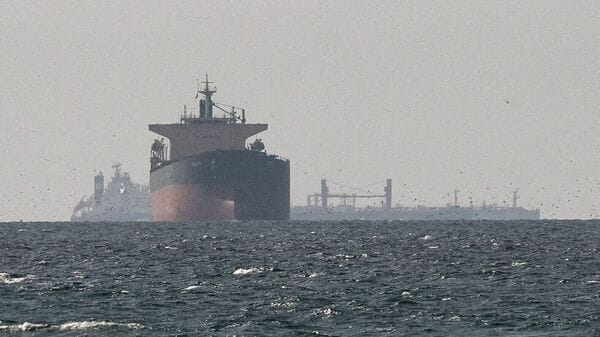
Iranian Foreign Minister Abbas Araghchi on Thursday confirmed that the Strait of Hormuz remains open only to select countries, even as Tehran continues its military operations in the Gulf.
India, China, Russia, Iraq and Pakistan have been granted passage, while others face restrictions, signalling a significant escalation in tensions over one of the world’s most critical energy routes.
“We permitted passage through the Strait of Hormuz for friendly nations including China, Russia, India, Iraq, and Pakistan”, Araghchi said.
Iran Defines Its Friends — and Its Enemies — at Hormuz
“The Strait of Hormuz, from our perspective, is not completely closed — it is closed only to enemies. There is no reason to allow the ships of our enemies and their allies to pass,” Araghchi said, drawing a geopolitical fault line across one of the most consequential stretches of ocean on earth.
The move has sent shockwaves through global energy markets, with Brent crude climbing toward $104 a barrel on Thursday after shedding more than 2% the previous session. West Texas Intermediate traded near $92.
Oil Prices Surge as Hormuz Closure Chokes Global Energy Supply
Brent crude is on course for its steepest monthly gain since 1990, a benchmark that underscores just how severely the conflict has disrupted the energy-rich Middle East.
Millions of barrels of daily oil output have been lost since the near-total closure of the Strait of Hormuz began, while prices for refined products, from diesel to jet fuel, have climbed sharply. Asia, heavily dependent on Gulf crude, has been hit particularly hard.
The White House insisted peace negotiations remain ongoing, but Tehran flatly rejected those overtures, issuing its own conditions for any resolution — among them, sovereign control over the strait itself.
Iran’s Parliament Eyes Tolls on Hormuz Shipping
Adding yet another layer of complexity, Iran’s parliament is reportedly drafting legislation that would impose a fee on vessels in exchange for safe passage through the waterway.
The semi-official Fars news agency, citing an unnamed lawmaker, said the bill is expected to be finalised next week.
If enacted, it would effectively transform one of the world’s busiest maritime corridors into a toll road controlled by Tehran, a development that would have profound implications for international shipping law and global trade.
ADNOC Chief Labels Iran’s Hormuz Disruption ‘Economic Terrorism’
The head of Abu Dhabi National Oil Company, speaking on Wednesday, Sultan Al Jaber, warned that Iran’s actions at the Strait of Hormuz constitute nothing less than economic terrorism, with consequences felt far beyond the Gulf.
“When Iran holds the Strait of Hormuz hostage, every nation pays the ransom at the gas pump, grocery store, and pharmacy,” he said.
The disruption has already begun driving up the cost of fuel, food, fertiliser, and medicine — commodities whose supply chains are deeply intertwined with the movement of Gulf energy exports.
United Nations Demands Immediate Reopening of Strait of Hormuz
UN Secretary-General António Guterres added his voice to the growing chorus of international concern, calling for the immediate reopening of the strait amid mounting disruptions to global energy and food supplies. His statement was pointed and wide-ranging in its implications.
“The prolonged closure of the Strait of Hormuz is choking the movement of oil, gas, and fertiliser at a critical moment in the global planting season. Across the region and beyond, civilians are enduring serious harm and living under profound insecurity. The UN is working to minimise the consequences of the war. And the best way to minimise those consequences is clear: End the war — immediately,” Guterres wrote on X.


