
China’s technological drive is no longer an economic project; it is a national security mandate. Reading Beijing’s latest ambitions as mere “digitalisation” or industrial “upgradation” fundamentally misinterprets the emerging architecture of Chinese power. In Beijing’s strategic calculus, technology is increasingly becoming the foundation through which national security, military capability, and State power are organised. China is steadily consolidating into what can best be described as a “tech-security State”. The 2026 Government Work Report (GWR) offers a clear signal of this shift. The report suggests that Chinese policymakers no longer treat development and security as separate policy tracks. Instead, technological capability is increasingly viewed as a critical instrument for reducing strategic vulnerabilities and strengthening national resilience.
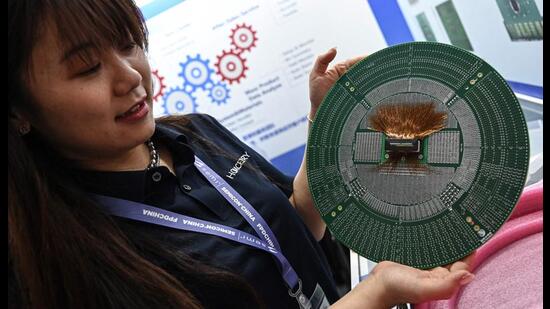
Chinese leaders have repeatedly emphasised the need to “seize the commanding heights” of emerging technologies. This ambition is increasingly embedded in the country’s policy framework. The projects highlighted in the GWR reflect a systematic push into areas such as semiconductors, Artificial Intelligence (AI), and advanced manufacturing. The objective is not only to boost growth but also to insulate China from external technological pressure and strengthen its strategic autonomy.
Beijing describes this transformation as the development of “new quality productive forces”. Chinese planning documents suggest that technological autonomy is increasingly viewed as a central guarantor of long-term national strength. To pursue this objective, the State has been encouraging a “triple helix” alignment between government institutions, research universities, and technology firms. The draft 15th Five-Year Plan presented at this year’s National People’s Congress provides the operational muscle to widen its scope and scale nationally. The road map is now clear — a transition to a system in which innovation hubs in cities such as Beijing, Shanghai, and Guangzhou function as integrated ecosystems where academic research, industrial capabilities, and state support converge. This formalises a shift in which technological autonomy is no longer merely a policy goal but a core pillar of national strength.
AI illustrates the logic of this approach particularly well. Beijing’s whole-of-nation strategy directs capital and institutional coordination to accelerate AI development while simultaneously emphasising the integration of civilian and military applications. In this framework, control over large data sets and computing infrastructure becomes a core part of strategic capability.
This ambition also requires a massive physical foundation. Advanced computing systems and semiconductor fabrication plants demand vast energy resources. China’s rapid expansion of transmission networks, renewable capacity, and nuclear power, therefore, also secures the energy backbone required to sustain technological leadership in the coming decades.
The scale of China’s investment reflects the seriousness of this effort. Research and development spending reached roughly $780 billion in 2023. These investments are shaped by a political narrative centred on national rejuvenation and overcoming the historical vulnerabilities of the “century of humiliation”.
The implications extend far beyond China. The global economy is entering a period in which innovation and supply chains are intertwined with geopolitical rivalry. In this environment of “weaponised interdependence”, control over critical technologies translates into strategic leverage. The resulting bifurcation of the global order means that technical standards and hardware ecosystems are increasingly partitioned into competing spheres. This fragmentation forces every middle power to make a high-stakes choice — remain integrated with a globalised past or align with specific technological ecosystems to ensure future security.
For India, this evolving landscape presents a complex, asymmetric challenge. China’s model is neither fully replicable nor necessarily desirable in its entirety. Yet in a world where supply chains reflect geopolitical alignments, technological capability has become a non-negotiable component of national resilience. New Delhi’s traditional strength in software services is insufficient in an era of “hard tech” dominance; a services-led approach offers little protection against the weaponisation of hardware or the monopolisation of foundational AI models.
India does not need to build a Chinese-style State-driven monolith. However, it cannot remain a passive consumer of technologies developed elsewhere as geopolitical competition reshapes the global order. Strengthening indigenous capabilities in semiconductors, AI, and energy security is a prerequisite for navigating this changing environment. The task ahead is to move toward specific “strategic bets” — ensuring that India’s path to development is not vulnerable to the choke points Beijing is perfecting.
G Venkat Raman is professor at the Indian Institute of Management Indore, and Fulbright, ICS Delhi Fellow. The views expressed are personal


