
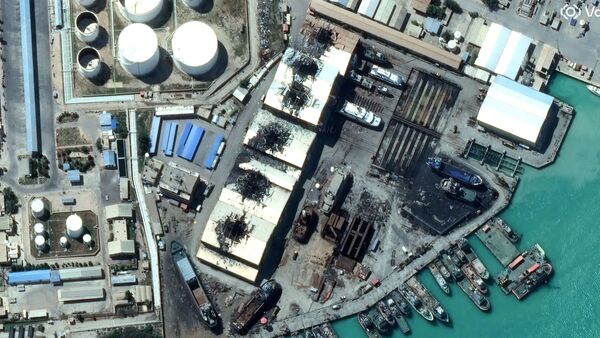
Iran war: The International Atomic Energy Agency (IAEA) said on Tuesday that Iran had informed it that a projectile struck the Bushehr nuclear power plant. Tehran, however, said that there was no damage to the facility, no injuries to staff, and the plant’s operations remain normal.
IAEA Director General Rafael Mariano Grossi stressed the need for maximum restraint to prevent any nuclear safety risks amid the ongoing conflict.
Iran’s Atomic Energy Organisation said that the US and Israel attacked the vicinity of Iran’s Bushehr nuclear power plant on Tuesday evening, IRNA reported.
Bushehr, a long-sought project by Iran – Why it matters?
In the 1970s, Iran’s Shah Mohammad Reza Pahlavi unveiled plans to construct 23 nuclear reactors and to gain full control over the nuclear fuel cycle, which could potentially allow the country to develop atomic weapons, according to a report by Associated Press.
This alarmed U.S. officials, who subsequently restricted American companies from selling nuclear-related equipment to Iran. As part of a $4.8 billion agreement for four reactors, the German company Kraftwerk Union began building the Bushehr nuclear plant in 1975.
According to a report by World Nuclear Association, Unit 1 (Bushehr-1) is a Russian-designed VVER-1000 pressurised water reactor (PWR) with a net output of 915 MW (gross around 1,000 MW). The unit feeds electricity into Iran’s national grid and typically operates near full capacity.
Original construction was halted after the 1979 Iranian Revolution. The site suffered damage from Iraqi bombings during the Iran-Iraq War (1980–1988).
Nuclear site always under the radar
During the eight-year Iran-Iraq War in the 1980s, Iraq repeatedly bombed the Bushehr site in an effort to halt Iran’s nuclear program. Russia eventually took over the project, completing the plant, which was connected to Iran’s national grid in 2011.
The facility operates a pressurised-water reactor capable of producing up to 1,000 megawatts of electricity—enough to supply hundreds of thousands of homes, businesses, and industries. Despite this capacity, Bushehr contributes only about 1% to 2% of Iran’s total electricity supply, AP reported.
Iran has been trying to expand the Bushehr nuclear facility to multiple reactors.
In 2019, it began a project that ultimately plans to add two additional reactors to the site, each adding another 1,000 megawatts apiece. A satellite image from Planet Labs PBC in December showed construction still ongoing at the site, with cranes over both sites.
The reactor currently running at Bushehr uses uranium from Russia enriched to 4.5%, a low level needed for power generation in such plants.
Bushehr, as a running, civilian nuclear power plant, was left untouched during the 12-day war in June between Israel and Iran.
During that war, the U.S. bombed three Iranian nuclear enrichment sites, destroying centrifuges and likely trapping Tehran’s stockpile of highly enriched, 60% uranium underground. Since then, Iran has blocked IAEA inspectors from visiting those sites.
A strike on a nuclear power plant could potentially release radiation into the environment, a concern that has grown since Russia’s full-scale invasion of Ukraine in 2022. During that conflict, Ukrainian nuclear facilities, many built during the Soviet era, have been targeted and placed on the front lines.
A similar radiation leak into the Persian Gulf would pose a catastrophic threat to the Gulf Arab states, which depend heavily on desalination plants in the Gulf for their freshwater supplies.
For Russia, Iran matters – Why?
Iran occupies a key position in Moscow’s Middle East strategy due to its geostrategic location and access to the Indian Ocean. The Soviet-Iranian relationship historically experienced cycles of cooperation and tension, underpinned by mutual mistrust, according to a report by ORF.
After the Cold War, conditions allowed for improved ties.
In 1992, Russia and Iran signed a civil nuclear agreement to expand collaboration in nuclear energy, with Moscow training Iranian scientists and helping construct a heavy-water nuclear power plant, although progress was limited by UN sanctions.
In 2000, Russia, Iran, and India agreed to create a multimodal network of sea, road, and rail routes to enhance regional connectivity.
As Russia’s relations with the West worsened, it developed closer ties with Iran, particularly in military-technical cooperation. Tehran exported mortars, munitions, and drones, including the Shahed 131/136 and Mohajer models, and shared the technology with Moscow for domestic production.
In return, Russia has reportedly agreed to supply 48 Su-35 fighter jets and has already provided Iran with Yak-130 trainer jets and MiG-29 fighters.
How big is Iran’s missile and drone stockpile?
Before the war, Iran possessed the largest stockpile of ballistic missiles in the Middle East, according to the U.S. Office of the Director of National Intelligence.
The arsenal included a variety of missiles, some with ranges of up to 2,000 kilometres (1,240 miles), putting Israel within reach, and speeds of up to 17,000 km/h (10,550 mph), according to Iranian state media. Some of the missiles fired at Israel have carried cluster munition warheads, which are more difficult for Israel’s missile defence systems to intercept, as reported by Associated Press.
The size of its missile stockpile before the war was unknown, with estimates ranging from 2,500 by Israel’s military to around 6,000 according to other analysts.
The Arms Control Association says Iran’s missile programme is largely based on North Korean and Russian designs and has benefited from Chinese assistance.
Many of Iran’s missile sites are in and around Tehran. There are at least five known underground “missile cities” in various provinces, including Kermanshah and Semnan, as well as near the Gulf region.
Iran is also a major drone manufacturer and has the industrial capacity to produce around 10,000 per month, according to the Centre for Information Resilience, a non-profit research group funded by Britain’s Foreign Office.
It pioneered the Shahed drone, a much cheaper alternative to expensive missiles, and sold large quantities of them to Russia for use in the war in Ukraine.


