NASA Administrator Jared Isaacman revealed the three-phase plan to build a permanent US base on the Moon. He said NASA plans to invest $20 billion over the next seven years to develop a base on the moon’s surface. It’s part of the US’s goal to not only send humans back to the lunar surface but also to allow them to live there.
Isaacman’s statement came just days before the scheduled launch of NASA’s Artemis 2 lunar mission which is parts of NASA’s program to humans to the moon for the first time in more than 50 years.
‘Goal is to stay’
Isaacman said a Moon Base will be built to “sustain human presence on the Moon.”
“This time, the goal is not flags and footprints. This time, the goal is to stay,” Isaacman said while providing an update on the implementation of the National Space Policy.
Three phases to build Moon Base
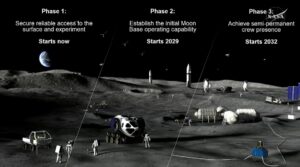
Isaacman said that NASA will build the moon base in phases in three phases:

Phase 1:
Isaacman said — endeavours to support industry by moving from infrequent bespoke efforts to a templated approach that will generate significant learning through experimentation.
Carlos Garcia-Galan, program executive, Moon Base, said ‘Phase one’ — “which starts today” — is “all about getting to the moon reliably, learning how to get there in high cadence, deploying assets in different areas of the moon where we think we may want to build this moon base.
He said NASA is going to experiment with new technologies that will be needed for future infrastructure development to support that permanent habitation.
He said, “…we’re going to actually start the infrastructure in this phase that goes from now to 2028.”
Meanwhile, Isaacman said, “We will dramatically expand lunar landings through the clips and the LTV [Lunar Terrain Vehicle] program, delivering rover’s instruments and technology payloads that test mobility power systems, such as working with international partners and industry on the production of Roos and RTG communications, navigation, surface operations, and all the science payload that can be incorporated.”
Phase 2:
Phase 2 is estimated to begin around 2029 . It transitions from experimentation to semi-habitable infrastructure and routine logistics, with the aim of supporting regular astronaut operations on the surface, Isaacman said.
“It’s at this point we anticipate seeing the significant contributions from our great partners like JAXA’s [Japan Aerospace Exploration Agency] pressurised rover,” he added.
Meanwhile, Carlos Garcia-Galan, who called himself the “Moonbase guy”, explained that in this phase, the NASA will think about establishing the infrastructure.
“We’re transitioning to actually establishing and laying out what we think are permanent elements of that infrastructure..it includes power, surface communication, surface preparation and mobility. And then once that’s set, establish…,” he said.
“We need to keep the crews alive and enable them to do groundbreaking science and exploration on the surface of the moon,” he said.
Phase 3:
Isaacman said Phase 3 “takes advantage of the affordable mass to surface capabilities that cargo human landing systems [HLS] will inevitably provide in the years ahead, and enables the permanent infrastructure necessary to sustain a human presence, such as Italy’s proposed habitation module.”
$20 billion investment
The NASA administration went on to say that the moon base will not appear overnight.
“We will invest approximately $20 billion over the next seven years and build it through dozens of missions, working together with commercial and international partners towards a deliberate and achievable plan,” he said.
Isaacman called it “humanity’s first permanent surface outpost beyond Earth.”
“Just as there was Mercury and Gemini before Apollo, there will be an evolutionary path to building humanity’s first permanent surface outpost beyond Earth,” he said.