
The Strait of Hormuz is the central artery of the global energy system. Approximately 20–21 million barrels per day (bpd) of crude oil used to pass through this narrow passage, accounting for nearly one fifth of global petroleum consumption. In addition, close to 25–30 percent of global LNG trade transits the same route.
For emerging economies like India, the implications of a closure at the Strait of Hormuz are immediate and severe. India imports nearly 85 percent of its crude oil requirements, with roughly 40 percent of imports coming from the Middle East. This creates a structural dependency on a single chokepoint. Unlike diversified energy systems, India’s supply chain has limited redundancy.
As per International Energy Agency’s (IEA) Oil Market Report published on March 12 2026, global oil supply is already estimated to have fallen by at least 8 million bpd in March alone, due to production shut-ins across the Gulf. This is the largest supply disruption in modern oil market history. A sustained disruption to supply of crude oil can lead to a significant appreciation of crude oil prices. At $130 oil and beyond, the macroeconomic impact for India becomes systemic.
The first channel of transmission is inflation. Energy costs feed directly into transportation, logistics, and manufacturing. In India, where supply chains remain cost sensitive, higher fuel prices quickly translate into higher food and core inflation. This would push the consumer price index well above the Reserve Bank of India’s target range, forcing a pause or reversal in any easing cycle.
The second channel is fiscal. The Indian government has historically used fuel taxes as a shock absorber. During periods of rising crude prices, excise duties are often reduced to contain inflation. This comes at a fiscal cost. A prolonged oil shock would therefore compress government revenues at the same time that expenditure pressures rise.
The third channel is growth. Higher energy prices act as a tax on consumption. Household spending weakens, corporate margins come under pressure, and capital expenditure decisions are delayed. Emerging markets are particularly vulnerable to such shocks because they lack the financial buffers available to developed economies.
What transforms this from a cyclical challenge into a structural risk is duration. Short disruptions can be managed. Global strategic petroleum reserves can be released. The IEA can coordinate supply responses. Demand can adjust at the margin.
However, the data shows that these mechanisms are insufficient for prolonged disruptions. IEA countries collectively hold over 1 billion barrels of emergency reserves, but coordinated releases can supply only 2–4 million bpd on a temporary basis. This is meaningful for short term shocks but inadequate if a significant portion of the 20 million bpd flowing through Hormuz is disrupted for weeks or months.
OPEC spare capacity, estimated at 3–4 million bpd, offers limited relief. More importantly, even this spare capacity depends on shipping routes that are themselves constrained by the same chokepoint or limited bypass infrastructure. Saudi Arabia and the UAE maintain partial bypass pipelines, but their combined capacity cannot fully offset the disruption. Countries such as Iraq, Kuwait, and Qatar have no viable alternatives.
In other words, the system has very little slack. For India, this lack of slack translates directly into vulnerability. The situation becomes more concerning when compared to China. Over the past decade, China has systematically built strategic petroleum reserves. Estimates suggest that China’s combined strategic and commercial reserves can cover anywhere between 90 to 100 days of imports, as it holds an estimated 1.2 to 1.3 billion barrels of total crude oil. In addition, China has diversified its supply base across Russia, Central Asia, Africa, and Latin America.
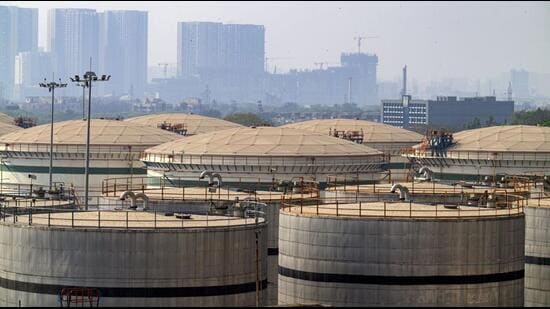
India’s position is significantly weaker. India’s strategic petroleum reserves currently cover roughly 9–10 days of consumption. Even after including commercial inventories which can theoretically provide an additional buffer of 64.5 days, the total buffer remains below that of China. According to a recent government report, the country has more than 250 million barrels of crude oil and petroleum products. The combined reserves provide 7-8 weeks of buffer across the country’s energy supply chain.
If the Strait of Hormuz faces disruption for a few days or even a couple of weeks, India can manage through inventory drawdowns, policy adjustments, and short-term market interventions. However, if the disruption extends into late April and beyond, the situation changes fundamentally.
At that point, India will be dealing with a double whammy of constrained physical supply, along with elevated prices. Refineries may face feedstock shortages. Fuel availability could tighten. The government may be forced to implement demand management measures. Inflation would accelerate sharply, and the rupee could come under sustained pressure. Financial markets have already begun to price in macro instability.
China, in contrast, would have greater room to manoeuvre. Larger reserves allow it to smoothen supply disruptions. Diversified sourcing reduces dependency on Hormuz. State control over energy infrastructure enables more coordinated responses. India lacks these advantages.
The vulnerability is not just about crude. It extends across the entire energy complex. In 2025, the Gulf exported approximately 3.3 million bpd of refined products and 1.5 million bpd of LPG. These flows are now severely disrupted. Refining capacity in the region has already been curtailed by more than 3 million barrels per day due to attacks and logistical bottlenecks.
India consumes roughly 1.1 to 1.2 million bpd of LPG, a large portion of which is imported from the Gulf. More than 45 percent of Middle Eastern LPG exports are directed towards India, primarily for household consumption. Unlike industrial fuels, LPG consumption in India is tied to basic household needs such as cooking. There is limited ability to substitute or reduce this consumption in the short term. At the same time, India has minimal LPG storage capacity. Supply chains are designed for continuous flow rather than stockpiling. This creates a fragile equilibrium.
There is another channel of risk that is often underappreciated: LNG. Qatar exports approximately 75–80 million tonnes per annum of LNG, most of which passes through Hormuz. A disruption would therefore not only affect oil markets, but also global gas markets.
For India, which has been increasing its reliance on LNG for power generation and industrial use, this creates an additional layer of vulnerability. Higher LNG prices would feed into electricity costs, fertiliser production, and industrial input prices. This amplifies the inflationary shock. The combined effect is a multi-layer stress event. Oil prices rise. Gas prices rise. Inflation accelerates. Growth slows. Fiscal and monetary policy are both constrained.
For India, a short disruption is manageable. A medium duration disruption is painful. A prolonged disruption is destabilising. We must remember that the oil shock in the 1970’s was one of the main contributing factors to the Emergency announced by Indira Gandhi in 1975. This is why the timeline matters more than the event itself. If the crisis extends beyond the end of April, India will find itself in a precarious position where its limited reserves, high import dependence and constrained policy flexibility converge into a full-scale supply shock.
The uncomfortable reality is that India is not adequately prepared for such a scenario. Oil importing emerging economies bear the highest burden of Strait of Hormuz being shut down. Among them, India stands out due to its dependence on imported energy from the conflict zone and limited buffer capacity.
The Indian Government’s good relations with Russia will help mitigate the situation. As of March 2026, Russia remains India’s largest crude supplier, with its share having reached as high as 33 percent in mid-2025. Recent reports suggest that Indian refiners are ramping up purchases, with around 33 million barrels of Russian crude scheduled to arrive in March 2026 following US waivers. While Russian oil will provide India with some breathing room, it may not be enough in case of a prolonged conflict.
The Iran crisis has laid bare India’s energy vulnerability with unusual clarity. If this conflict sustains, it can inflict significant economic damage to India. The disruption at Strait of Hormuz leads to energy shocks which have repercussions across domestic inflation, growth, and financial stability. If the disruption persists beyond a breaking point, it will have a catastrophic impact on our economy and markets.
Smiran Bhandari is an Investment Manager and Equity Analyst with a deep interest in geopolitics, financial markets, and global power dynamics. He has authored articles across leading publications including Firstpost, Swarajya, The Wire, Newslaundry, and The Quint. His writing focuses on the intersection of economics and geopolitics. The views expressed are personal.


