
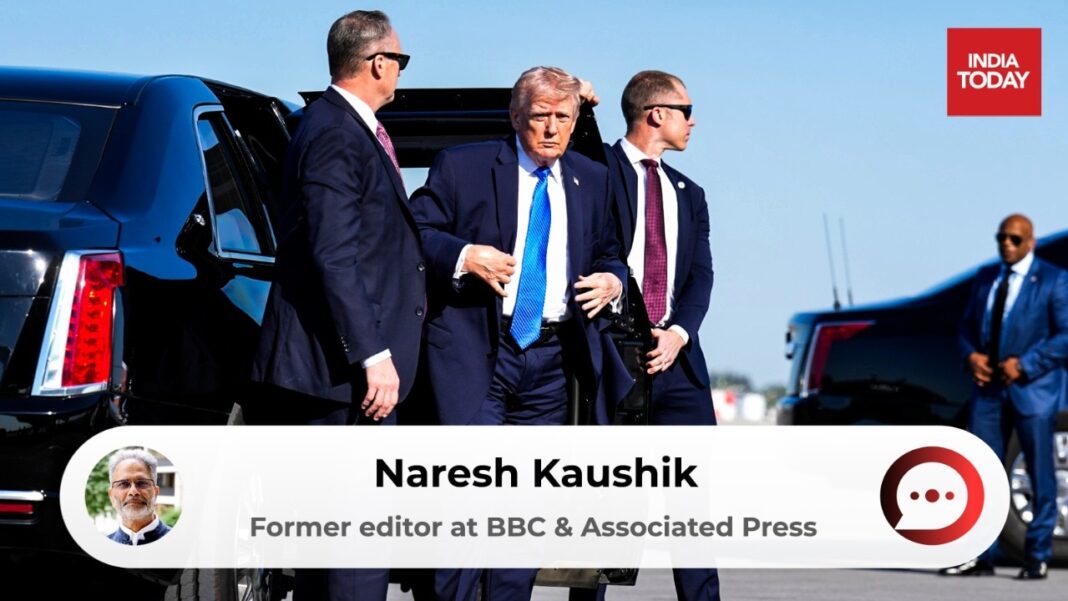
This round has also gone to Iran. After threatening, on Saturday, to “obliterate” Iran’s power plants unless it reopened the Strait of Hormuz within 48 hours, Donald Trump blinked even before the deadline.
He postponed strikes for five days after claiming that the US and Iran had held talks on the “complete and total resolution of hostilities”. Iran denied having any such talks. Earlier, Tehran had warned it would retaliate in kind, targeting key power plants on the Arabian side of the Gulf, pushing global energy prices even higher and stock markets lower.
Iran’s denial has not deterred Trump, who is keen to cut losses and end the war before it becomes even a bigger liability for him and the United States. On Monday, he claimed the talks produced “15 points” of agreement, adding that the US had demanded Iran stop nuclear enrichment and eliminate the country’s uranium stockpiles, terms the nation had previously rejected.
Israel is also reported to be on board, although it has continued to attack Iran. The US-based news outlet Axios quoted an Israeli official on Monday saying that US envoy Steve Witkoff and Trump’s son-in-law Jared Kushner were in contact with Mohammad Bagher Ghalibaf, the speaker of the Iranian parliament. Ghalibaf dismissed the claim as a US effort to manipulate markets and “escape the quagmire in which the US and Israel are trapped”.
PAKISTAN, THE MEDIATOR
Even if one believes the US President, the Pakistan connection to the said talks exposes the limitations of their success and Trump’s desperation. Islamabad is set to host a meeting between the two sides this week, according to Axios’s reporter Barak Ravid.
Trump’s “favourite field marshal”, Asim Munir, is reported to have spoken to the US President on Sunday, while Prime Minister Shahbaz Sharif had a chat with Iranian President Masoud Pezeshian.
Pakistan’s relations with Iran are not very friendly, and Tehran will not see Islamabad as a trustworthy mediator.
Last year, Islamabad signed a defence agreement with Saudi Arabia, Iran’s long-standing rival. Last week, Munir upset Pakistan’s Shia community by telling them to go to Iran if they loved that country, after they protested against Israel and US military actions in Iran.
Just over two years ago, the two nations exchanged missile fire following allegations that Pakistan was harbouring anti-Iran militants in Balochistan.
WHY IS TRUMP LOOKING FOR AN EXIT?
Trump became involved in what was essentially Israel’s war without clearly defining its objectives, planning for its execution, or establishing an exit strategy.
In his first statement on the day the war started, Trump didn’t mention the Strait of Hormuz once. He aimed to replicate his success in Venezuela without realising that Iran was a much larger and entirely different country. Even on Monday, he suggested jointly controlling Hormuz with an Ayatollah, much like how he has been doing in Venezuela with Delcy Rodriguez since Nicholas Maduro’s abduction in January.
But Iran has proved to be far more resilient than Israel and the US expected. Decades of planning have ensured that it not only survived the decapitation of its leadership and the relentless bombing campaign by the US and Israel but also managed to retaliate and escalate the conflict beyond its borders.
ECONOMIC FALLOUT
Iran’s strategy to use the Strait of Hormuz as a nuclear button and retaliate against the US military and energy facilities in the Gulf has upset all calculations of Trump and his advisors. Oil and gas prices have shot up by more than 50% since the start of the war. According to the head of the International Energy Agency, the crisis is now worse than the oil shocks of 1973 and 1979 combined.
The war has also threatened global food supplies. Nearly half of the world’s fertiliser is produced in the Gulf, which has virtually stopped due to attacks on gas fields and tankers. Natural gas is used in the Gulf to produce urea. Hormuz is a crucial choke point for exporting it. Farmers, including those in the US, are concerned about their livelihoods as a result, which could lead to political unrest in many countries.
For Trump, the crisis is hitting home. Petrol prices at US pumps are now the highest in over three years. For a president who always boasted about lower petrol prices as one of his administration’s success stories, the development is inflicting a political cost on him.
The invasion of Iran was not approved by a majority of Americans, even before the joint Israeli-US air strikes began. But now, even Trump’s own support base is increasingly opposing the war.
AMERICA FIRST TO ISRAEL FIRST
The war has also caused division within Trump’s Make America Great Again (MAGA) movement — although most supporters still back him. However, some influential figures within the movement, including Tucker Carlson, Megyn Kelly, and former Congresswoman Marjorie Taylor Greene, have turned against him.
They argue that the war contradicts his “America First” philosophy and breaches his campaign promises not to engage in any new conflicts. They also believe that Trump was lured into joining the war by Israel’s Prime Minister, Benjamin Netanyahu.
One such former Trump loyalist who’s fallen out over the Iran war is Joe Kent. He resigned from his position as head of the National Counterterrorism Centre last week, blaming Israel and its powerful American lobby for dragging the US into the war.
The division within the US conservative movement has made some Republicans uneasy. Most MAGA supporters may still back Trump, but a quarter of non-MAGA voters who supported him in November 2024 oppose him joining the war. If the war continues for a few more months, the number of such voters is likely to rise.
Trump is worried about that prospect. In January, he warned Republicans, “You’ve got to win the midterms, because if we don’t win the midterms, it’s just going to be — I mean, they’ll find a reason to impeach me. I’ll get impeached.”
WHY IS IRAN RELUCTANT?
Iran’s reluctance stems from its experience negotiating with the Trump administration.
During his first term, Trump withdrew from the Iran nuclear deal. And less than a year later, he attacked Iran twice while negotiating with its envoys — and, according to mediators, making progress.
The Islamic Revolutionary Guard Corps-affiliated Fars News Agency has accused the US and Israel of attacking a gas administration building and a gas pressure reduction station in central Isfahan on Monday night.
If that is true, Israel and the US have already violated their assurances made last week after Israeli strikes on Iran’s South Pars gas field a week ago. Iran retaliated by targeting Qatar’s liquefied natural gas infrastructure, knocking out 17 per cent of its production capacity for several years.
GROUND INVASION
A sceptical Iran suspects Trump may be buying time to prepare for a ground invasion. Trump and his officials have not ruled out deploying troops and have discussed capturing Iran’s Kharg Island, through which about 90 per cent of Iran’s oil exports are shipped. The US has relocated 2,500 marines from the Indo-Pacific to the Gulf and is reportedly sending an additional 3,000 troops to join the forces there.
A ground invasion could prove to be a very costly mistake for Trump. Iran is unlikely to surrender and might inflict heavy casualties on US troops. The American military may be forced to stay there for weeks or months. Another hostage crisis cannot be ruled out. That could increase political pressure on Trump and lead to potential humiliation for the world’s most powerful military. Even Trump loyalists, MAGA, could abandon him.
But an unpredictable Trump can still be prepared to take the risk if his military and aides convince him that a ground invasion could be successfully carried out in a relatively short time. So, Iran is preparing for that possibility. A long conflict suits Iran, which survived an eight-year war in the 1980s with Iraq. But that could be disastrous for the US, its Gulf allies, and the world economy.
Trump, therefore, is more inclined to end the war sooner. But Tehran shows no desire to comply. Even surviving the combined US-Israeli assault is enough for Iran to claim victory. A negotiated settlement will eventually be needed to end the conflict, but there is no doubt that this war has strengthened Tehran’s position for such talks.
(Naresh Kaushik is a former editor at the BBC and Associated Press. He is based in London.)


