
That’s not my voice! Why your voice sounds so different in recordings

You press play on a voice note and something feels off. The voice coming through the speaker sounds familiar yet foreign, close but not quite right. Everyone else insists that is exactly how you sound. The gap between what you hear and what others hear has a precise scientific explanation.

This new series from India Today Science explores the why and how behind everyday phenomena we notice, wonder, but often overlook. Each edition breaks down the science behind familiar experiences in simple terms. Today, we look at why your voice is a stranger to your own ears.

YOU HAVE NEVER ACTUALLY HEARD YOUR OWN VOICE

Every time you speak, your voice reaches your ears through two simultaneous pathways, not one.

The first is air conduction. Sound waves leave your mouth, travel through the air, enter your ear canal, vibrate your eardrum, and pass through three tiny bones in the middle ear: the hammer, the anvil, and the stirrup. These are, incidentally, the smallest bones in the human body.

From there, sound arrives at the cochlea, a snail-shaped, fluid-filled chamber in the inner ear that converts vibration into signals your brain reads as sound.
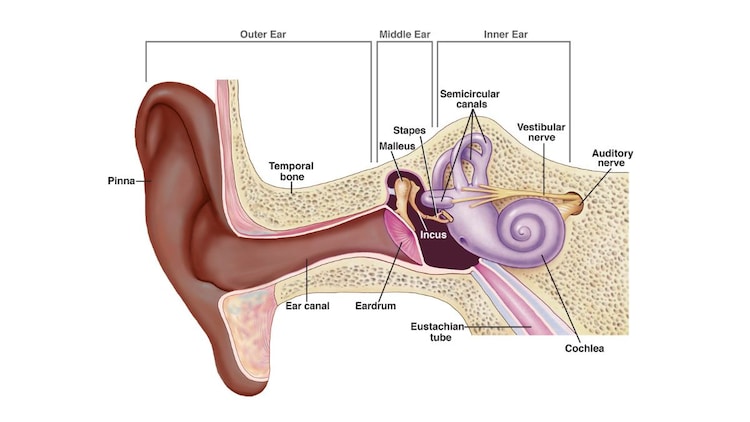
Sound from your vocal cords travels two routes simultaneously, through the air to your ears and through the bones of your skull directly to the cochlea, giving your internal voice a richer, deeper quality

Sound from your vocal cords travels two routes simultaneously, through the air to your ears and through the bones of your skull directly to the cochlea, giving your internal voice a richer, deeper quality. (Photo: NIH)
The second pathway is bone conduction. When you speak, vibrations from your vocal cords travel through the bones of your jaw and skull, bypassing the ear canal and eardrum entirely, and arriving directly at the cochlea.
Since the cochlea is the part of the ear that actually does the hearing, bone conduction delivers sound to exactly the right place, just through a different route.
You can test this right now. Press both palms flat over your ears and speak. You will still hear yourself clearly, and that sound is not leaking through your hands.
It is travelling through your skull bones straight to the cochlea. That is bone conduction at work.
What you hear as your own voice is a blend of both pathways, every single time you open your mouth.

YOUR BONES HAVE BEEN AUTOTUNING YOUR VOICE YOUR ENTIRE LIFE

Here is where it gets interesting. The two pathways do not contribute equally.

According to researchers at Imperial College London, bone conduction is more effective at transmitting lower frequency sounds to the brain, which means that we perceive our voice as being deeper than it actually is.

A microphone captures only air-conducted sound. The moment you press play on a voice note, the bone-conducted half of your voice is already gone, and what remains sounds like a stranger. (Photo: Getty)

A microphone captures only air-conducted sound. The moment you press play on a voice note, the bone-conducted half of your voice is already gone, and what remains sounds like a stranger. (Photo: Getty)

Your skull has been quietly boosting the bass of your voice your whole life, and you never knew.

The internal version of your voice, richer, fuller, and deeper, is the only version you have ever known.

WHY DOES YOUR BRAIN TREAT YOUR OWN VOICE LIKE A THREAT?

A microphone only captures what travels through the air. When you record your voice, only the air conduction part is captured because the microphone is outside your head. The bone conduction part is completely missing, which is why your voice sounds so different from how it usually sounds to you.

Stripped of those bone-conducted low frequencies, your recorded voice sounds thinner and higher than the version your brain has been filing away since childhood. The auditory cortex, the part of the brain that processes sound and stores a memory of how familiar sounds should feel, has spent years building an internal model of your voice. A recording that does not match that model feels jarring and foreign.

The science of why your recorded voice sounds unfamiliar is rooted in how sound reaches your inner ear through two completely different routes

The science of why your recorded voice sounds unfamiliar is rooted in how sound reaches your inner ear through two completely different routes

As a study published in Nature Communications by researchers at Imperial College London and the Max Planck Institute for Brain Research confirms, bone conduction stimulates the inner ear through a separate propagation mode entirely, one that a microphone outside the head simply cannot capture.

In other words, the recording is not wrong. It is simply the first time you are hearing yourself the way everyone else always has.

Your recorded voice is not your worst voice. It is just your real one.

#TheDailyWhy
Latest

Day temperatures to rise in north India, heavy rain in northeast on Tuesday

Minimum temperatures are likely to remain under control, bringing relatively pleasant conditions during early mornings and nights.

Indian startup delivers Akasha300 3D printer to Isro. It can print rocket parts

The system has been developed to support cutting-edge research and rapid prototyping in demanding environments where conventional manufacturing techniques fall

How many Indian owls can you spot in this picture? The answer will surprise you

Perfectly blending into their surroundings, these birds demonstrate camouflage so effective that even trained eyes can miss them at first.

Earth’s first quake: Scientists pinpoint when the first tremors hit the planet

Plate tectonics is not just about earthquakes and volcanoes. It is deeply connected to the conditions that made life possible on Earth, shaped continents, regul

What is the special wristband Artemis-II astronauts will wear to the Moon?

As Artemis II inches closer to launch, the tiny wristband on each astronaut's arm may become one of the most consequential scientific instruments of the mission

Topics

Dayton Webber: 5 things to know about amputee cornhole athlete accused of murder in Maryland

Amputee cornhole athlete Dayton Webber, 27, is charged with fatally shooting Bradrick Wells after an argument in Maryland; investigation is ongoing.

Staffing shortage, rainy weather: What officials said on LaGuardia airport crash

According to initial information, the fire truck was responding to another incident and was on the runway when it hit the Air Canada Express CRJ-900 plane.

LaGuardia Airport crash was ‘entirely avoidable; expert blames FAA, controllers

A plane crash at LaGuardia that killed two pilots may have been caused by a major air traffic control mistake.

Antoine Forest: 11 key things to know about Jazz Aviation pilot killed in LaGuardia airport crash

Antoine Forest has been identified as one of the pilots killed in Sunday's Air Canada Express crash at New York’s LaGuardia Airport.

Who was Antoine Forest, pilot killed in Air Canada crash at LaGuardia Airport?

Antoine Forest, a pilot, was identified as one of the casualties in the Air Canada crash at LaGuardia Airport. 

Twitch streamer Clix raises subscription price to $10 after exclusive deal

US Streamers News: Twitch streamer Clix, a popular Fortnite player, announced that he is raising the subscription price on his Twitch channel to $10 per month.

Is LaGuardia Airport open? Hundreds of flights disrupted after fatal runway collision in New York

US News: LaGuardia Airport in New York reopened on Monday afternoon after a deadly runway collision shut the busy airport for several hours and disrupted hundr.

Italian voters reject Giorgia Meloni’s judicial reform in referendum

The “No” camp won almost 54% of the vote against the government‑backed “Yes” campaign, which secured about 46%, according to final results released by
spot_img

Related Articles

Popular Categories

spot_imgspot_img