
On a Monday, the most powerful man in the world was sitting in Mar-a-Lago, possibly in a bathrobe, definitely on Truth Social, hammering out a post in ALL CAPS at the precise moment the New York Stock Exchange opened for business. The timing is impeccable. The spelling? Not exactly! The President of the United States of America wrote “witch will continue throughout the week”, presumably casting a spell on global energy markets, which, to be fair, have been bewitched for some time now.
The Indian stock market fell by 1,500 points before Trump made that announcement. We, along with the world, have been bleeding value for three weeks on a trot.
This is the man who said, just three days prior, “You know you don’t do a ceasefire when you’re literally obliterating the other side.” The man who on Friday declared, with chest puffed and chin jutted, “I think we’ve won.”
By Monday morning, he had instructed what he calls, magnificently, the “Department of War” to postpone all strikes for five days. Not victory. Not a deal. A pause. A pit stop. A presidential blink.
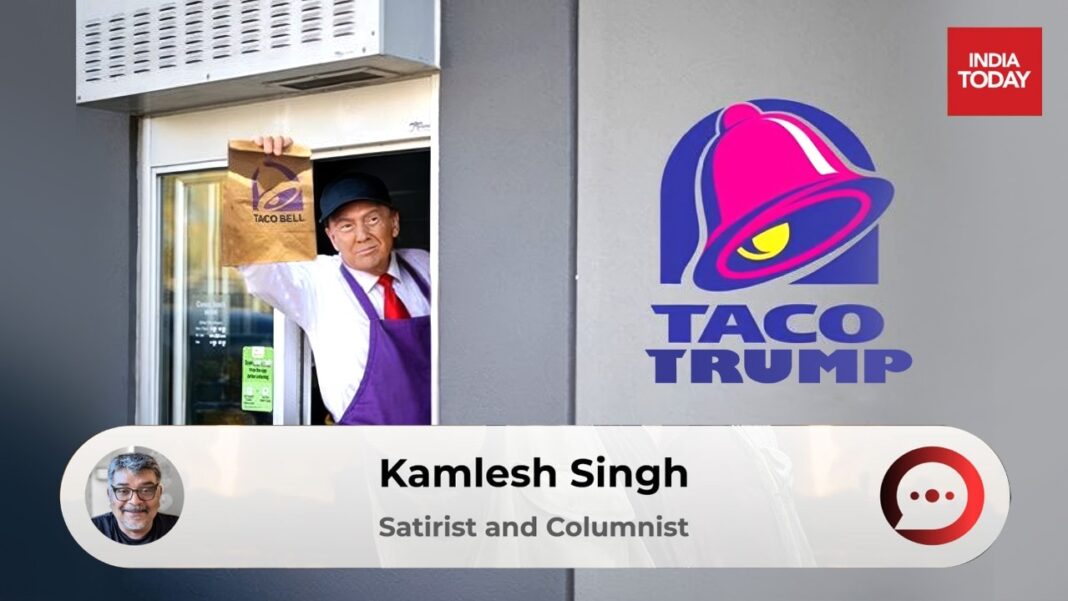
Does that ring a bell? A TACO bell? Welcome, ladies and gentlemen, to the TACO doctrine. Trump Always Chickens Out. It has a ring to it, doesn’t it? The ring of a fire alarm pulled in panic at a building that was never actually burning.
Let us examine the alleged triumph being sold to the world. Trump cited “very good and productive conversations” with the Country of Iran as the basis for his five-day ceasefire, and US stock futures, which had been falling earlier in the morning, suddenly surged on Trump’s post, while oil prices fell.
The announcement, made precisely as markets opened, had the aesthetic beauty of insider timing and the narrative coherence of a fever dream. Productive conversations, he said. The markets believed him. The Iranians did not.
Iran’s foreign ministry flatly denied that any talks between Iran and the US had taken place, though some countries in the region were apparently attempting to reduce tensions. So either Trump had tremendously productive conversations with people who weren’t there, or the “very good” talks were conducted through intermediaries that Tehran does not dignify as direct contact.
Either way, somebody is lying, and it is probably not the foreign ministry of the country that had just threatened to leave your Gulf allies without drinking water. Because that is what Iran actually threatened to do. Not metaphorically. Literally.
Desalinated water provides 42% of drinking water in the UAE, 70% in Saudi Arabia, 86% in Oman and 90% in Kuwait. The IRGC, in language that was neither diplomatic nor deniable, made clear that all energy, IT and desalination infrastructure belonging to the US and Israel in the region would be targeted.
A CIA assessment as far back as 2010 warned that disrupting desalination facilities in Arab countries could have more serious consequences than the loss of any other industry or commodity. Trump looked at these threats, looked at the bill arriving from the Pentagon, looked at petrol prices strangling the American voter, and reached for his phone. To post. To pause. To pivot.
The blockade of the Strait of Hormuz has been described by the International Energy Agency as the largest disruption to the energy supply since the 1970s energy crisis. That was the largest, in fact, in the history of the global oil market. Brent crude surged past $100 per barrel, with some intraday peaks reaching $126 last week. Daily transit calls through the Strait have tumbled to nearly zero from highs above 120 seen earlier this year.
And still, on Friday, the President of the United States was telling reporters he didn’t need the Strait. “We don’t need it,” he said, with the breezy confidence of a man who has never paid for his own fuel.
His own Secretary of War had been more candid. When asked about the potential $200 billion needed for the war effort, Pete Hegseth offered the memorable line: “It takes money to kill bad guys.” Refreshingly honest. Fatally expensive. And apparently, the bill arrived. The Department of Defence doesn’t print the dollars. It has to seek Congressional approval.
The consequences of this particular brand of presidential poker are not abstract. They are geopolitical, generational, and grim. The Abraham Accords, that much-celebrated architecture of American-brokered Arab-Israeli normalisation, now looks like a sand castle at high tide.
The Arab allies who were coaxed and cajoled into those agreements had been promised a security umbrella. They are now watching, in real time, as Tehran threatens to cut off their water supply and Washington does the geopolitical equivalent of calling a timeout. The optics, to put it charitably, are sub-optimal.
Iran, predictably and correctly, is already polishing the trophy. The IRGC has told its people, through state television and social media and every available medium, that it stared down a superpower and made the superpower blink.
Iranian media framed the earlier ceasefire as having been “imposed on the enemy” after four waves of attacks on Israeli-occupied territories, with the National Security Council claiming it had “shattered the enemy’s primary strategic goal”.
This narrative, true or not, will now calcify. It will be taught in schools. It will be used as leverage in every negotiation for the next two decades. The Persian Empire, humbled for the better part of 40 years, has found its story again.
The Arab states who staked their diplomatic futures on American reliability will be disappointed and confused. They were begging, “Mr President, Finish the Job” from a president who isn’t particularly known for finishing anything.
The Gulf monarchies who were assured that the United States was the indispensable, indefatigable, inexhaustible guarantor of their security will have sleepless nights. Trump himself blasted NATO allies for failing to send real men and material to assist in the war, and complained openly that the bulk of energy shipments through the Strait were destined for Asian markets anyway, implying, with Trumpian subtlety, that the Gulf’s problems were the Gulf’s problems.
One imagines the Crown Princes watching this unfold with the quiet, controlled terror of people who have just realised the bodyguard they paid for is actually a performance artiste.
The economic damage is not a future tense problem. It is present tense. Consumers worldwide can expect to pay more for groceries and travel as the energy crisis triggered by the US-Israel war drags on, even if the war does not.
Even if the Strait opens tomorrow, even if the talks this week produce something worth calling a deal, the infrastructure is battered, the shipping insurers are scarred, and energy production capacity will not recover quickly. Qatar has already said it would take three to five years to repair Ras Laffan, its biggest gas production complex. Traders already expect oil prices to remain elevated for the rest of the year, with no alternative supply ready to fill the gap.
This war, begun on February 28 with the casual confidence of someone who has never personally experienced consequences, has lasted four weeks and accomplished the following: elevated Iran’s regional standing, shattered energy markets, terrified American allies, antagonised the rest of the world, and produced a five-day pause announced in ALL CAPS on a social media platform that the President himself owns.
Trump is proud of his ghost-written Art of the Deal. This is the art of the no-deal. This is insider trading taking unprecedented precedence over everything else. What else explains the talks that Iran says never happened. By the way, who has he been talking to? The answer, my friends, remains among the President’s friends, who will cash in on the dips they bought as the markets bled. Because some people aren’t worried about the Iranian, and also Israeli, blood being spilt in the process of an uncalculated, unthought-through war.


