
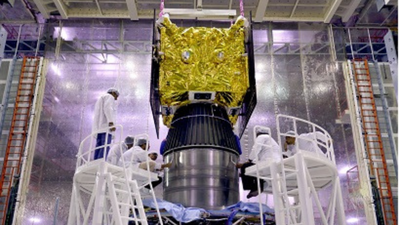
Imagine a satellite moving around the Earth for an entire decade without any sound, sending precise location details to millions of people on the Earth’s surface. IRNSS-1F, one of India’s navigation satellites, completed its 10-year design mission life on March 10, 2026, marking a key milestone for the country’s regional navigation system. The Indian Space Research Organisation launched the satellite in March 2016 as the sixth satellite of the Indian Regional Navigation Satellite System. The satellite has been a silent contributor to India’s pursuit of self-sufficient navigation technology. As reported on ISRO’s official website, while the atomic clock of the satellite has stopped working on 13th March 2026, IRNSS-1F continues to make a difference to the lives of the people by sending one-way broadcast messages. This is not just an achievement; it is the epitome of Indian engineering skills despite the space race between nations. It stands as a testament to India’s growing technological resilience, proving that even in the vast silence of space, innovation can speak volumes.
IRNSS-1F launch and NavIC role
IRNSS-1F blasted off on 10 March 2016 aboard PSLV-C32 from Sriharikota, as reported by ISRO, joining five earlier siblings to form the core NavIC constellation.
Weighing 1,425 kg, it settled into a geostationary slot at 32. 5° East with a 5° inclination, designed for over 10 years of reliable service.
The satellite had two payloads: a navigation transmitter for transmitting at the L5 and S-bands, as well as a C-band transponder for precise ranging, assisted by corner cube retroreflectors for laser ranging. ISRO’s Master Control Facility in Hassan quickly took control of the satellite, deploying the solar panels perfectly after a 19-minute launch.
For India, the NavIC satellite means independence from the GPS, covering 1,500 km beyond borders for vehicle tracking
Mission life triumph and atomic clock legacy
On 13th March 2026, ISRO declared: IRNSS-1F satellite launched in March 2016 has completed its design mission life of 10 years on 10th March 2026. On 13th March 2026, the procured onboard atomic clock stopped functioning. Yet, it keeps going for societal applications such as broadcast notifications.
Rubidium atomic clocks are at the heart of its timing, which faced early setbacks, with two failing pre-end, leaving it on one clock’s grit. Still, it outlasted expectations, proving IRNSS design robustness. Late U R Rao told Ursc Gov. Satellite centre specs pegged mission life above 10 years, validated here.
This endurance highlights ISRO’s clock tech evolution, now upgraded in NVS follow-ons for NavIC’s future-proofing.
NavIC’s applications and future impact
IRNSS-1F helped to achieve success in real-life situations, such as providing accurate time for mobile navigation, fishing advisories at sea, and highway safety through vehicle tracking. In civilian usage, it helped in disaster response and fleet management, which is in line with strategic autonomy.
In its post-launch role, it is used for one-way messaging, thereby increasing its utility without full navigation capability. The regional advantage of NavIC over GPS is its dual-frequency capability to tackle challenging Indian terrain.
Looking ahead, NVS satellites bolster the constellation, targeting global standards. IRNSS-1F’s run fuels Gaganyaan ambitions and beyond, cementing ISRO’s cost-effective prowess. As one engineer noted in URSC docs, such milestones “enhance regional navigation autonomy.”
This chapter closes, but NavIC’s story soars as proof that indigenous tech delivers, decade after decade.


