
How ravens outsmart wolves using memory, not sight, and find the next kill

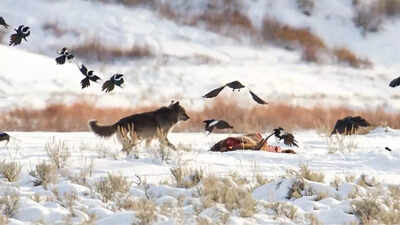
For a long time, scientists thought ravens simply trailed wolves to feed on fresh carcasses. The idea was straightforward. Follow the predator and grab the meal while the blood is still wet. Recent research, though, paints a different picture. Conducted over two and a half years in Yellowstone National Park, the study suggests that ravens rely on their spatial memory to locate wolf kills. They do not need to stalk wolves closely. Instead, they seem to know the landscape and return to spots where kills are likely to occur. The research was published in Science and led by the Research Institute of Wildlife Ecology at the University of Veterinary Medicine Vienna, together with the Max Planck Institute of Animal Behaviour in Germany.

How ravens use memory to find wolf kills instead of following them

Researchers tagged 69 ravens with small GPS devices, as reported by The CSR Journal. This allowed them to monitor the birds’ movements in detail. They also tracked 20 wolves during the winter months. Ravens were logged every 30 minutes, and wolves every hour. Surprisingly, there was only one instance where a raven followed a wolf for longer than a kilometre or more than an hour.

The study titled, ‘Ravens anticipate wolf kill sites across broad scales’, published in Science, shows that ravens are not shadowing wolves as closely as previously thought.

Instead, they appear to use memory and intuition. Some birds reportedly flew up to 155 kilometres in a single day toward likely carcass sites.

How Ravens remember the land

The Science study shows that ravens have a remarkable ability to remember stable food sources. They seem to learn which areas are historically prone to wolf kills. Flat valley bottoms where wolves hunt successfully are some of the most productive areas. A single kill is unpredictable, but certain areas regularly provide food over time, allowing ravens to optimise their foraging strategies and conserve energy. Ravens reportedly exploit these patterns, increasing their chances of finding a meal without relying on wolves to lead the way.

Experts say this extends what we know about scavenger behaviour. They are planners in their own right, capable of anticipating opportunities and adapting to changing conditions.

How ravens’ memory are changing what we know about scavengers

This research could reshape how we understand scavengers. Ravens do not appear tied to a single wolf pack. They are flexible, choosing foraging spots based on memory and environmental cues. They can scan vast areas and then return to locations that previously yielded results.

Senior author John M. Marzluff of the University of Washington suggests that some scavenger species might have been underestimated in their cognitive abilities. Ravens, it seems, combine instinct with memory to maximise survival.


Latest

Rains not over yet: Back-to-back weather systems to keep India on edge next week

A feeble western disturbance is set to influence weather conditions on Monday, March 23, particularly across Delhi-NCR, Haryana, Punjab, north Rajasthan, and Ch

Nasa sets April 2 launch for Artemis-II. Here’s when Moon rocket will lift off

The mission aims to test critical systems needed for future lunar landings, including those planned under Artemis III.

Ancient river delta on Mars: Nasa rover uncovers evidence of area once ‘flooded with water’

Science News: Nasa’s Perseverance rover has detected underground remains of an ancient river delta on Mars, offering some of the strongest evidence that water

Why is NASA watching the Sun 24/7 before the Artemis II launch? Astronauts face invisible danger

Science News: With the Artemis II mission launching its astronauts outside Earth's magnetic field for the first time on 1 April 2026 in over 50 years, NASA is s

Beyond a diagnosis: Rethinking Down Syndrome in a more inclusive world

Science News: Every year on March 21, the world observes World Down Syndrome Day, a date that reflects the very nature of the condition it represents. The symbo

Topics

Explained: The benefits of DGCA’s new flight ticket refund rules

There's now a 48-hour look-in period for flight ticket cancellation or amendment with no charges, and a 24-hour window for name correction without charges.

Aneet Padda delivers a striking runway moment in stunning 3D floral ensemble at Lakme Fashion Week finale. Watch

Aneet Padda lit up the Lakmé Fashion Week finale as Péro’s showstopper, serving a dreamy mix of texture, shimmer and understated elegance. See pics and vide

A Kyunki Saas Bhi Kabhi Bahu Thi spinoff in the pipeline? Smriti Irani clears the air

Over the weekend, several reports suggested that a new series is being planned, which they claimed will be a spinoff to Kyunki Saas Bhi Kabhi Bahu Thi.

Dhurandhar 2 worldwide box office collection day 4: Ranveer film ends 1st weekend with ₹750 crore; beats Baahubali, RRR

Dhurandhar 2 worldwide box office collection day 4: The Ranveer Singh-starrer has registered the second-biggest opening weekend for an Indian film.

Anil Agarwal’s Vedanta moves NCLAT against Adani’s bid for Jaypee group’s flagship firm

Vedanta had earlier termed the approval a “commercial conspiracy” and sought reconsideration of its bid.

Gaurav Gera posts a 1998 letter reflecting on struggles leading to Dhurandhar 2: ‘Thanks to my 23 year old self, Ma Pa’

Actor Gaurav Gera, praised for his role in Dhurandhar: The Revenge, shared letters from 1998 to his parents, detailing early struggles. 

‘He sends cringe reels’: Shruti Haasan reveals Kamal Haasan’s unseen side and his shared trait with Rajinikanth

Shruti Haasan discussed her close bond with father Kamal Haasan, highlighting their everyday interactions and shared values of hard work. 

The Theatre of the Absurd in Trump’s Trade Fight

The US government’s trade lawyers are working overtime. So what if the work in question requires more imagination than it does expertise?
spot_img

Related Articles

Popular Categories

spot_imgspot_img