
On the first day of the Vikram Samvat 2083 (the Hindu new year), I got up a little early. In the red-hued sunrise, I remembered poet Kalidas. In Ṛtusaṃhāra, he beautifully narrates the spring season:
Drumah sapushpaah salilam sapadyam, streeyah sakama pavanah sugandhih/Sukhaah pradosha divsashch ramyaah, sarvam priye charutaram vasante
(The verse means: Oh beloved! everything has turned so beautiful during spring. Trees are laden with flowers, ponds are full of lotuses, air is scented, evenings pleasant and days are delightful.)
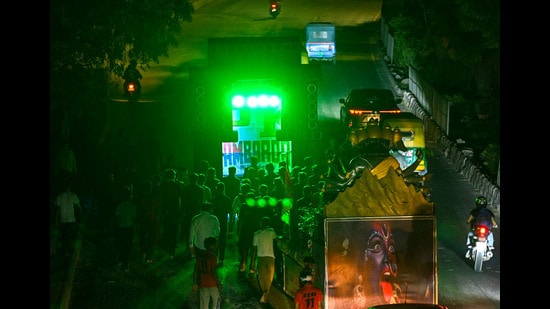
With a lot of enthusiasm, I entered my housing society’s park to meditate but was unsuccessful. Why? An unbearable decibel assault was on from the Noida-Greater Noida expressway that is close to the society. A group of devotees were moving with the “flame” of the goddess as the period of Navratra was on, expressing their religious fervour through boom boxes blaring music at 120+ decibels.
I am a practising Hindu. My grandfather used to be a dandi swami (an ascetic of the Advait Vendant tradition). My father was a poet, and discourse on religion and literature within my household and outside shaped my early childhood. I thought of confronting these “decibel devotees”. I wanted to ask them, “Do you have any idea what the sacred flame represents?
Our ancestors started the tradition of carrying a lamp to the temple to let knowledge reach all and sundry and not be confined to a fortunate few. Invocations such as tamaso ma jyotirgamaya (take me from darkness to light) were a result of this practice. But today’s youngsters are doing exactly the opposite. I never thought the first day of the Hindu new year would start on such a note. I thought that had the youngsters played Durga Saptashati or other hymns of Goddess Durga, people would have still tolerated the noise. But the songs being played were all ostensibly in praise of goddesses but set to music copied from cheap film songs. The people organising such processions forget that the noise is damaging their ear drums (and by that, their hearing) and their long-term cognition.
According to the World Health Organization (WHO) and reports from other environmental organisations, sound that is any higher than 85 decibels can not only permanently damage your hearing but also increase your blood pressure and affect concentration. These youngsters listen to it for hours. Many have been doing this for years. I shudder to imagine the consequences.
Such decibel devotees have no clue as to what havoc they create for their surroundings. In Delhi-NCR, noise pollution is already at a critical level. The Central Pollution Control Board (CPCB) and Delhi Pollution Control Committee data paint a grim picture. In most parts of Delhi, the average noise remains between 60-75 decibels; during night they hover at around 55-65 decibels. It is 25 decibels higher than the safe limits prescribed by WHO. Congested areas such as Kashmiri Gate, ITO, Anand Vihar and Karol Bagh regularly experience noise levels in excess of 85 decibels.
It’s no surprise that people in the Capital are increasingly suffering from insomnia, unease and hypertension. Half of the population in the region suffers from one of these ailments. Are we inadvertently creating an ailing society?
Raising questions is a valid cause. During Navratri and other religious functions, noise pollution registers a 15-30% increase. You may be wondering if there are any regulations to check this menace. According to Bharatiya Nyay Samhita (BNS) sections 270, 292 and 293, high decibel noise is considered an attempt to create unrest. Boom boxes can be confiscated and those playing it can be jailed. It can also attract a fine of ₹1 lakh. Though there is a provision of imposing a fine of ₹10,000 to 50,000 for bursting high decibel crackers, these provisions have rarely been invoked to punish the guilty. Throughout the country, the police avoid taking action in matters of a “religious nature”.
Did people of the previous generation avoid high decibel noise? Not at all. They used drums, barrel drums, cymbals and conches. Many Sanskrit words are based on the science of sound. Our sacred Om is said to fill our body, mind and environment with positive energy. However, I have already mentioned the impact loud sound-producing equipment wreaks on us.
It’s not that Hindus alone suffer from this malady; others aren’t far behind. Some years ago, I was in Pahalgam during the time of Barawafat. Religious songs and sermons played throughout the night from the mosque’s many loudspeakers, at a very high pitch. It gave us sleepless nights. It felt as if even the perennial flow of the Lidder river was subdued by the noise assault.
We need to make a distinction between religious procession and aggression. Festivals were created by our forefathers to rejuvenate our body and soul, not to destroy them.
Shashi Shekhar is editor-in-chief, Hindustan. The views expressed are personal


