
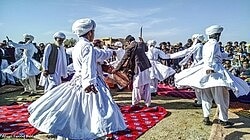
The Baloch tribe has been part of recorded history for over two thousand years and continues to hold influence across the region. Its past is marked by constant movement, shaped by migration, conflict, and repeated invasions. Yet, despite these pressures, the tribe endured. What survived was not just a people, but a way of life they continue to call their culture.
Today, the Baloch are largely concentrated in Pakistan and Iran, known over centuries for their role as fighters, organisers, and custodians of a strong tribal identity.
The Baloch are an Iranian-origin ethnic group who speak the Balochi language.
Over time, Baloch groups moved from areas near the Caspian Sea towards Sistan, Makran, and eventually into the region now known as Balochistan.
A large population lives in Pakistan’s Balochistan province, while others are settled in Sindh and Punjab, forming one of the region’s enduring communities.
ORIGINS AND EARLY MOVEMENT
Historians trace the Baloch to regions around the Caspian Sea, ancient Iran, and Central Asia. Linked by many scholars to the Medes, they were part of early Persian tribal and military systems.
In early records, the Baloch appear more as fighters than rulers, mentioned in accounts of Persian wars and in the Shahnama as battle-ready groups.
Continuous conflict and pressure from empires forced them to move eastwards, gradually settling in Makran, Sistan, and the region now known as Balochistan.
THE ISLAMIC PERIOD AND TRIBAL IDENTITY
A major shift came in the 7th century with the arrival of Islam. Many Baloch accepted the new faith and joined Arab armies, with some moving to regions like Syria and Iraq. Leaders such as Siyah al-Sawar are linked to this phase, as Baloch groups gained a role in early Islamic military and political structures.
This phase did not last without conflict. After the Battle of Karbala and during Umayyad rule, tensions grew. Many Baloch groups faced pressure and began moving back towards Iran and Balochistan.
By the medieval period, the Baloch had expanded into South Asia, settling in Sindh and Punjab between the 12th and 15th centuries. Tribal confederacies began to take shape, with leaders like Jalal Khan organising groups, while figures such as Mir Chakar Rind extended control into regions like Multan.
Political structures also emerged. The Khanate of Kalat became a key centre of power, while the Talpur dynasty ruled Sindh until the British arrived. Despite this expansion, the Baloch remained organised along tribal lines, with authority resting with local chiefs and alliances shaping their unity.
The colonial period changed this balance, weakening traditional authority and reshaping power in the region.
The arrival of the British changed the political structure of the region. The Khanate of Kalat lost autonomy, and Baloch territories were gradually brought under colonial control.
While the British recognised some tribal authority, they also reshaped borders and governance. This weakened traditional systems and set the stage for future tensions.
AFTER 1947: CONFLICT AND RESISTANCE
The creation of Pakistan in 1947 marked another turning point. Balochistan became part of the new state, but not without resistance. The accession of princely states like Kalat led to the first Baloch conflict soon after independence.
Over the decades, several uprisings took place, in 1948, the late 1950s, 1960s, and 1970s. These movements were driven by demands for autonomy, control over resources, and political rights.
Even in recent years, tensions have continued. Baloch groups have raised concerns over development projects, representation, and alleged human rights violations. Issues such as enforced disappearances and military operations have kept the region unstable.
The Balochis rose as warriors, formed tribal confederacies, ruled regions, and resisted external control.
Even today, their identity remains tied to tribe, land, and a long memory of displacement and resistance.
In Pakistan, the Baloch are both a significant community and a region in tension, holding onto a past that continues to shape its present.


