
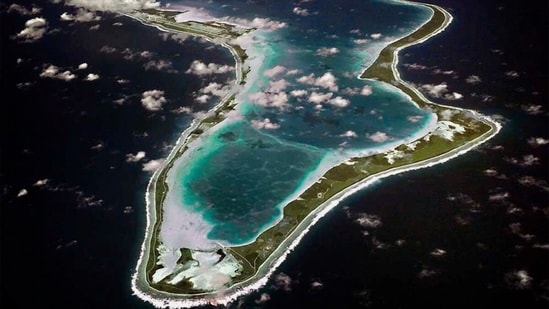
Iran’s failed strike roughly 4,000 kilometres away on the Diego Garcia air base in the Indian Ocean this week is now raising an even bigger question: Are Tehran’s military capabilities more that what’s known? The attack, though unsuccessful, is significant for what it suggests rather than what it achieved.
Iran reportedly fired two ballistic missiles at the joint UK-US base, marking the first known instance in the current conflict where Tehran appears to have used weapons with a range exceeding 2,000 km.
One missile reportedly failed mid-flight, while the second triggered a response from a US warship, which launched an SM-3 interceptor, a report in the Wall Street Journal said. Track US-Iran war live updates
It, however, remains unclear whether or not that interception was successful.
A failed strike, but strategic messaging intact
Even though the missiles did not hit their target, the implications go beyond success. Diego Garcia is a critical hub for US military operations. It is a high-value logistics and strike platform that hosts heavy bombers and surveillance aircraft, including B-2 stealth bombers.
If the SM-3 interceptor failed to neutralise the incoming missile, it would raise concerns about the effectiveness of even advanced defence platforms.
If it succeeded, Tehran still achieved a political objective of forcing the Americans to deploy high-end interception systems against a limited strike.
‘Nobody even guessed’ this capability
William Alberque, a Europe-based Senior Fellow at the Pacific Forum told news agency Bloomberg, “Nobody, and I mean nobody, even guessed” that Iran had missiles with that range.
He said Iran may have used an experimental system: “They probably used a modified missile – maybe a prototype.”
Such modifications could include reducing payload weight or even removing the warhead entirely to extend range, the analyst added.
Timing adds to escalation
Notably, the attempted strike came before the United Kingdom publicly confirmed that it would allow the United States to use Diego Garcia and the Fairford base in southwest England for operations targeting Iranian missile infrastructure linked to attacks in the Strait of Hormuz, reported AFP.
The strike also comes a day after Iran’s General Abolfazl Shekarchi issued a broad warning, saying “parks, recreational areas and tourist destinations” worldwide would not be safe for the country’s enemies,” AFP reported citing state news TV.
British officials later described Iran’s actions as destabilising, with the ministry of defence stating that Tehran’s “lashing out across the region and holding hostage the Strait of Hormuz, are a threat to British interests and British allies”.


